Introduction
Transmission media refers to the medium through which data travels from one device to another in a computer network. It provides the communication path that allows devices to exchange information using electrical, optical, or wireless signals. Transmission media can be broadly classified into wired and wireless forms of communication and forms the foundation of data transmission at the lower layers of the network stack.
Network Cabling
Network cabling is the physical infrastructure used to connect devices and carry data across a network. These cables provide a structured and reliable communication path, allowing signals to travel between computers, switches, routers, servers, and other networking devices.
Depending on the technology being used, data may travel through copper conductors as electrical signals or through fiber-optic cables as pulses of light.
Bandwidth
Bandwidth refers to the maximum capacity of a communication link to carry data over a given period of time. It is commonly measured in bits per second (bps) and is often expressed as Mbps, Gbps, or even Tbps in modern networks.
Examples of common bandwidth values include:
100 Mbps
1 Gbps
10 Gbps
100 Gbps
A higher bandwidth means that more data can be transmitted every second. However, bandwidth represents the theoretical capacity of a link and should not be confused with actual network performance.
Signals
A signal is the physical representation of data as it travels through a transmission medium. Different networking technologies use different types of signals to carry information from one device to another.
Copper Cables: Use electrical signals.
Fiber Optic Cables: Use light signals.
Wireless Networks: Use radio signals.
Although users see data as files, webpages, or messages, networking equipment ultimately transmits information as physical signals through a communication medium.
Attenuation
Attenuation refers to the gradual reduction in signal strength as it travels through a transmission medium. As the signal covers longer distances, it becomes weaker, which can affect communication quality and increase the chances of data transmission errors.
Types of Transmission Media
Transmission media can be classified into two major categories based on how signals travel between devices.
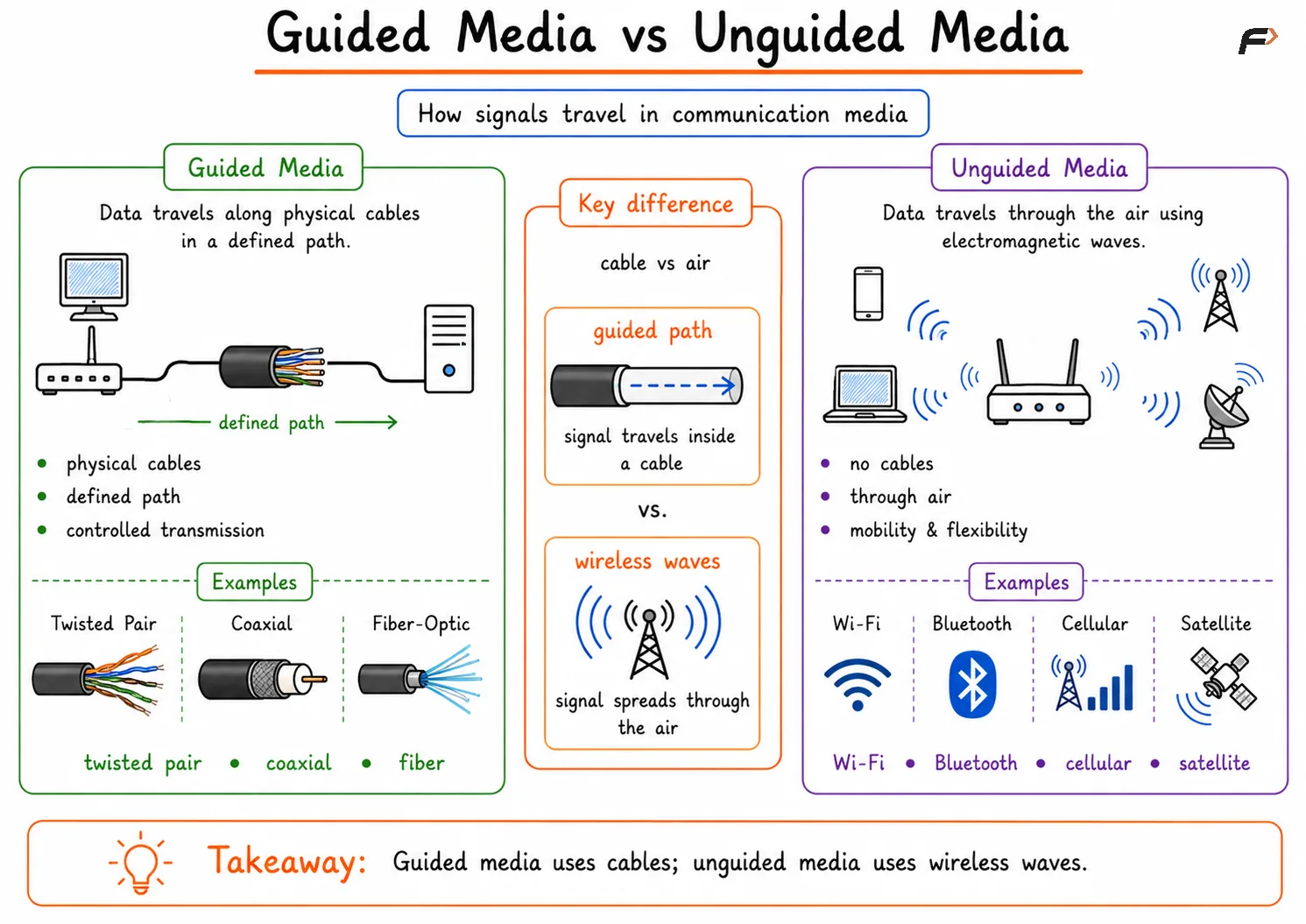
Guided Media and Unguided Media
Guided Media | Unguided Media |
|---|---|
Uses physical cables to guide signals through a defined path. | Uses electromagnetic waves to transmit data through the air without cables. |
Signals travel through media such as copper wires or fiber-optic cables. | Signals travel using radio waves, microwaves, or infrared waves. |
Provides controlled and directed transmission. | Provides mobility and flexibility for wireless communication. |
Common examples include twisted pair, coaxial, and fiber-optic cables. | Common examples include Wi-Fi, Bluetooth, cellular networks, and satellite communication. |
Major Types of Network Cables
Modern wired networks primarily rely on three major cable technologies. Each offers different characteristics in terms of speed, distance, cost, and resistance to interference.
Twisted Pair Cable: The most commonly used networking cable, especially in Ethernet-based LANs.
Coaxial Cable: Uses a central conductor surrounded by shielding and is commonly used in cable television and broadband networks.
Fiber Optic Cable: Uses pulses of light to transmit data at extremely high speeds over long distances with minimal signal loss.
These cable types form the foundation of modern network infrastructure and are used across homes, enterprises, data centers, telecommunications networks, and the Internet backbone.
Summary
Transmission media is the communication channel that carries data between devices in a network using electrical, optical, or wireless signals. It forms the foundation of data communication and includes both guided (wired) and unguided (wireless) media.
Wired transmission media includes twisted pair, coaxial, and fiber-optic cables, each offering different levels of speed, distance, and resistance to interference. Wireless transmission media uses radio, microwave, or infrared waves to provide flexible communication. Understanding transmission media helps in selecting the right networking technology and troubleshooting common issues such as cable damage, signal loss, and interference.
Be the first to add a comment.