Introduction
The Internet is a worldwide network of interconnected computer networks that communicate using the TCP/IP protocol suite. The key idea is that it is a network of networks rather than a single network or organization. Countless independently managed networks work together to provide seamless communication and data exchange across the globe. This interconnected system enables services such as web browsing, email, video streaming, cloud computing, and online communication.
Key Characteristics of the Internet
Decentralized Ownership: The Internet is not owned or controlled by any single organization; it is operated collectively by numerous entities worldwide.
Standardized Protocols: Communication relies on the TCP/IP protocol suite, allowing devices and networks from different vendors to interoperate.
Global Reach: Users and devices located anywhere in the world can communicate with each other.
Scalability: New networks and devices can continuously join the Internet without requiring major architectural changes.
Reliability: Multiple communication paths help ensure connectivity even when individual links or devices fail.
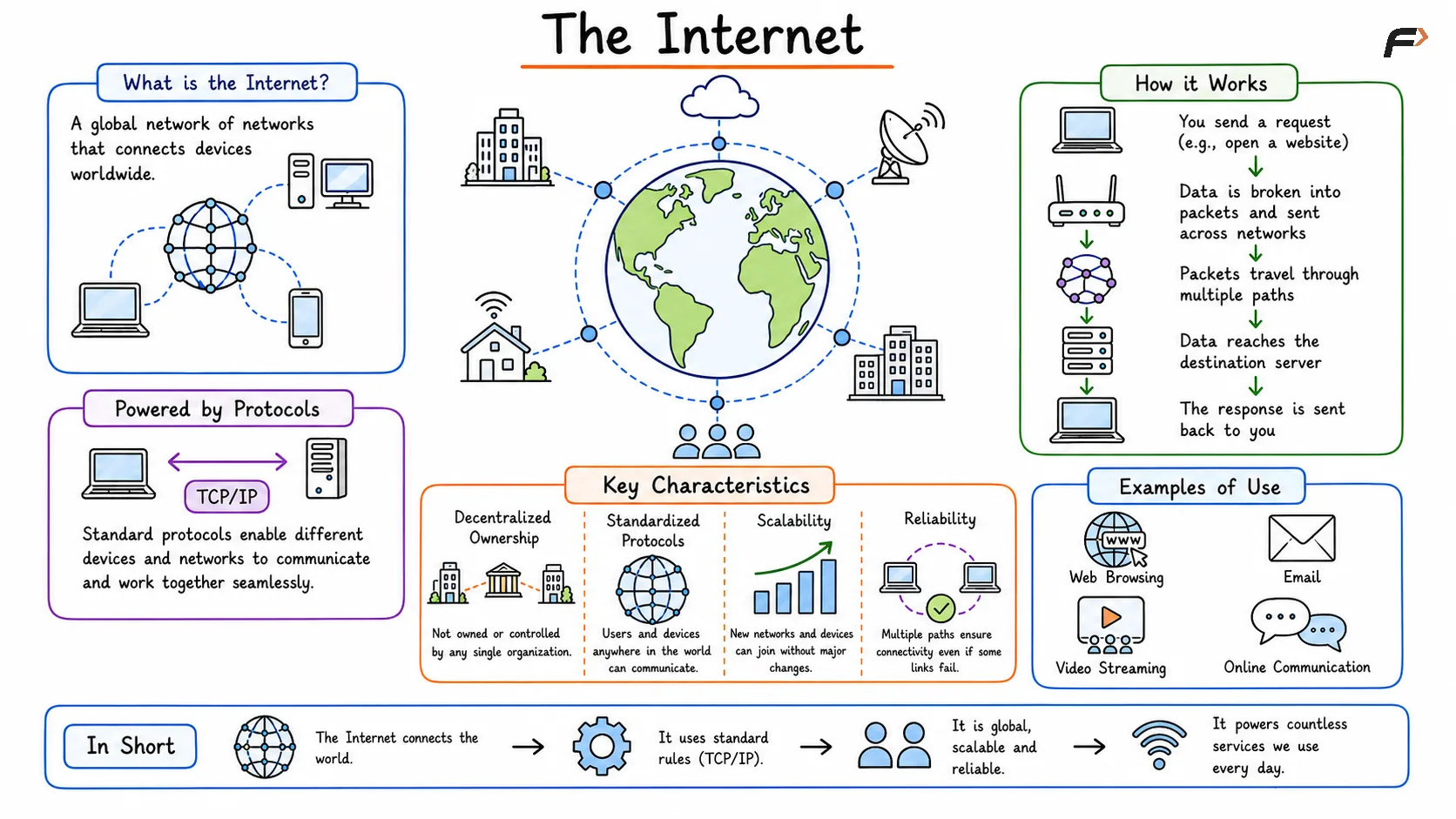
Visualization of the Internet as a global network connecting computers, smartphones, servers, and data centers across the world. Devices communicate through interconnected networks, enabling worldwide access to websites, online services, and information.
Networks That Form the Internet
Internet Service Providers (ISPs): Deliver Internet connectivity to individuals, businesses, and institutions. Examples include Airtel, Jio, and other service providers.
Cloud Providers: Operate large-scale data centers and host applications, services, and computing resources.
Universities and Research Institutions: Maintain campus networks that are connected to the global Internet.
Enterprise Networks: Corporate and organizational networks that communicate with other networks through Internet connectivity.
Network Connection Flow
When a user accesses a website or online service, the request passes through multiple networking components before reaching the destination server. The communication process generally follows this path:
Laptop => Home Router: The user's device connects to a local router, often through Wi-Fi.
Home Router => ISP Router: The router forwards traffic through a physical connection such as fiber or cable to the ISP.
ISP Router => Multiple Networks: The ISP routes the traffic through interconnected routers and networks.
Intermediate Networks => Destination Server: The request eventually reaches the server hosting the requested content or service.
Response Path: The server sends the response back through a similar route to the user's device.
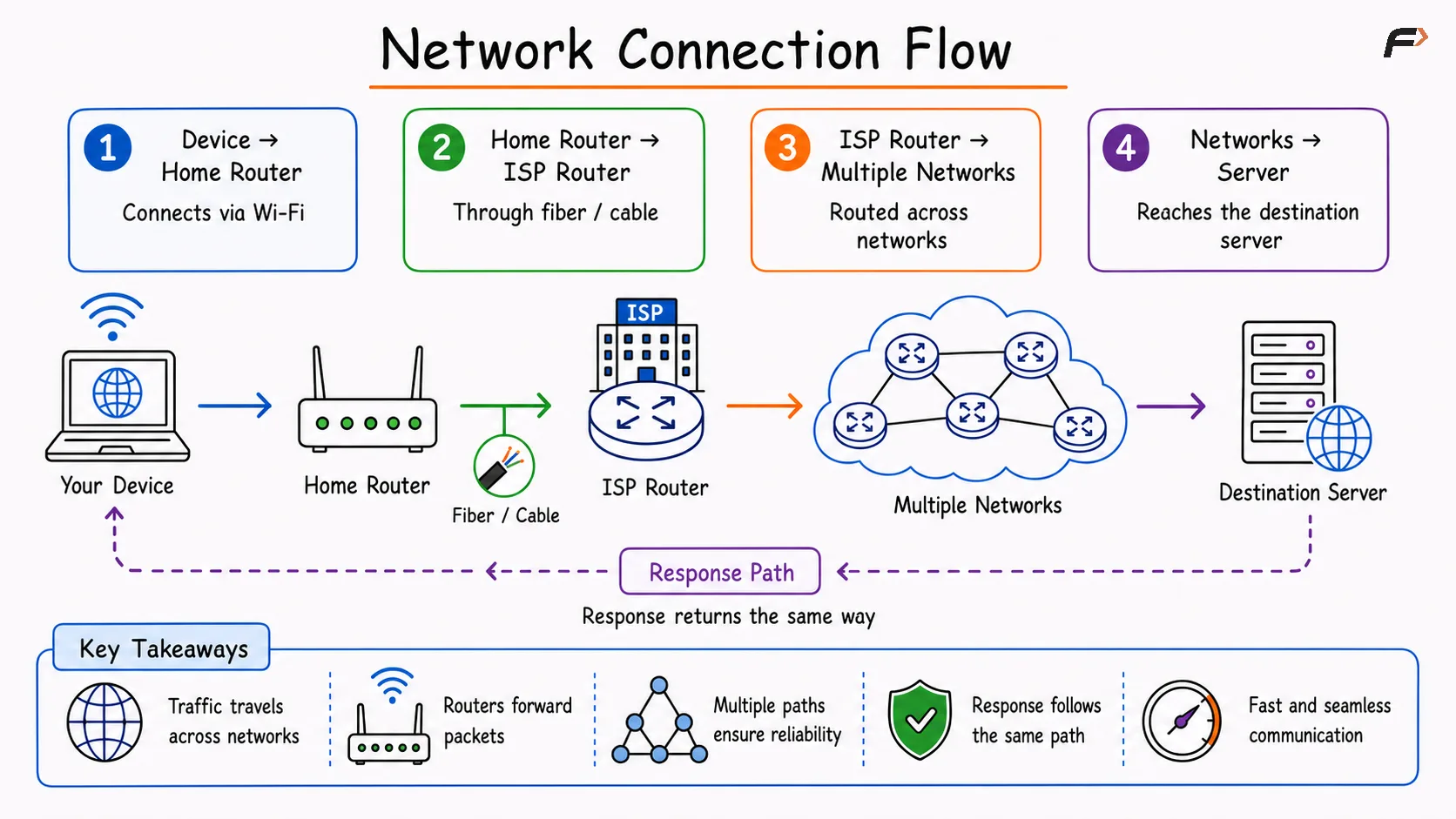
Flow diagram illustrating a network connection, where data travels from a user's device through a router, internet service provider (ISP), and the Internet to reach a destination server, with responses returning along the same communication path.
Backbone Networks
Backbone networks form the core infrastructure of the Internet. These high-capacity networks are responsible for transporting enormous amounts of data across long distances and connecting major service providers, data centers, and regional networks.
Key Features of Backbone Networks
High Capacity: Built to carry massive volumes of traffic efficiently.
Fiber Optic Infrastructure: Uses high-speed fiber-optic links for long-distance communication.
High-Performance Routers: Employs powerful networking equipment capable of handling large packet volumes.
Undersea Cables and Redundancy: Uses international fiber links and multiple routes to provide global connectivity and fault tolerance.
A useful analogy is to think of backbone networks as express highways. Local networks connect to regional networks, which then connect to these high-capacity backbone networks for long-distance communication across countries and continents.
Services Enabled by the Internet
World Wide Web (WWW): Accessing websites and web applications through HTTP and HTTPS.
Email: Electronic communication using protocols such as SMTP, IMAP, and POP3.
File Transfer: Exchanging files through FTP services and cloud storage platforms.
Streaming Services: Delivering audio and video content over the network.
Cloud Computing: Providing on-demand computing, storage, and application services.
Online Gaming and VoIP: Supporting real-time interactive communication and gaming experiences.
Be the first to add a comment.