Introduction
The TCP/IP model is the practical networking model used on the Internet. It organizes communication into layers with clearly defined responsibilities, enabling efficient and standardized data exchange. Within this model, TCP provides reliable end-to-end communication, while IP handles addressing and routing across networks, together forming the foundation of modern Internet communication.
TCP/IP Model
The TCP/IP Model is the practical model used on the internet. It is named after two core protocols:
Transmission Control Protocol (TCP)
Internet Protocol (IP)
The OSI model is great for learning and understanding concepts, but the real internet is more practically implemented using the TCP/IP model. OSI is more research-oriented, while TCP/IP is what is actually used in real systems.
Why Protocols Are Needed
For devices to communicate successfully over a network, they must follow a common set of communication rules. A network message typically contains information such as the data itself, its length, the sender's address, and the receiver's address. Without standardized rules for creating, sending, and interpreting messages, different systems would be unable to understand each other.
These communication rules are known as protocols. Protocols define how data is formatted, transmitted, received, and processed between devices. One of the most widely used protocol suites in networking is TCP/IP.
TCP and IP Working Together
TCP and IP work together to enable reliable communication across networks. When data is sent, TCP first breaks the data into smaller pieces called segments. These segments are then passed to IP, which is responsible for addressing and delivering them across the network.
As the segments travel through the network, they may take different routes before reaching the destination. Once all segments arrive, TCP reassembles them in the correct order and reconstructs the original data.
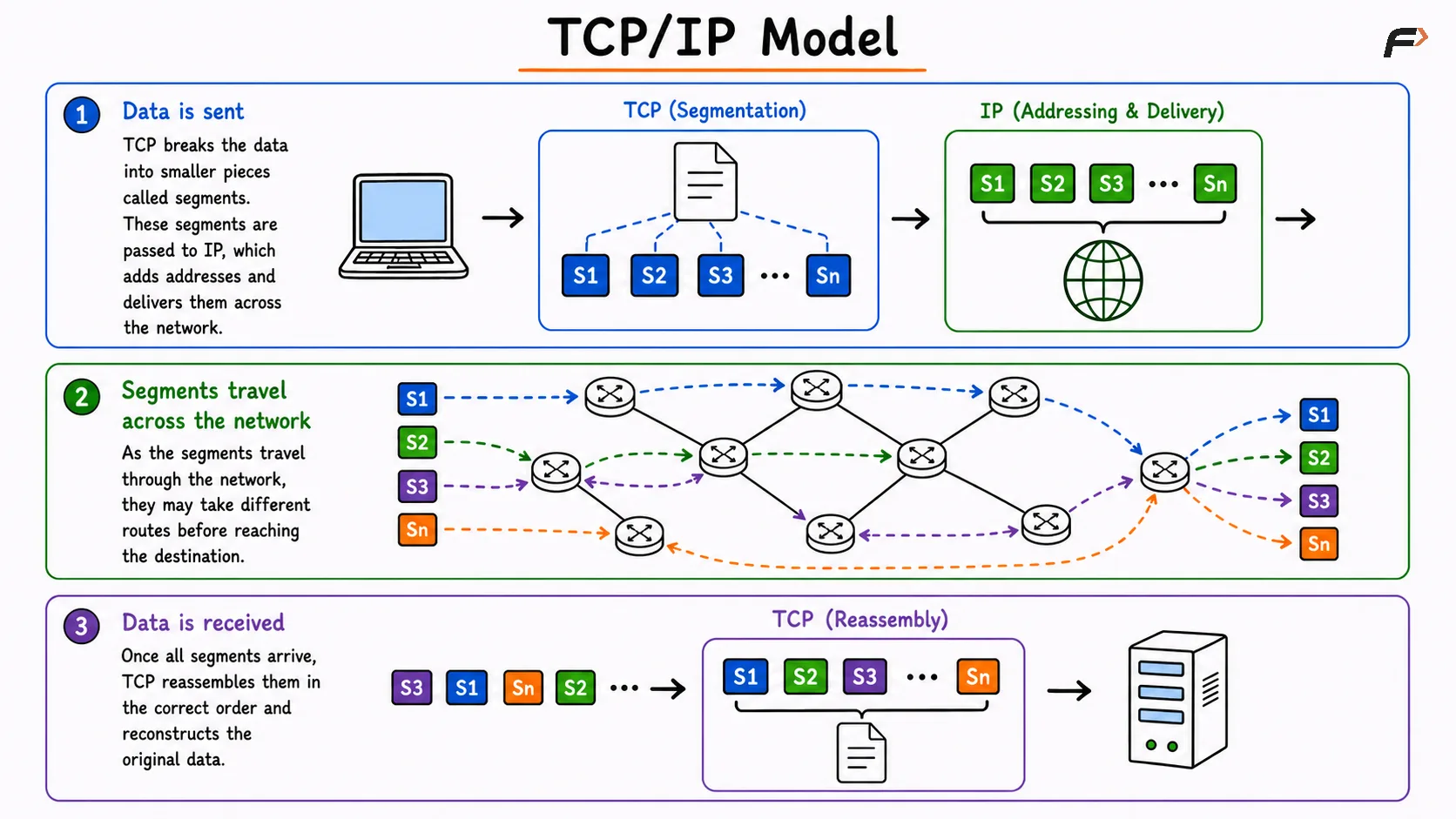
Data transmission in the TCP/IP model is shown through three stages: TCP divides data into segments, IP delivers the segments across different network paths, and TCP reassembles them in the correct order at the destination.
This demonstrates the separation of responsibilities between the two protocols:
TCP: Handles segmentation, ordering, and reliable delivery.
IP: Handles addressing and packet delivery across networks.
TCP vs UDP
UDP (User Datagram Protocol) is another transport-layer protocol that serves as an alternative to TCP. While UDP focuses on speed and simplicity, TCP provides reliability features such as sequencing, acknowledgements, and retransmissions. Because TCP has historically been the most widely used transport protocol for Internet communication, the protocol suite is commonly referred to as TCP/IP rather than UDP/IP.
TCP/IP Is a Protocol Suite
Although the name TCP/IP suggests only two protocols, it actually represents a collection of protocols operating across multiple networking layers. Each layer performs a specific function and uses its own set of protocols to support communication.
As data moves through the network stack at the sender, each layer adds information required for its specific task. At the receiver, these layers process and remove that information in reverse order to recover the original data.
Application Layer: Protocols like HTTP, DNS, and FTP are used here, and the data unit is called an application message.
Transport Layer: Protocols such as TCP and UDP operate at this layer, and the data unit is a TCP segment or UDP datagram.
Network / Internet Layer: Protocols like IP, ICMP, and ARP are used for addressing and routing, and the data unit is an IP packet.
Data Link Layer: Protocols like Ethernet are responsible for local delivery, and the data unit is an Ethernet frame.
Physical Layer: This layer handles actual transmission over the medium, and the data unit consists of bits in the form of electrical, optical, or radio signals.
Together, these layers provide a structured framework for communication, allowing devices and applications to exchange data reliably across interconnected networks.
Be the first to add a comment.