Introduction
TCP and UDP are the two main transport layer protocols used on the internet. Both support process-to-process communication, but they are built for different kinds of applications and different network priorities.
The simplest way to understand them is this: TCP is designed for reliable communication, while UDP is designed for fast communication with very little delay. Once that difference is clear, choosing between them becomes much easier.
What TCP and UDP Do
Both protocols sit at the transport layer and work above IP. IP helps data reach the correct machine, while TCP and UDP help the data reach the correct application using port numbers.
Even though they work at the same layer, their behavior is very different. TCP creates a managed communication session with checks and controls. UDP sends data quickly without building that kind of session.
TCP vs UDP Comparison
Feature | TCP | UDP |
|---|---|---|
Connection type | Connection-oriented | Connectionless |
Handshake | Required before data transfer | No handshake |
Reliability | Reliable delivery | Best-effort delivery |
Packet order | Maintains order | No ordering guarantee |
Retransmission | Yes | No |
Acknowledgments | Yes | No |
Flow control | Yes | No |
Congestion control | Yes | No |
Header size | Larger | Smaller |
Speed | Slower than UDP | Faster than TCP |
Main goal | Correct and reliable delivery | Fast and low-latency delivery |
This table gives the main picture, but the real difference is not just technical. It is about what the application needs most: correctness or speed.
How TCP Works
TCP establishes a connection before sending actual data. It tracks what has been sent, what has been received, and what needs to be retransmitted if something is lost.
Because of this, TCP provides several important features:
Reliable delivery: Lost data can be detected and sent again.
Ordered delivery: Data is delivered to the application in the correct sequence.
Acknowledgments: The receiver confirms successful receipt.
Flow control: A fast sender does not overwhelm a slow receiver.
Congestion control: TCP adjusts its sending rate based on network conditions.
These features make TCP dependable, but they also add overhead and delay.
How UDP Works
UDP takes a much simpler approach. It does not create a connection before sending data, and it does not wait for acknowledgments after sending it.
Because UDP avoids many control mechanisms, it stays lightweight and fast. But that speed comes with trade-offs.
No delivery guarantee: A packet may be lost.
No ordering guarantee: Packets may arrive out of order.
No retransmission: Lost data is not automatically recovered.
No built-in flow control: The sender is not slowed by receiver limits.
No built-in congestion control: The protocol itself does not adapt to network congestion.
UDP is useful when fresh data matters more than perfect delivery.
When to Use TCP
TCP should be used when the application cannot afford missing, duplicated, or out-of-order data. If the message must arrive correctly, TCP is usually the better choice.
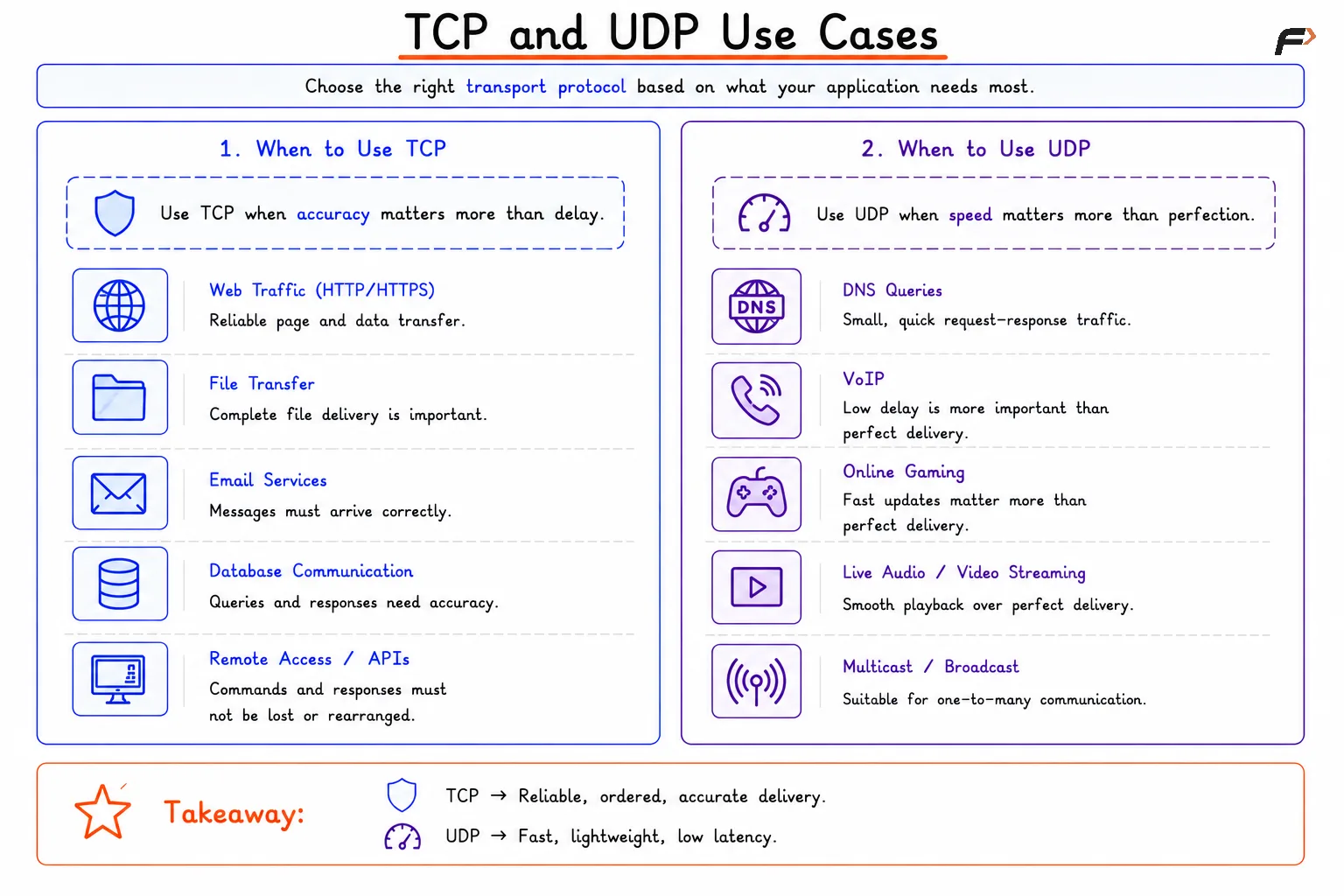
TCP vs UDP Use Cases
Use TCP in cases like these:
Web traffic: Traditional HTTP and HTTPS commonly rely on TCP for reliable page and data transfer.
File transfer: Missing or damaged data is not acceptable in file downloads and uploads.
Email services: Mail data must arrive correctly and in full.
Database communication: Queries and responses need accuracy and consistency.
Remote access and APIs: Commands and responses should not be lost or rearranged.
A simple rule is:
Use TCP when accuracy matters more than delay.
When to Use UDP
UDP should be used when low latency and speed are more important than perfect delivery. In real-time applications, waiting for old lost data can be more harmful than simply moving forward.
Use UDP in cases like these:
DNS queries: Small request-response traffic benefits from low overhead.
VoIP: Voice communication works better with low delay than with late retransmitted packets.
Online gaming: Fast updates matter more than perfect delivery of every packet.
Live audio and video streaming: Smooth playback is often more important than recovering every lost packet.
Multicast and broadcast traffic: UDP is suitable for one-to-many communication models.
A simple rule here is:
Use UDP when speed matters more than perfection.
TCP and UDP Are Not Opponents
TCP and UDP are often compared as if one is better than the other, but that is not the right way to look at them. They solve different transport problems.
TCP is built for controlled, reliable, ordered communication. UDP is built for minimal overhead, low latency, and speed. Good network design means choosing the protocol that matches the application instead of forcing one protocol into every situation.
Summary
TCP and UDP are the two primary transport layer protocols, but they follow different design goals. TCP provides reliable, ordered, connection-oriented communication with acknowledgments, retransmissions, flow control, and congestion control. UDP provides connectionless, lightweight, low-latency communication with minimal overhead.
The choice between TCP and UDP depends on the application. Use TCP for web traffic, file transfer, email, APIs, and any case where correctness matters most. Use UDP for DNS, gaming, voice, and streaming, where fast delivery is more important than guaranteed delivery of every packet.
Be the first to add a comment.