Introduction
Symmetric encryption is a cryptographic technique where the same secret key is used to encrypt and decrypt data. The sender uses the shared key to convert readable data into unreadable ciphertext, and the receiver uses the same key to recover the original plaintext.
The core idea is simple: both communicating parties must already have the same secret key. Anyone who does not have that key should not be able to understand the encrypted data.
How Symmetric Encryption Works
Symmetric encryption uses three main components: plaintext, a secret key, and ciphertext. Plaintext is the original readable data, the secret key is the shared value used by both sides, and ciphertext is the encrypted unreadable output.
A simple flow looks like:
The sender starts with plaintext.
The plaintext is encrypted using the shared key.
The encrypted data becomes ciphertext.
The ciphertext is decrypted using the same shared key.
The receiver obtains the original plaintext.
For example, if Alice wants to send a message to Bob, she encrypts the message using their shared key. Bob receives the ciphertext and uses the same key to decrypt it back into the original message.
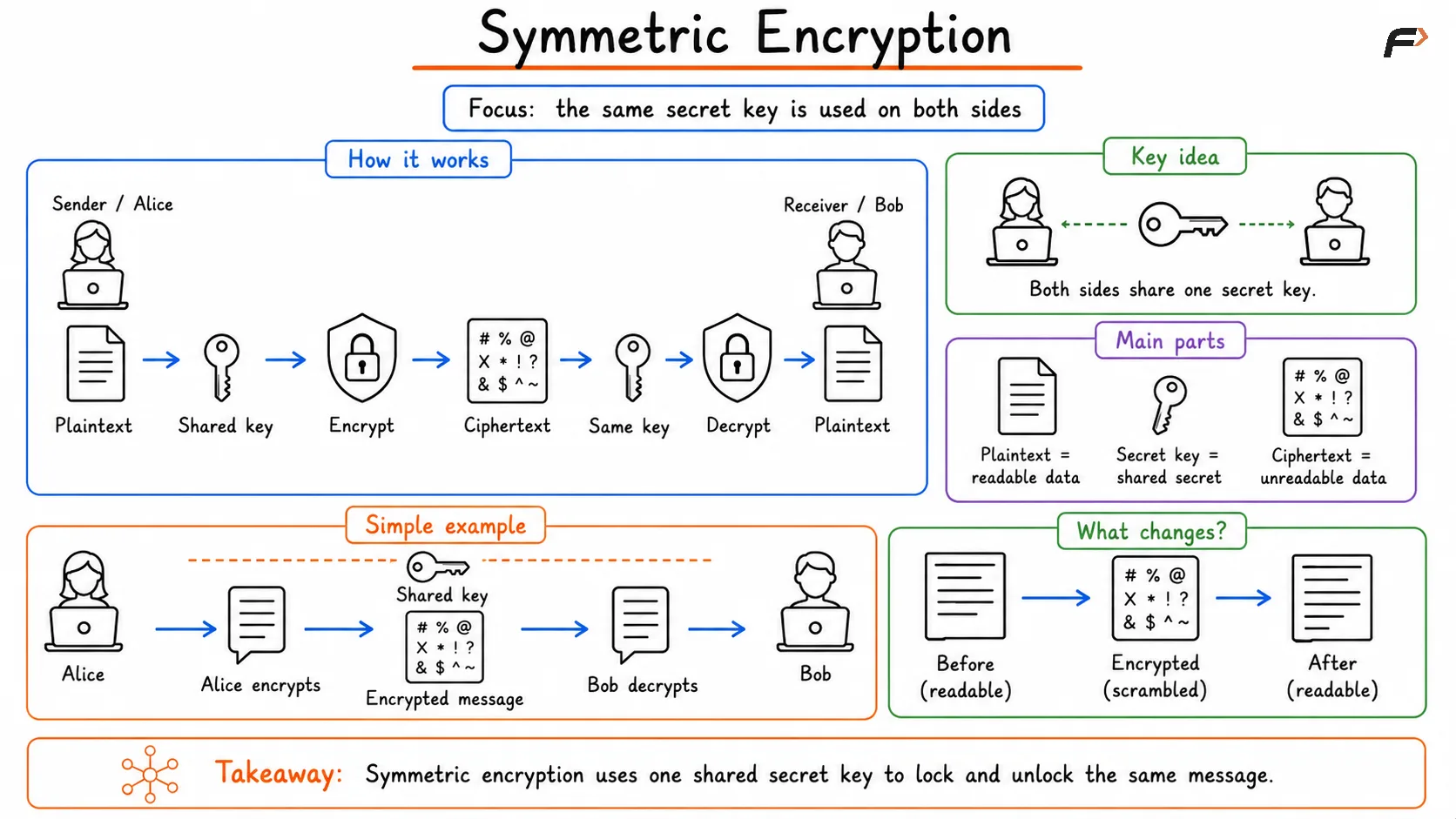
Symmetric Encryption
Why Symmetric Encryption Is Fast
Symmetric encryption is popular because it is very efficient. It can protect large amounts of data without requiring heavy computation, which makes it useful for real-time communication and high-volume systems.
Common advantages include:
Fast processing: Encryption and decryption are quick compared to many public-key methods.
Low overhead: It does not require very expensive computation for every message.
Good for bulk data: Large files, backups, database data, and network traffic can be encrypted efficiently.
Useful in secure protocols: Many secure systems use symmetric encryption after a secure key is established.
This is why symmetric key encryption is widely used in practical systems where speed matters.
Where Symmetric Encryption Is Used
Symmetric encryption appears in many real-world security systems. It is often used after two parties have safely agreed on a shared key.
Common uses include:
HTTPS and TLS: Protects data exchanged between browsers and websites after secure session keys are created.
VPN traffic: Encrypts data inside a secure tunnel over the public internet.
File encryption: Protects local files, documents, archives, and storage volumes.
Cloud storage: Encrypts stored data before or after it reaches cloud systems.
Database backups: Protects sensitive backup files from unauthorized reading.
Secure messaging: Helps encrypt message content between communicating parties.
Popular symmetric encryption algorithms include AES and ChaCha20. AES is widely used across security systems, while ChaCha20 is often used where speed and software performance are important.
The Key Exchange Problem
The biggest challenge in symmetric encryption is not the encryption process itself. The main problem is securely sharing the secret key.
For symmetric encryption to work:
Sender needs the key: The sender must use the secret key to encrypt the data.
Receiver needs the same key: The receiver must use the same key to decrypt the data.
Attackers must not get the key: If the key is exposed, the encrypted data becomes unsafe.
If Alice sends the secret key directly over an insecure network and an attacker intercepts it, the attacker can decrypt future messages. This weakness is known as the key exchange problem.
This is why symmetric encryption is often combined with asymmetric cryptography or key exchange protocols. The shared key is established securely first, and then symmetric encryption is used for fast data transfer.
Symmetric vs Asymmetric Encryption
Aspect | Symmetric Encryption | Asymmetric Encryption |
|---|---|---|
Keys Used | Same shared key for encryption and decryption | Public key and private key pair |
Speed | Faster | Slower |
Best Use | Encrypting large amounts of data | Secure key exchange, authentication, digital signatures |
Main Challenge | Sharing the secret key safely | Higher computational cost |
Example Algorithms | AES, ChaCha20 | RSA, ECC |
In real systems, both are often used together. Asymmetric cryptography helps establish a shared secret safely, and symmetric encryption protects the actual data efficiently.
Summary
Symmetric encryption uses the same secret key for both encryption and decryption. It converts plaintext into ciphertext so unauthorized users cannot read the original data.
It is fast, efficient, and widely used in HTTPS, TLS, VPNs, file encryption, cloud storage, backups, and secure messaging. Its main limitation is the key exchange problem: both parties need the same secret key, but that key must be shared without exposing it to attackers.
Be the first to add a comment.