Introduction
Subnetting is one of the most important concepts in IPv4 networking because it solves a very practical problem. A single large network may be easy to imagine at first, but it quickly becomes inefficient when too many devices share the same address space and the same broadcast domain.
Instead of keeping every device inside one flat network, subnetting allows that larger network to be divided into smaller logical networks called subnets. This makes the network easier to manage, easier to secure, and more efficient to operate.
What Subnetting Means
Subnetting is the process of dividing one larger network into multiple smaller networks by borrowing bits from the host portion of an IP address and using them as additional network bits.
That means subnetting does not create new IP addresses. It reorganizes the existing address space into smaller blocks so that the network can be used more effectively.
A subnet usually has:
Network address: Identifies the subnet itself
Usable host addresses: Can be assigned to devices
Broadcast address: Used to reach all devices in that subnet
Why Subnetting Is Needed
If all devices are placed inside one large network, several problems start appearing. Too many systems share the same broadcast domain, address usage becomes less structured, and enforcing separation between departments or device groups becomes harder.
Subnetting helps solve these issues by breaking one large network into smaller, more controlled segments.
Some major reasons for subnetting are:
Better address utilization: Smaller blocks can match actual requirements more closely
Smaller broadcast domains: Broadcast traffic reaches fewer devices
Improved segmentation: Different teams or services can be placed in separate networks
Simpler management: Troubleshooting and administration become easier
Cleaner routing design: Networks become more structured and scalable
How Subnetting Works
Suppose a network starts as /24. That means:
24 bits: Network portion
8 bits: Host portion
If 3 bits are borrowed from the host portion, the prefix becomes /27. The structure then changes to:
27 bits: Network portion
5 bits: Host portion
Because only 5 host bits remain, each subnet becomes smaller, but more subnets are created inside the original network.
A Simple Subnetting Example
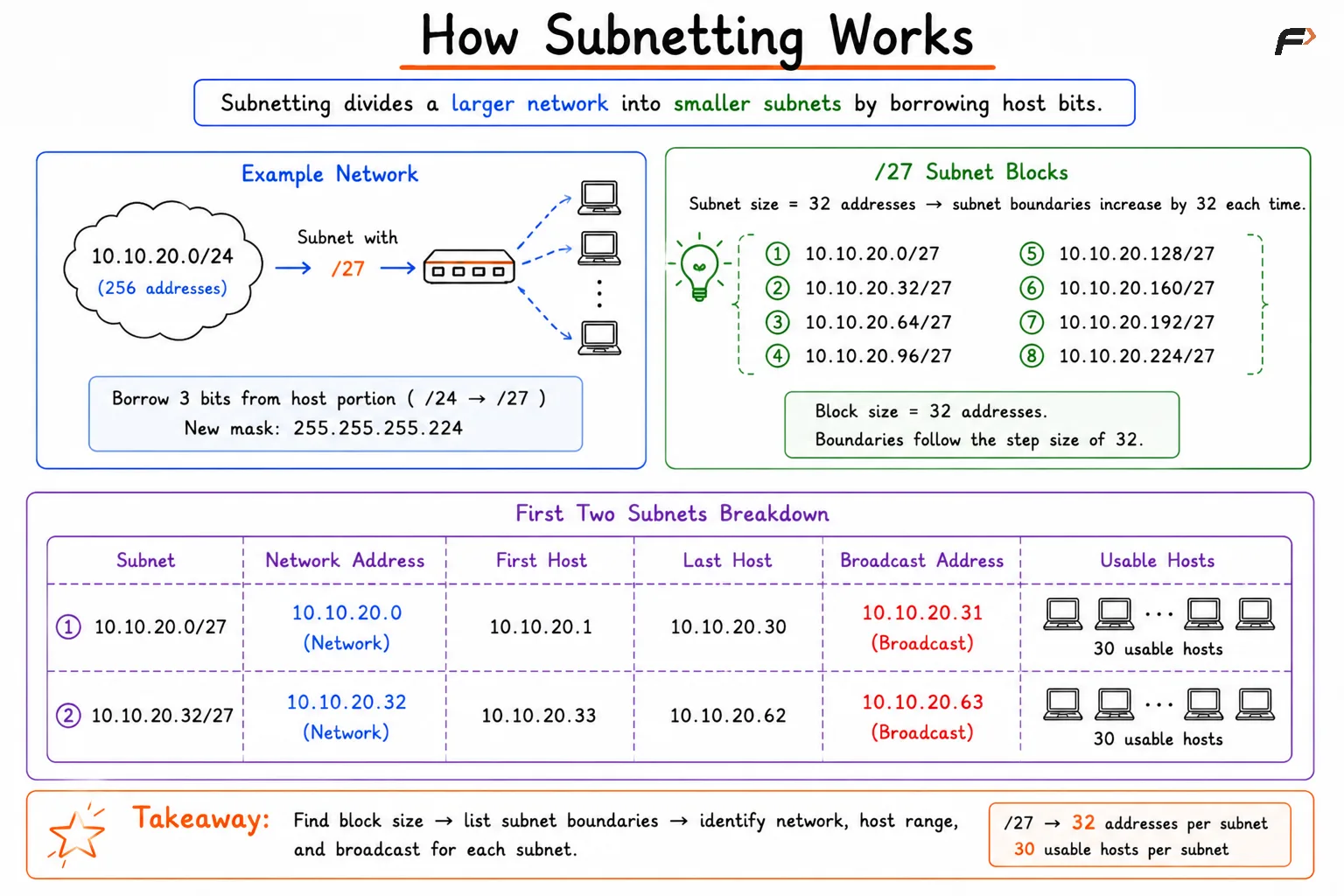
Consider this original network: 10.10.20.0/24
How Subnetting Works
A /24 network has 256 total addresses. Now suppose this network needs to be divided into smaller subnets for different teams. If 3 host bits are borrowed, the new prefix becomes: 10.10.20.0/27
With /27, there are 5 host bits left. So each /27 subnet has:
32 total addresses
1 network address
1 broadcast address
30 usable host addresses
Because 3 bits were borrowed, the original /24 network is divided into 2^3 = 8 subnets
/27 Subnet Blocks
The subnet size is 32 addresses, so the subnet boundaries increase by 32 each time.
The eight /27 subnets inside 10.10.20.0/24 are:
10.10.20.0/2710.10.20.32/2710.10.20.64/2710.10.20.96/2710.10.20.128/2710.10.20.160/2710.10.20.192/2710.10.20.224/27
This is the main pattern to notice in subnetting. Once the block size is known, the subnet boundaries follow that step size.
First Two Subnets Breakdown
A breakdown makes the idea much easier to see.
Subnet | Network Address | First Host | Last Host | Broadcast Address |
|---|---|---|---|---|
|
|
|
|
|
|
|
|
|
|
The same pattern continues for the remaining subnets. Each block has 32 total addresses, and after reserving the first and last address, 30 remain usable for hosts.
Where Subnetting Is Used
Subnetting is used everywhere in practical network design. A company may place different departments into different subnets. A school may use separate subnets for labs, faculty systems, and guest access. A data center may use different subnets for application servers, storage, and management traffic.
Common use cases include:
Department-based separation: Engineering, HR, Finance, and Sales
Guest network isolation: Guest users separated from internal users
Server segmentation: Different services placed in different subnets
Security boundaries: Restricting communication between groups
Routing organization: Creating a cleaner IP structure
Summary
Subnetting is the process of dividing a larger network into smaller logical subnets by borrowing bits from the host portion and turning them into network bits. It improves address utilization, reduces broadcast traffic, strengthens segmentation, and makes network design easier to manage and scale.
In the example 10.10.20.0/24 => /27, borrowing 3 host bits creates 8 smaller subnets, each with 32 total addresses and 30 usable host addresses. That is the main value of subnetting: turning one large network into smaller, more practical, and more efficient network segments.
Be the first to add a comment.