Introduction
Static routing is one of the simplest ways to make a router send packets toward a destination network. Instead of learning routes automatically through routing protocols, the router depends on instructions entered manually by a network administrator.
That manual approach makes static routing easy to understand and useful in the right environment. At the same time, it also creates limits, especially when the network becomes large or changes frequently.
What Static Routing Means
Static routing is a routing method in which routes are configured manually rather than learned dynamically. The administrator tells the router exactly how to reach a destination network, usually by specifying a next hop or an outgoing interface.
A simple idea behind static routing is:
Manual route definition: The administrator enters the route directly.
Fixed behavior: The route remains in place until someone changes it.
No automatic learning: The router does not discover paths by itself.
This is why the word static matters. The route does not automatically change with network conditions.
How Static Routing Works
Suppose an administrator configures a rule like this:
To reach 10.20.0.0/16 => Send traffic to 192.168.1.2
Once that route is placed into the routing table, the router uses it whenever a matching packet arrives.
A short forwarding process looks like this:
Packet arrives: The router reads the destination IP address.
Route lookup happens: The routing table is checked for a matching destination network.
Static entry matches: The configured route is selected.
Packet is forwarded: Traffic is sent to the specified next hop or interface.
No automatic route discovery or path calculation happens during this process. The router is simply following the route that was manually configured.
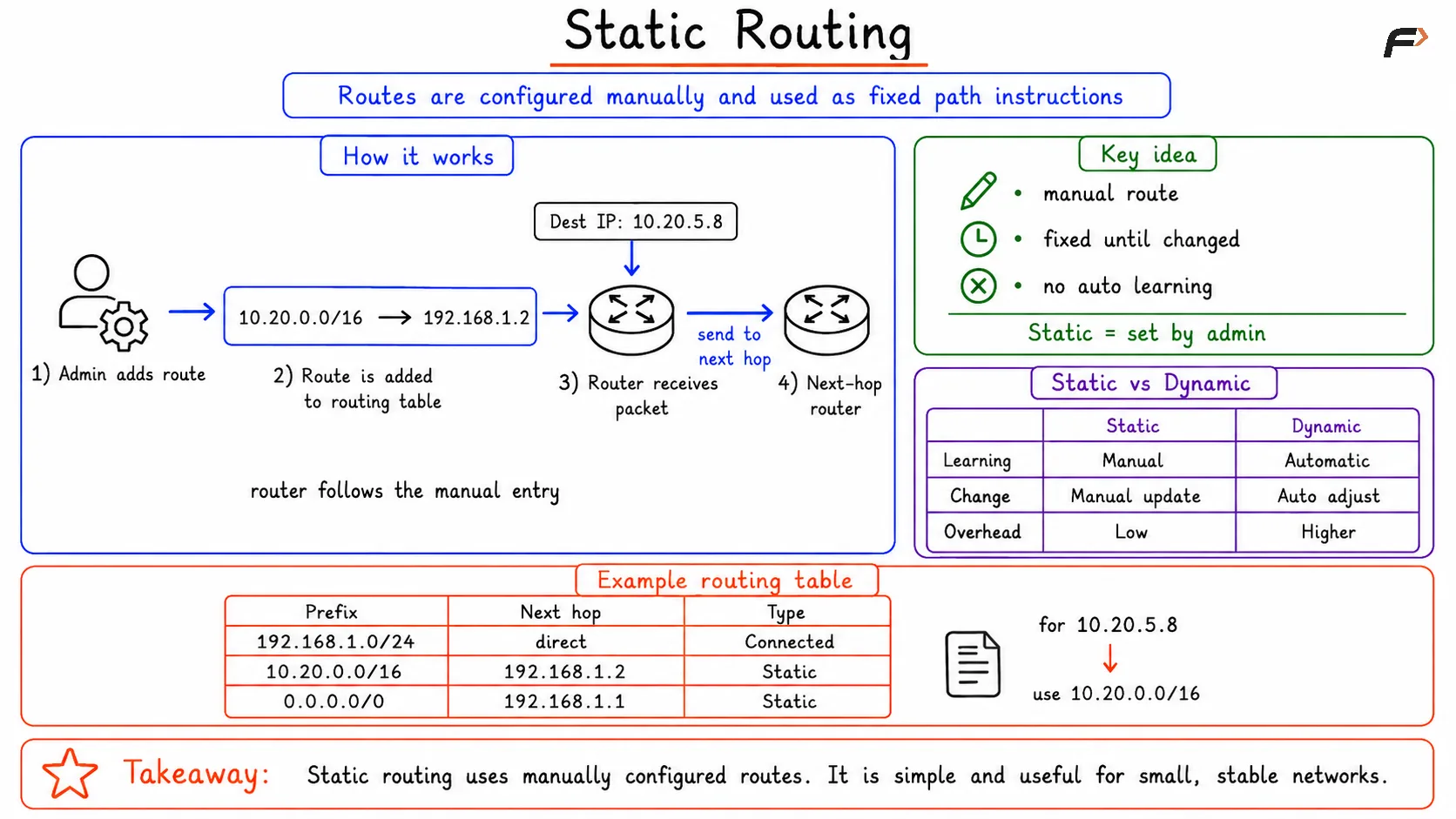
Static Routing
Static Routing and Routing Protocols
One of the defining features of static routing is that it does not depend on dynamic routing protocols.
That means the router is not using protocols such as:
RIP
OSPF
BGP
In dynamic routing, routers exchange route information and adapt when the topology changes. In static routing, the router uses only what the administrator has configured.
This creates a major difference in behavior:
Aspect | Static Routing | Dynamic Routing |
|---|---|---|
Route learning | Manual | Automatic |
Reaction to topology changes | Manual update required | Automatic adjustment possible |
Protocol overhead | Very low | Higher than static routing |
Best use case | Small, stable networks | Larger or changing networks |
Why Static Routing Exists
At first, manual routing may seem old-fashioned, but it still has an important place in networking. Not every network is large, and not every environment needs the overhead of dynamic routing protocols.
Static routing is useful because some networks are:
Small
Predictable
Stable
Easy to understand
Rarely changed
In those cases, a simple manually configured route may be more practical than running a dynamic routing system.
Common Use Cases of Static Routing
Static routing is most useful in environments where the path is already known and does not change often.
Common situations include:
Small office or branch networks
Simple lab environments
Home routers using an upstream default route
Controlled network segments
Backup routes in some designs
Administrative path control where exact behavior is required
A home router is one of the easiest examples. It usually does not know the full internet routing structure. Instead, it often uses a default route that sends unknown traffic to the ISP.
Advantages of Static Routing
Static routing remains useful because it offers several practical benefits in the right environment.
Simple for small networks: A few routes can be configured and understood easily.
No routing protocol overhead: No route advertisements, protocol updates, or dynamic calculations are needed.
Predictable path selection: The forwarding path stays exactly as configured until changed manually.
Strong administrative control: The administrator decides the route explicitly.
Low resource use: Less CPU, memory, and bandwidth are consumed compared with dynamic routing protocols.
This makes static routing attractive in networks where simplicity matters more than automatic adaptation.
Limitations of Static Routing
The simplicity of static routing is also its biggest weakness. Because the router does not learn or adjust automatically, it cannot respond intelligently when the network changes.
Some major limitations are:
No automatic adaptation: If a link fails, the route does not update itself.
Poor scalability: Large networks require too many manual route entries.
Higher chance of human error: Mistyped destinations, wrong next hops, or missing routes can break connectivity.
Manual maintenance burden: Topology changes require administrators to update routes by hand.
Weak fit for dynamic environments: Networks with frequent changes are hard to manage using only static routes.
These limits are the reason static routing works best only in small or stable environments.
Static Routing and Default Routes
One of the most common uses of static routing is the default route. A default route is used when the router does not have a more specific route for the destination.
In IPv4, the default route is written as:
0.0.0.0/0
In practice, this means:
Known local destinations: Use specific routing entries if available.
Everything else: Send traffic toward the configured upstream next hop.
This is extremely common in home and small-office networking, where the local router simply forwards unknown traffic to the ISP.
Summary
Static routing is a routing method where routes are entered manually by a network administrator instead of being learned through dynamic routing protocols. It gives routers fixed instructions for reaching destination networks, which makes routing behavior simple, predictable, and easy to control in small or stable environments.
Its biggest strengths are low overhead, explicit control, and straightforward design. Its biggest weaknesses are lack of automatic adaptation, poor scalability, and the need for manual updates whenever the network changes. For that reason, static routing works best in small, simple, and predictable networks rather than large or frequently changing ones.
Be the first to add a comment.