Introduction
Redundant links are useful in a switched network because they provide backup paths. If one link fails, another link can keep the network connected.
However, redundancy at Layer 2 can create a serious problem: switching loops. Since Ethernet frames do not have a TTL field like IP packets, a frame can keep circulating inside a looped switched network. Spanning Tree Protocol, or STP, prevents this by creating a loop-free logical path through the network.
What Is Spanning Tree Protocol?
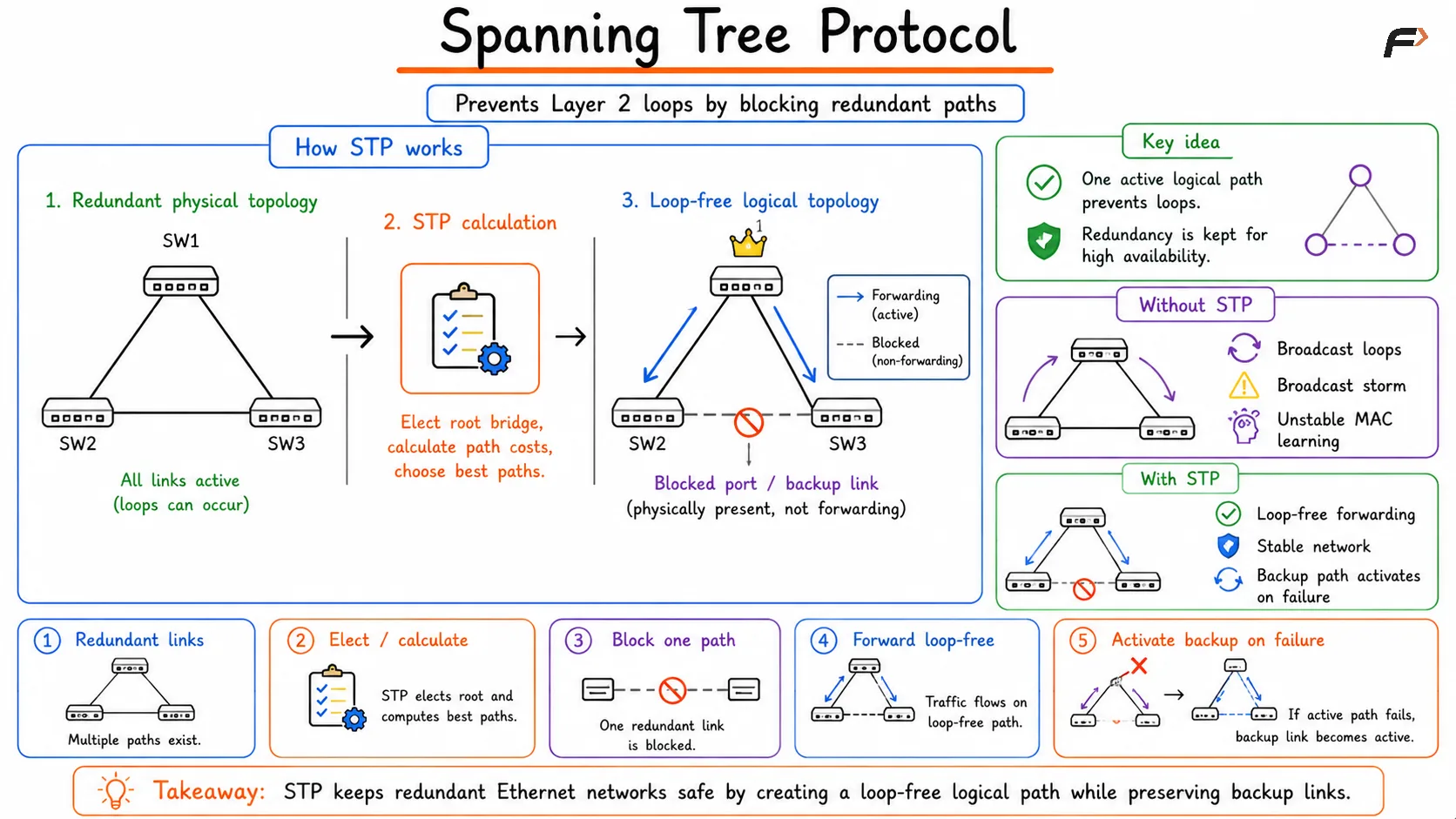
Spanning Tree Protocol is a Layer 2 protocol used by switches to prevent loops in Ethernet networks. It allows switches to discover redundant paths and then block some ports so that only one active logical path exists between any two points.
STP does not remove the physical cable. The redundant link still exists, but one side may be placed in a non-forwarding state. If the active path fails, STP can allow the backup path to become active.
A simplified idea looks like this:
Redundant physical topology => STP calculation => Loop-free logical topology
This gives the network both safety and backup connectivity.
Spanning Tree Protocol and Switching Loops
How Switching Loops Happen
Consider three switches connected in a triangle. This design gives redundancy, but it also creates a loop.
If one switch receives a broadcast frame, it floods the frame to the other switches. Those switches also flood the frame further. Because the topology is circular, the same frame can return again and again.
Without STP, this can continue indefinitely because Ethernet frames do not naturally expire inside the Layer 2 network.
Without STP | With STP |
|---|---|
Redundant links remain fully active | Some redundant ports are blocked |
Frames can loop endlessly | A loop-free logical path is formed |
Broadcast storms can occur | Broadcast traffic has a controlled path |
MAC tables may become unstable | MAC learning becomes stable |
Backup path is uncontrolled | Backup path can activate after failure |
How STP Works
STP works by allowing switches to exchange control messages called BPDUs. Using these messages, switches agree on a loop-free topology.
The basic STP process includes:
Root bridge election: One switch becomes the central reference point for the spanning tree.
Best path selection: Each non-root switch chooses its best path toward the root bridge.
Port role selection: Switch ports are assigned roles based on how they connect to the root and other switches.
Port blocking: Redundant ports that can create loops are placed in a blocking state.
Topology update: If a link fails, STP recalculates and may unblock a backup path.
The result is that some ports forward traffic, while others stay blocked to prevent loops.
Root Bridge, Ports, and Blocking
The root bridge is the main reference switch in the STP topology. Every other switch calculates its best path toward this root bridge.
Common STP terms include:
Root Bridge: The central switch selected by STP as the reference point.
Root Port: The port on a non-root switch that provides the best path toward the root bridge.
Designated Port: A forwarding port selected for a network segment.
Blocked Port: A redundant port that does not forward normal traffic to prevent loops.
BPDU: Control message exchanged by switches to build and maintain the spanning tree.
A blocked port is not useless. It acts like a backup path. If the active forwarding path fails, STP can recalculate the topology and bring a backup path into use.
STP and Network Redundancy
STP is important because it allows network designers to add backup links safely. Without STP, redundant Layer 2 links can be risky. With STP, the network can keep backup paths while forwarding traffic through a loop-free tree.
STP is useful in switched LANs where:
Multiple switches are connected together.
Redundant links exist between switches.
Layer 2 loops are possible.
Broadcast traffic must be controlled.
Backup paths are needed for reliability.
STP is not mainly about increasing speed. Its main purpose is loop prevention and network stability.
Summary
Spanning Tree Protocol prevents switching loops in Layer 2 Ethernet networks. It is needed because redundant switch links can cause broadcast storms, MAC table instability, duplicate frames, and network outages.
STP works by exchanging BPDUs, electing a root bridge, selecting forwarding paths, and blocking redundant ports that could create loops. The physical redundancy remains available, but the active logical topology becomes loop-free. This allows switched networks to maintain backup paths without allowing frames to circulate endlessly.
Be the first to add a comment.