Introduction
A router cannot forward packets intelligently unless it already knows which networks are reachable and how to reach them. That stored path information lives in one of the most important structures in networking: the routing table.
Whenever a packet arrives, the router checks the destination IP address and uses stored route information to decide the next step. That is why the routing table sits at the center of Network Layer decision-making.
What a Routing Table Is
A routing table is a data structure maintained by a router that stores information about reachable destination networks and the paths used to reach them. It acts like a network map that helps the router make forwarding decisions.
At a basic level, many people describe a routing table as storing:
Destination network
Next hop
That is a good starting point, but real routing tables store much more than that because routers need extra information for route selection, monitoring, troubleshooting, and protocol behavior.
Why is Routing Table Needed
When a packet reaches a router, the router must answer a simple question: where should this packet go next?
Without a routing table, the router would not know:
Which networks are reachable
Which path should be used
Which next hop is appropriate
Which interface should send the packet out
So the routing table is not optional. It is the structure that allows Layer 3 forwarding to happen in a controlled and scalable way.
What a Routing Table Stores
A real routing table contains multiple fields that help the router choose and use the correct route.
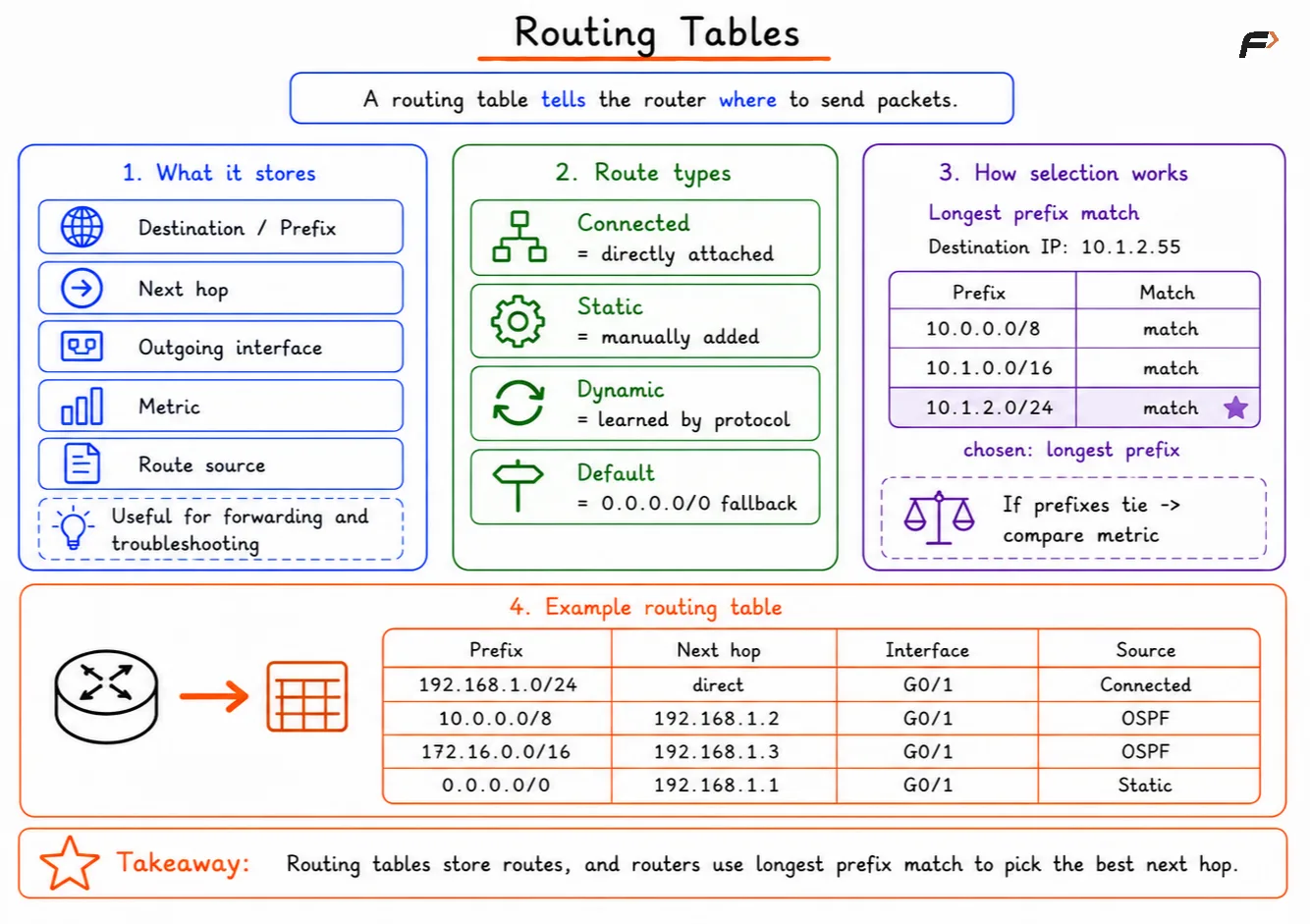
Common routing table information includes:
Destination network or prefix: Identifies the network the route can reach
Prefix length or subnet mask: Defines how large that destination network is
Next hop: Identifies the next router toward the destination
Outgoing interface: Tells the router which interface should send the packet
Metric or cost: Helps compare multiple possible routes
Route source: Shows whether the route came from a static configuration, a directly connected interface, or a routing protocol
Additional details: May include timers, age, protocol-specific information, or administrative data
This is why routing tables are useful not only for forwarding, but also for operational visibility and debugging.
Routing Tables Basics
Main Route Types
Routers can learn or build routing table entries in different ways. The route source matters because it affects how the route is chosen and how it behaves.
Common route types include:
Directly connected routes: Learned automatically from the router's own active interfaces
Static routes: Manually configured by an administrator
Dynamic routes: Learned through routing protocols such as RIP, OSPF, or BGP
Default route: A fallback route used when no more specific route matches
A directly connected route means the network is already attached to the router, so no extra next-hop router is needed. A default route is commonly written as 0.0.0.0/0 in IPv4 and acts as a catch-all option when no specific destination is found.
How Route Selection Works
A routing table may contain several routes, and sometimes more than one route may match the same destination. In those cases, the router has to select the most appropriate one.
The first major rule is longest prefix match. If multiple entries match the destination IP address, the router chooses the route with the most specific prefix.
For example, if these routes exist:
10.0.0.0/810.1.0.0/1610.1.2.0/24
and the destination is 10.1.2.55, all three routes match. But the router selects 10.1.2.0/24 because it has the longest matching prefix.
If multiple routes still have the same prefix length, the router then compares other factors such as:
Metric or cost
Administrative preference
Protocol behavior
This is why metrics and route-source information are important in real routing tables.
Why Routers Store Prefixes Instead of Every IP
A router does not store a separate entry for every single IP address on the internet. That would be far too large and inefficient.
Instead, routers store network prefixes. A single prefix can represent many individual addresses.
For example, instead of storing separate entries for every host from 172.16.0.1 to 172.16.255.254, the router can store just:
172.16.0.0/16
This improves scalability by:
Reducing routing table size
Saving memory
Making lookups more efficient
Supporting route aggregation
This prefix-based design is one of the reasons internet routing can scale at all.
Summary
A routing table is the control-plane structure that stores reachable network prefixes and the information needed to decide how packets should be forwarded. It includes destination networks, prefix lengths, next hops, outgoing interfaces, metrics, route sources, and other operational details.
Routers use the routing table to select the best route, usually through longest prefix match and then metric comparison. These mechanisms allow routers to make scalable, accurate forwarding decisions across large interconnected networks.
Be the first to add a comment.