Introduction
REST APIs are one of the most common ways modern applications communicate. In most systems, the frontend and backend are separate parts of the application. The frontend shows data to the user, while the backend handles business logic, databases, authentication, and processing.
The frontend does not directly talk to the database. Instead, it sends requests to an API, and the backend responds with data or confirmation. This is the role of a REST API.
What Is an API?
API stands for Application Programming Interface. It is a contract that allows two software systems to communicate with each other in a structured way.
In a typical client-server model:
Client: Sends a request for data or an action
Server: Processes the request and returns a response
For example, a dashboard may request user progress, product details, submissions, or analytics from the backend. The backend receives the request, works with the database if needed, and returns the required response.
This separation makes applications easier to manage and scale.
What REST Means
REST stands for Representational State Transfer. It is an architectural style used to design APIs over HTTP. REST is not a protocol. It is a set of design principles that helps APIs stay simple, predictable, and scalable.
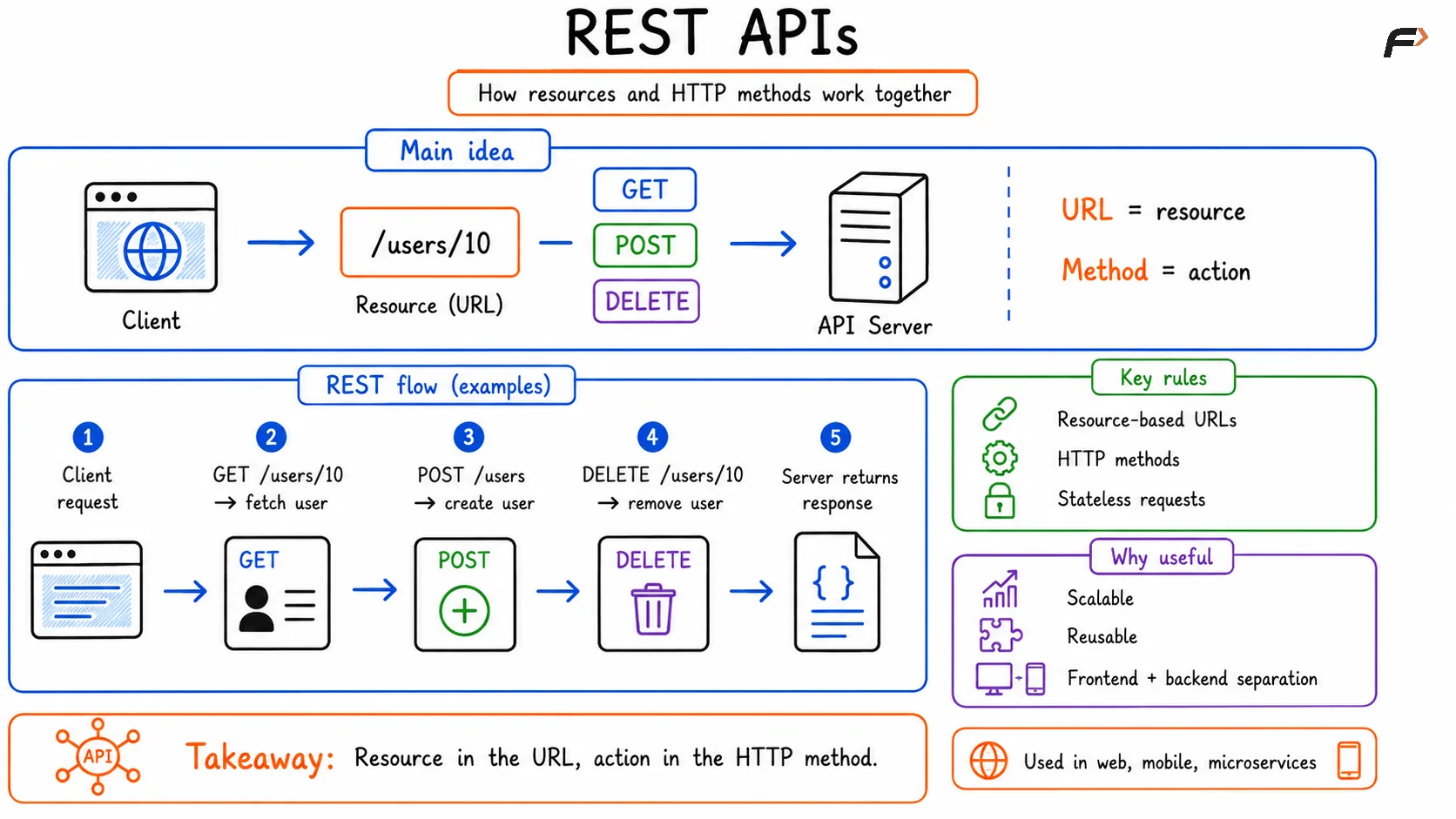
The main idea is straightforward:
The URL identifies the resource
The HTTP method tells what action should be performed
For example:
GET /users/10=> fetch details of user 10POST /users=> create a new userDELETE /users/10=> remove user 10
The URL focuses on the resource, and the HTTP method defines the operation.
REST APIs
Why REST APIs Are Important
REST APIs make communication between systems clean and standardized. They are widely used in web applications, mobile apps, dashboards, microservices, and third-party integrations.
Some important benefits are:
Frontend-backend separation: Both sides can be developed independently
Scalability: Stateless communication is easier to scale across servers
Maintainability: Predictable endpoint design makes systems easier to manage
Security: Clients do not directly access internal databases
Reusability: The same API can serve web apps, mobile apps, and other services
REST Principles
REST APIs usually follow a few core design principles. These principles are the reason REST feels organized and easy to work with.
Resource-oriented design: Everything is treated as a resource and identified through URLs
Stateless communication: Every request should carry the information needed to process it
Uniform interface: Standard HTTP methods should be used consistently
Meaningful status codes: The server should clearly communicate request outcomes
Predictable structure: Endpoints should follow a consistent design pattern
When these principles are followed properly, APIs become easier to test, document, debug, and extend.
Resources and URL Design
In REST, URLs should represent resources, not actions. That means endpoints are usually written as nouns rather than verbs.
Good examples:
/users/users/10/orders/orders/99/items/products/api/profile
Poor examples:
/getUser/createUser/deleteUser
The better design is resource-based because the action should come from the HTTP method, not from the URL name itself.
Stateless Nature of REST
One of the most important REST ideas is statelessness. A stateless API means each request should contain the information required to process it.
The server should not depend on memory of previous requests to understand the current one. That makes scaling much easier, because any server instance can handle the request independently.
This does not mean authentication cannot exist. It simply means authentication details, tokens, or session-related information should be sent in a way that each request can be processed properly.
Structure of a REST Request
A REST request usually contains several parts that work together.
Method: What operation is being performed
URL: Which resource is being targeted
Headers: Extra metadata about the request
Path parameters: Specific resource identifiers inside the URL
Query parameters: Filters or modifiers for the response
Body: Data sent to the server, usually for create or update requests
These pieces give the server everything it needs to understand the request.
Path Parameters, Query Parameters, and Body
These three are often confused, but they serve different purposes.
Part | Purpose | Example |
|---|---|---|
Path parameter | Identifies a specific resource |
|
Query parameter | Filters, sorts, paginates, or modifies results |
|
Request body | Sends actual data to the server |
|
A simple way to remember this is:
Path parameters: identify
Query parameters: refine
Request body: provide data
Headers in REST APIs
Headers carry metadata that helps the client and server understand how to handle the request or response.
Common headers include:
Authorization: Sends authentication credentials such as bearer tokens
Content-Type: Tells the server the format of the request body, such as
application/jsonAccept: Tells the server which response format the client expects
Headers are very important in real-world APIs because they carry context, security details, and content rules.
Example of REST API Communication
Suppose a client wants to fetch details of user 10.
Method:
GETURL:
/users/10Header:
Authorization: Bearer token123Header:
Accept: application/json
Now suppose the client wants to create a new user.
Method:
POSTURL:
/usersHeader:
Content-Type: application/jsonBody: name, email, or other user details
In both cases, the communication stays predictable because the API follows standard REST rules.
Summary
REST APIs are a widely used way to build communication between clients and servers in modern applications. They use HTTP, resource-based URLs, standard methods such as GET and POST, meaningful status codes, stateless requests, headers, parameters, and request bodies to create a clear and scalable interface.
A well-designed REST API is easy to understand, easy to maintain, and easy to use across web apps, mobile apps, dashboards, and backend services. That is why REST remains one of the most important concepts in modern application architecture.
Be the first to add a comment.