Introduction
Not all IPv4 addresses are used in the same way. Some addresses are meant only for internal communication inside a home, office, or cloud network, while others are designed to be reachable across the global internet.
That is why IPv4 addresses are broadly divided into private IP addresses and public IP addresses. The biggest difference between them is simple: one is used inside private networks, and the other is used for internet-wide communication.
Why Two Types of IP Addresses Exist
If every laptop, phone, printer, camera, and smart device needed its own globally unique public IPv4 address, the available IPv4 space would run out very quickly. IPv4 uses only 32 bits, so the number of addresses is limited.
Private addressing helps solve that problem. Devices can use private IP addresses inside internal networks, while a much smaller number of public IP addresses can be used for internet connectivity.
This design helps with:
Address conservation: Reduces consumption of limited public IPv4 addresses.
Internal organization: Makes private networks easier to structure and manage.
Scalability: Supports large numbers of internal devices.
Internet access through NAT: Allows many internal devices to share limited public addressing.
What a Private IP Address Is
A private IP address is an IPv4 address reserved for internal network use. These addresses are not routable on the public internet and are meant to stay within local network boundaries unless translation is performed.
Private IP addresses are commonly used in:
Home networks
Enterprise LANs
Corporate networks
Cloud private networks
Data centers
If a packet carries a private source or destination address, internet routers generally do not forward it across the public internet.
RFC 1918 Private IP Ranges
The private IPv4 address ranges are defined by RFC 1918. These are the three reserved blocks:
10.0.0.0/8
172.16.0.0/12
192.168.0.0/16
Each of these ranges is used for private networking, but they are often seen in different environments.
The 192.168.x.x range is the one most users see at home. Addresses such as 192.168.1.10 or 192.168.0.25 are very common on Wi-Fi routers and local LANs.
What a Public IP Address Is
A public IP address is a globally unique IPv4 address that can be routed across the internet. These addresses are visible in global routing systems and are used when a device or service must be reachable from outside its local network.
Public IP addresses are typically associated with:
Web servers
Public DNS servers
Internet-facing APIs
Cloud-hosted services
Email servers
Home routers on the ISP side
When a user opens a website, the browser ultimately communicates with a destination that is reachable through a public IP address.
Public vs Private IP Addresses
Feature | Private IP Address | Public IP Address |
|---|---|---|
Scope | Internal network use | Global internet use |
Internet routable | No | Yes |
Global uniqueness | No | Yes |
Typical location | Homes, offices, enterprises, cloud private networks | ISP edge, public servers, internet-facing services |
Example | 192.168.1.20 | ISP-assigned internet address |
This is the key idea behind the comparison: private IPs work inside the network, while public IPs make communication possible across the internet.
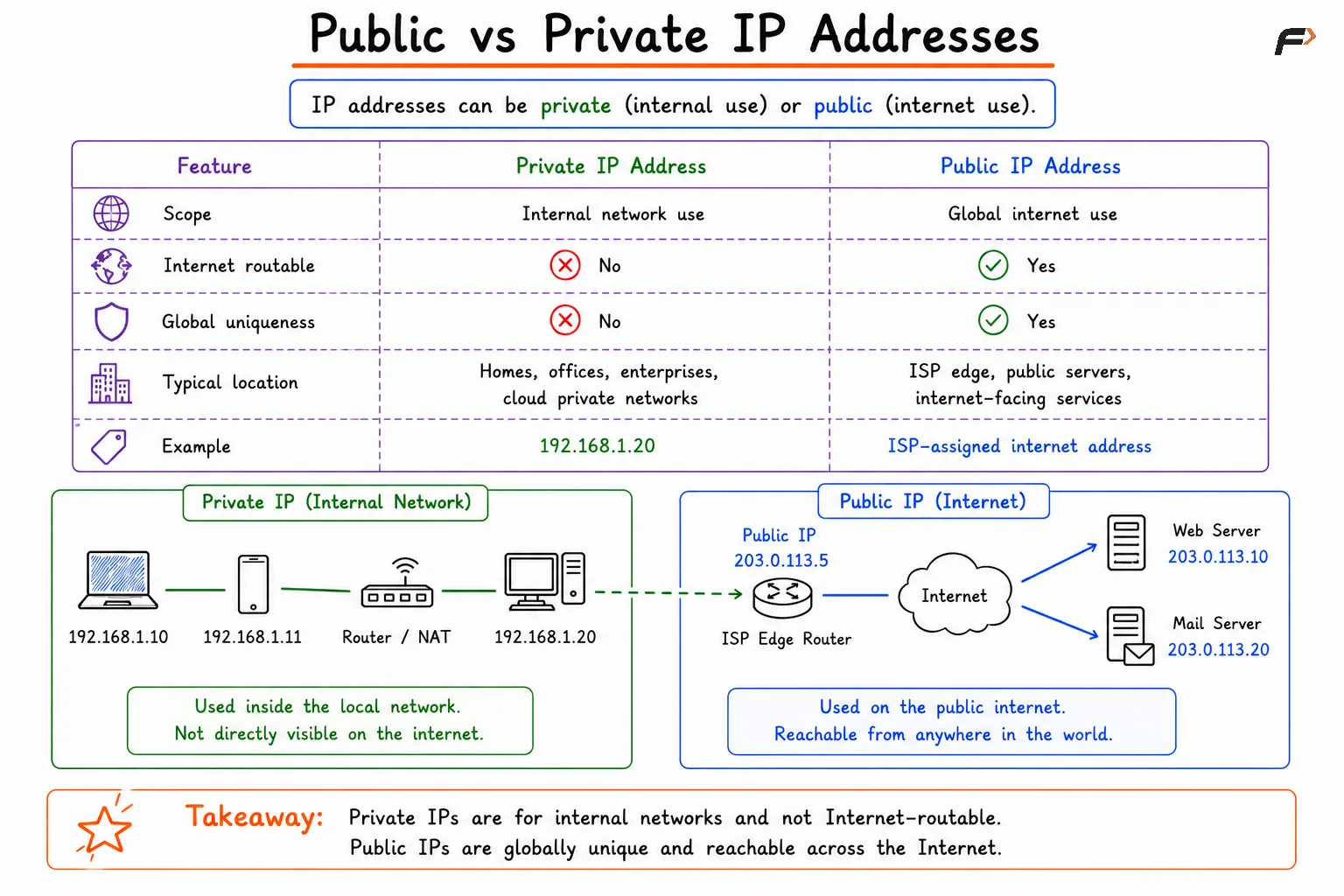
Public IP vs Private IP
How NAT Connects Private and Public Networks
NAT allows internal devices using private IP addresses to communicate with public internet services. A home router is the easiest example.
Inside the home network, devices may look like this:
Laptop: 192.168.1.20
Phone: 192.168.1.21
Smart TV: 192.168.1.22
The router itself receives a public IP address from the ISP. When one of the internal devices sends traffic outward, the router translates the private source IP into its public IP.
This process allows many private devices to share one public IP address.
Summary
Public and private IP addresses serve different roles in IPv4 networking. Private IP addresses are reserved for internal network use and are not routable on the public internet, while public IP addresses are globally unique and used for internet-facing communication.
This distinction is important because IPv4 address space is limited. Private addressing helps conserve public IPv4 addresses, and NAT bridges the gap by translating private internal traffic into public internet traffic. Together, public IPs, private IPs, and NAT make modern home networks, enterprise LANs, and cloud environments practical at scale.
Be the first to add a comment.