Introduction
Packet switching is the fundamental communication technique used in modern computer networks, especially on the Internet. Instead of creating one fixed path and reserving it fully for a single user, packet switching divides data into smaller pieces called packets and sends them through the network as needed.
This approach makes network communication far more efficient. It allows many users, applications, and services to share the same network infrastructure without needing dedicated communication paths all the time.
What Is Packet Switching?
Packet switching is a communication method in which data is divided into smaller units called packets, and each packet is forwarded independently through the network.
A packet usually contains:
Payload: The actual data being carried
Source information: Where the packet came from
Destination information: Where the packet should go
Protocol headers: Extra control information needed for forwarding and delivery
Once all packets reach the destination, the original data is reconstructed.
Why Packet Switching Is Needed
Modern network traffic is not continuous. Users do not keep using bandwidth in a perfectly steady way. Instead, communication happens in bursts.
For example, a user may:
Open a webpage
Send a message
Watch a video
Refresh an app
Upload a file
Make an API request
If the network reserved a full communication path for every user all the time, a lot of bandwidth would stay unused during idle periods. Packet switching solves this problem by using network capacity only when data actually needs to be transmitted.
That is why packet switching is efficient, scalable, and suitable for the Internet.
How Packet Switching Works
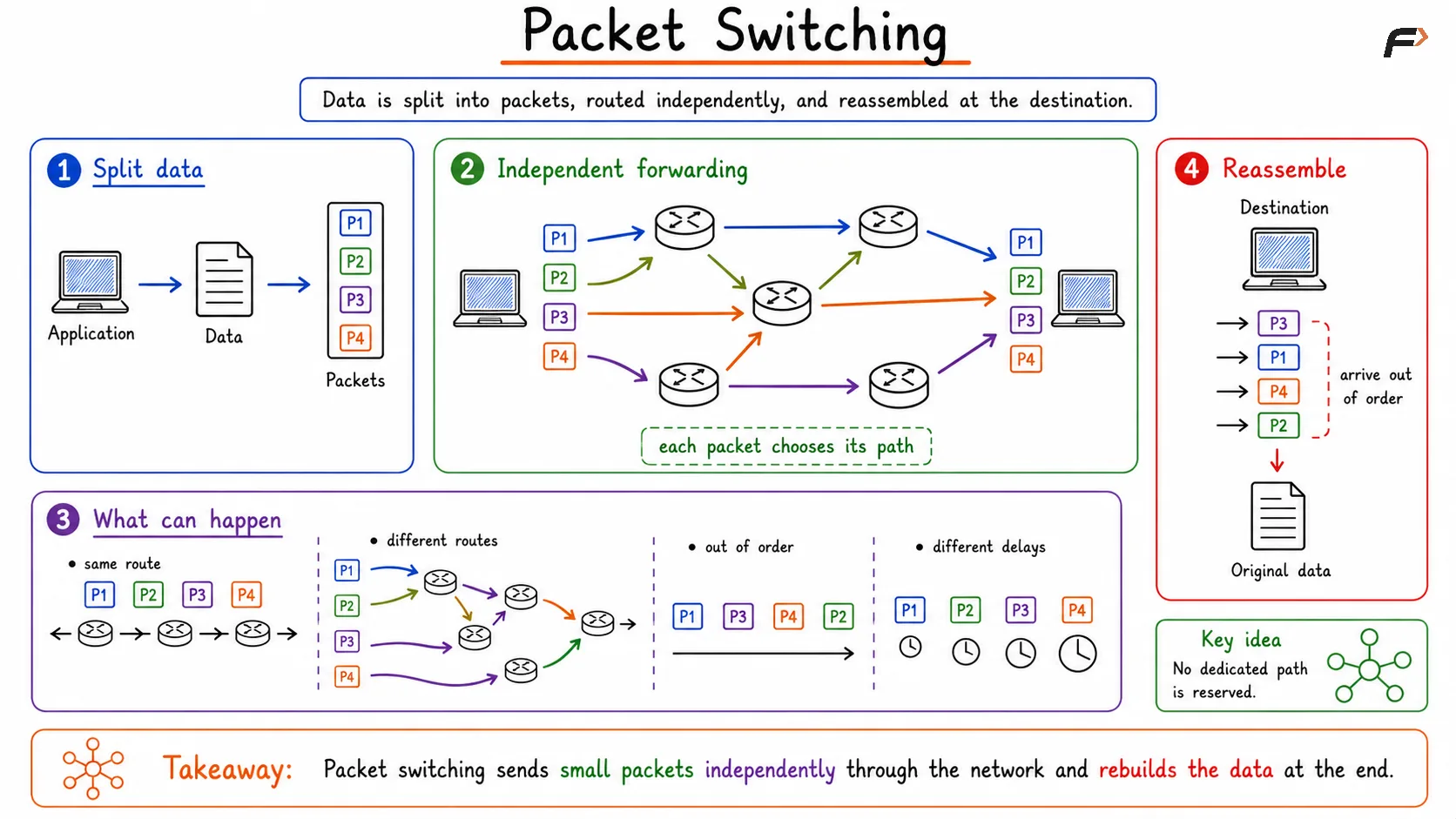
The process begins when an application creates data. That data is then split into packets before being sent into the network.
A simple flow looks like this:
The application creates the data.
The data is divided into smaller packets.
The packets enter the network.
Routers forward the packets hop by hop toward the destination.
The packets reach the destination.
The destination reassembles the packets into the original data.
Each packet is treated as an independent unit during forwarding.
Packet Switching
Independent Packet Forwarding
A packet-switched network does not require all packets to follow the same route. Every packet can be forwarded independently based on current network conditions and routing information.
That means:
Packets may follow the same route
Packets may follow different routes
Packets may arrive out of order
Packets may experience different delays
This flexibility is one of the biggest differences between packet switching and circuit switching.
Router’s Role in Packet Switching
Routers are responsible for forwarding packets from one hop to the next. When a packet reaches a router, the router examines the packet header, checks the destination address, and decides where the packet should go next.
In simple terms, the router does this:
Receives the packet
Reads the destination address
Checks forwarding or routing information
Selects the next outgoing interface
Sends the packet onward
This process repeats until the packet reaches the destination network.
Statistical Multiplexing
Packet switching works efficiently because of statistical multiplexing. This means the network shares its available bandwidth dynamically among many users depending on actual demand.
The network does not permanently dedicate a whole link to one communication. Instead, packets use the link only when they are ready to be sent.
This allows:
Better bandwidth utilization
Support for many simultaneous users
Efficient handling of bursty traffic
More practical large-scale communication
Statistical multiplexing is one of the strongest reasons packet switching became the foundation of modern networking.7
Packet Delay and Congestion
Packets do not always move through the network instantly. They can experience different types of delay:
Processing delay: Time taken by routers to examine and handle the packet
Queuing delay: Time spent waiting in a buffer before transmission
Transmission delay: Time needed to place the packet bits onto the link
Propagation delay: Time needed for the signal to travel through the medium
If too many packets arrive at a router at once, the router may not be able to process or store all of them immediately. This creates congestion.
When congestion becomes severe and buffers fill up, some packets may be dropped. This leads to packet loss.
Reliability in Packet Switching
Packet switching by itself does not guarantee:
Packet delivery
Correct ordering
No duplication
Fixed delay
Its main job is forwarding. Reliability is usually handled by higher-layer protocols.
For example, TCP provides:
Retransmission
Ordering
Flow control
Congestion control
So packet switching is responsible for moving packets, while protocols like TCP help make communication reliable when needed.
Types of Packet Switching
Packet switching is commonly discussed in two forms.
Type | Meaning |
|---|---|
Datagram Packet Switching | Each packet is routed independently and may take different paths |
Virtual Circuit Packet Switching | A logical route is chosen first, and packets usually follow that same path |
The modern Internet mainly follows the datagram packet switching model.
Advantages of Packet Switching
Packet switching became the dominant network communication technique because it offers several major benefits:
Efficient use of bandwidth: Capacity is used only when data exists
Supports many users: Shared links can carry traffic for multiple systems
Scalable design: Suitable for very large networks
Flexible routing: Packets can move through different available paths
Good fit for bursty traffic: Ideal for modern internet communication
These advantages make packet switching much better suited for web traffic, cloud systems, messaging, and general Internet communication.
Summary
Packet switching is the core communication technique used in modern networks and the Internet. It works by dividing data into packets, forwarding each packet independently through a shared network, and reassembling the data at the destination.
Its biggest strength is efficiency. Instead of reserving full communication paths, packet switching allows bandwidth to be shared dynamically through statistical multiplexing. Even though packet delay, congestion, and packet loss can occur, packet switching remains the most practical and scalable foundation for modern digital communication.
Be the first to add a comment.