Introduction
The OSI Model and TCP/IP Model are fundamental networking frameworks that explain how data travels across computer networks. While the OSI model provides a detailed seven-layer conceptual structure for understanding network communication, the TCP/IP model offers a practical four-layer architecture used by the Internet. Understanding the differences and mapping between OSI and TCP/IP helps in learning network protocols, packet transmission, troubleshooting, routing, transport services, and modern Internet communication.
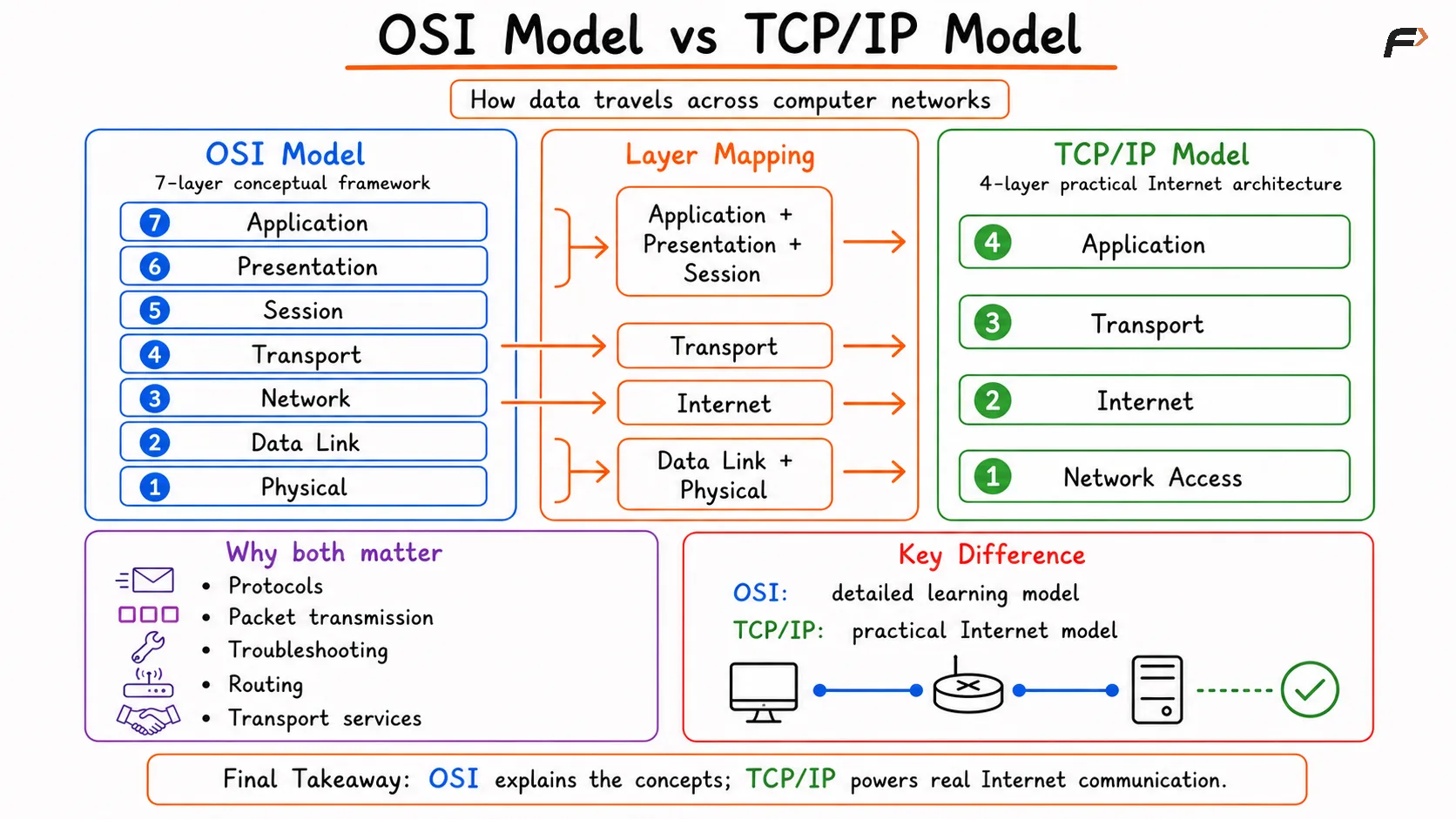
Side-by-side comparison of the OSI and TCP/IP models, showing how the seven OSI layers map to the four TCP/IP layers, along with their key differences and roles in network communication.
Comparison
Feature | OSI Model | TCP/IP Model |
|---|---|---|
Full Form | Open Systems Interconnection Model | Transmission Control Protocol / Internet Protocol Model |
Purpose | Reference model for understanding network communication | Practical model used for Internet communication |
Number of Layers | 7 Layers | 4 Layers |
Developed By | ISO (International Organization for Standardization) | DARPA |
Usage | Mainly used for learning, design, and troubleshooting | Used in real-world networking and the Internet |
Protocol Dependency | Protocol-independent reference model | Built around TCP/IP protocol suite |
Complexity | More detailed and granular | Simpler and more practical |
Be the first to add a comment.