Introduction
Switching is one of the most important ideas in computer networking. In a local network, many devices need to communicate at the same time, but the network should send data only where it is actually needed. That is the problem switching solves.
A switch connects multiple devices in a LAN and forwards data toward the correct destination instead of sending the same data everywhere. This makes communication faster, cleaner, and more efficient.
What Is Switching?
Switching is the process of receiving data on one port and forwarding it only to the appropriate port based on the destination information. In Ethernet networks, this forwarding decision is mainly based on the MAC address.
In simple terms, a switch works like an intelligent traffic controller inside a local network. It checks where the frame should go and sends it only in that direction.
A switch is therefore different from a simple shared communication device. It does not blindly repeat every frame to all connected devices in normal operation.
Why Switching Is Needed
If there were no switching, every device that wanted to communicate with another device would need a separate direct connection. As the number of devices increases, this quickly becomes difficult, expensive, and almost impossible to manage.
For example, in a network with many devices:
Direct device-to-device connections: Wiring becomes too complex
Shared communication without intelligent forwarding: Every device may receive traffic not meant for it
Network growth: Adding more devices becomes harder
Switching solves this by allowing all devices to connect to one central switch while still keeping communication efficient. So the need for switching is not only about speed. It is also about making multi-device networking practical at all.
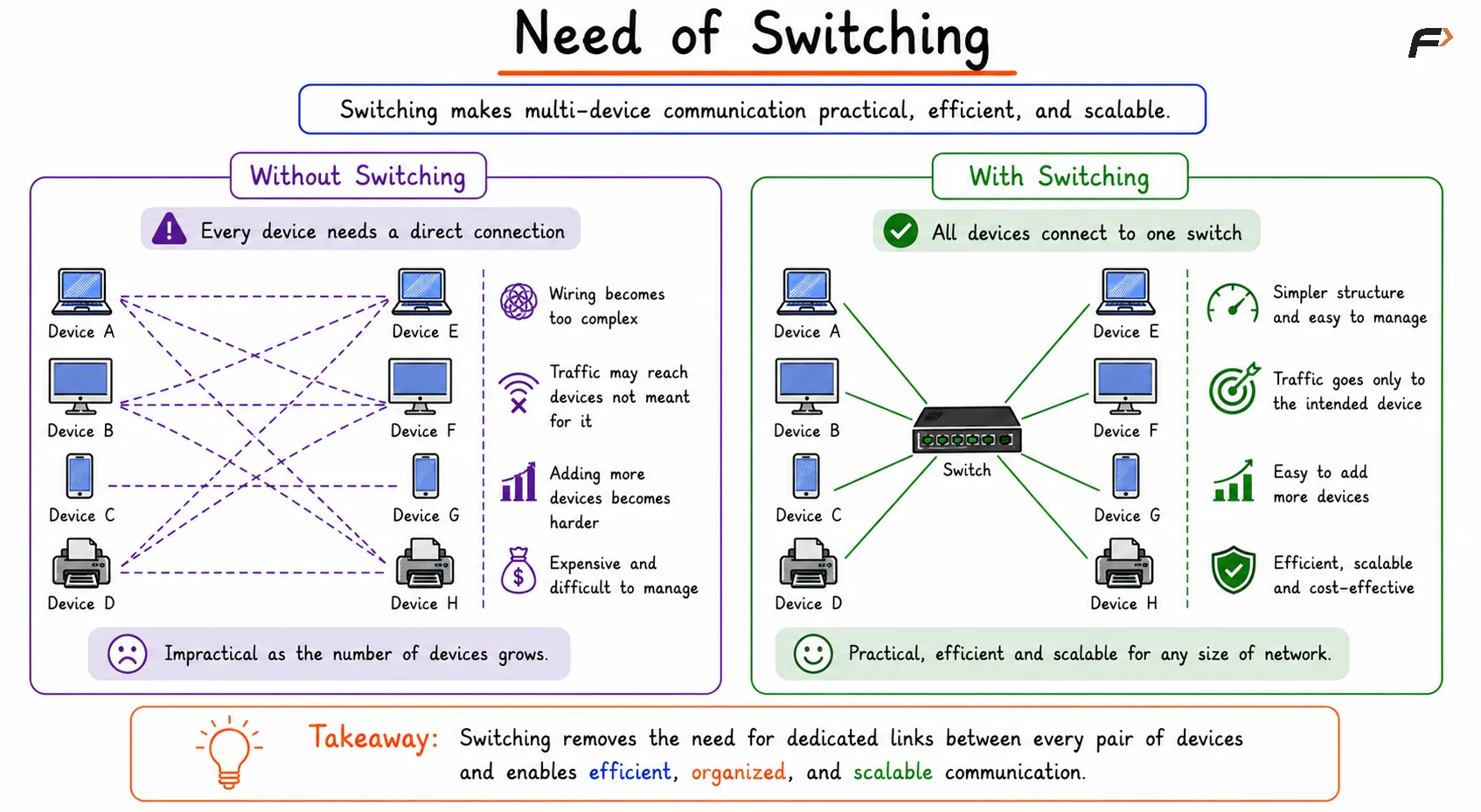
Need of Switching
How Switching Works
When a frame enters a switch, the switch reads the destination MAC address in that frame. It then checks its internal MAC address table, which stores mappings between MAC addresses and switch ports.
The basic working is:
A frame arrives on a switch port
The switch reads the source MAC address and learns which port that device is on
The switch checks the destination MAC address
If the destination is known, the frame is forwarded only to that port
If the destination is unknown, the frame may be flooded to other relevant ports
Over time, the switch learns where devices are connected and becomes more efficient in forwarding traffic.
MAC Address Table
The MAC address table is one of the key reasons switching works so well. It helps the switch remember which device is connected to which port.
For example:
Device A with one MAC address may be connected on port 1
Device B may be connected on port 4
When traffic for Device B arrives, the switch sends it only to port 4
This learning-based forwarding makes switching much smarter than older shared-network approaches.
Switching vs Hub
A very simple way to understand the need for switching is to compare a switch with a hub.
Aspect | Hub | Switch |
|---|---|---|
Traffic forwarding | Sends data to all ports | Sends data only to the correct port when known |
Efficiency | Low | High |
Collision handling | Shared collision environment | Separate collision domain per port |
Performance | Lower | Better |
Intelligence | Very limited | Learns MAC addresses and forwards accordingly |
This comparison shows why switches replaced hubs in most real networks.
Benefits of Switching
Switching provides several practical benefits in local area networks:
Better bandwidth use: Traffic stays more focused
Improved scalability: More devices can be connected efficiently
Faster communication: Frames reach the intended device more directly
Cleaner network behavior: Less unnecessary traffic across the LAN
Foundation for modern Ethernet networks: Most wired LANs depend on switching
Because of these benefits, switches are now standard in homes, offices, campuses, and data centers.
Summary
Switching is the process of forwarding data inside a network toward the correct destination instead of sending it everywhere. In Ethernet LANs, switches use MAC addresses and MAC address tables to decide where frames should go.
Switching is needed because it improves efficiency, reduces unnecessary traffic, supports multiple devices, and delivers much better performance than older shared-network designs. In simple terms, switching makes local network communication organized, intelligent, and practical.
Be the first to add a comment.