Introduction
Network devices are specialized hardware components that enable communication between computers and other networked systems. They help transmit, receive, manage, secure, and route data across local and wide-area networks. Each device performs a specific function within the network and operates at different layers of the OSI or TCP/IP model.
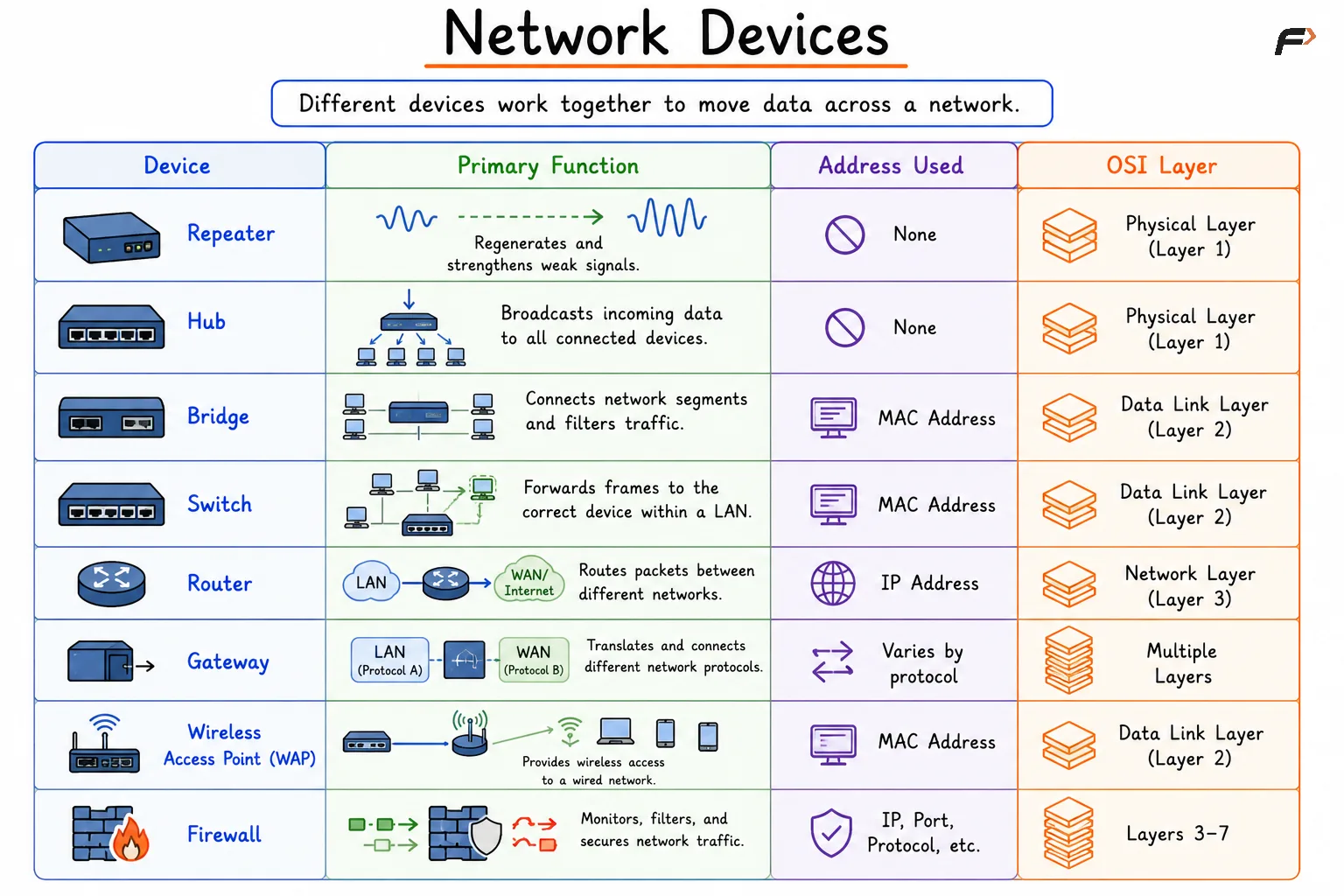
Network Devices
Repeater
A repeater is a networking device used to regenerate and strengthen weak signals. As signals travel over long distances, they gradually lose strength due to attenuation. A repeater receives the weakened signal, restores it to its original form, and retransmits it.
Repeaters are primarily used to extend the transmission distance of a network. They do not inspect, filter, or modify data; their sole purpose is to improve signal strength and allow communication over longer distances.
Hub
A hub is a basic networking device used to connect multiple devices within a local area network (LAN). When a hub receives data from one device, it simply broadcasts that data to all connected devices without examining the destination.
Because every device receives every transmission, hubs are inefficient and can create unnecessary network traffic. Modern networks have largely replaced hubs with switches due to better performance and reduced collisions.
Bridge
A bridge is a device used to connect and divide network segments. Unlike a hub, a bridge examines MAC addresses and forwards traffic only when necessary, helping reduce unnecessary network communication.
By separating large networks into smaller segments, bridges help reduce collisions and improve overall network efficiency. Bridges can be considered an early form of intelligent traffic management within LAN environments.
Switch
A switch is one of the most commonly used devices in modern local area networks. It connects multiple devices and forwards data based on MAC addresses rather than broadcasting traffic to every connected device.
When a switch receives a frame, it consults its MAC address table and forwards the frame only to the intended destination port. This significantly improves performance, reduces collisions, and allows multiple devices to communicate simultaneously.
Router
A router is a networking device responsible for connecting different networks and forwarding packets between them. It operates using IP addresses and determines the best path for data to travel from the source network to the destination network.
Routers are essential for Internet communication because they enable packets to move across multiple interconnected networks. Home routers, enterprise routers, and ISP routers all perform routing functions to ensure data reaches its intended destination.
Gateway
A gateway acts as a bridge between networks that use different protocols, architectures, or communication methods. It enables communication between otherwise incompatible systems by translating data from one format to another.
In many networks, the router that provides access to external networks is often referred to as the default gateway. More broadly, gateways are used whenever protocol conversion or interoperability between different systems is required.
Wireless Access Point (WAP)
A Wireless Access Point (WAP) allows wireless devices to connect to a wired network using Wi-Fi technology. It acts as a central communication point for wireless clients such as smartphones, laptops, tablets, and IoT devices.
Access points extend network connectivity by providing wireless coverage while still connecting to the underlying wired infrastructure. They are commonly used in homes, offices, campuses, and public Wi-Fi deployments.
Firewall
A firewall is a security device that monitors and controls network traffic based on predefined security rules. It examines incoming and outgoing traffic and determines whether communication should be allowed or blocked.
Firewalls play a critical role in network security by preventing unauthorized access, filtering malicious traffic, and enforcing organizational security policies. They can be implemented as dedicated hardware devices, software applications, or integrated network appliances.
Summary Table
Device | Primary Function | Address Used | OSI Layer |
|---|---|---|---|
Repeater | Regenerates and strengthens weak signals. | None | Physical Layer (Layer 1) |
Hub | Broadcasts incoming data to all connected devices. | None | Physical Layer (Layer 1) |
Bridge | Connects network segments and filters traffic. | MAC Address | Data Link Layer (Layer 2) |
Switch | Forwards frames to the correct device within a LAN. | MAC Address | Data Link Layer (Layer 2) |
Router | Routes packets between different networks. | IP Address | Network Layer (Layer 3) |
Gateway | Translates and connects different network protocols. | Varies by protocol | Multiple Layers |
Wireless Access Point (WAP) | Provides wireless access to a wired network. | MAC Address | Data Link Layer (Layer 2) |
Firewall | Monitors, filters, and secures network traffic. | IP, Port, Protocol, etc. | Layers 3–7 |
Be the first to add a comment.