Introduction
Network congestion happens when more traffic enters a network path than the path can handle smoothly. Packets may still be moving, but they begin waiting inside routers, switches, firewalls, load balancers, or other network devices.
At first, congestion appears as delay. If traffic keeps increasing, buffers fill up and packet loss begins. In TCP-based communication, packet loss can trigger retransmissions, and if this behavior is not controlled properly, the network may enter a congestion collapse loop.
What Is Network Congestion?
Network congestion occurs when traffic demand becomes greater than available network capacity. In simple terms, packets arrive faster than they can be processed or forwarded.
For example, suppose a router can forward traffic at 100 Mbps, but incoming traffic reaches 180 Mbps. The router cannot immediately send out every packet, so it stores extra packets in a queue. These packets wait until the outgoing link becomes available.
This waiting time increases latency. If the queue becomes full, new packets are dropped.
Common effects of congestion include:
Higher latency: Packets spend more time waiting inside queues.
More jitter: Packet delay becomes irregular, which affects calls, gaming, and streaming.
Packet loss: Full buffers force devices to drop packets.
Lower throughput: Useful delivered data decreases during heavy congestion.
TCP slowdown: TCP reduces its sending rate when it detects packet loss.
Packet Loss During Congestion
Routers and other network devices use buffers to temporarily store packets. These buffers are useful because traffic often arrives in bursts. A small queue gives the device time to handle short traffic spikes without dropping packets immediately.
However, buffers are limited. When the buffer becomes full, newly arriving packets cannot be stored, so they are discarded. This is packet loss.
TCP and UDP behave differently during packet loss:
Protocol | Packet Loss Handling |
|---|---|
TCP | Detects loss, retransmits missing packets, and reduces sending speed |
UDP | Does not automatically retransmit or slow down; the application must handle loss |
TCP treats packet loss as a possible sign of congestion. This is why TCP retransmits lost data but also slows down, giving the network time to recover.
What Is Bufferbloat?
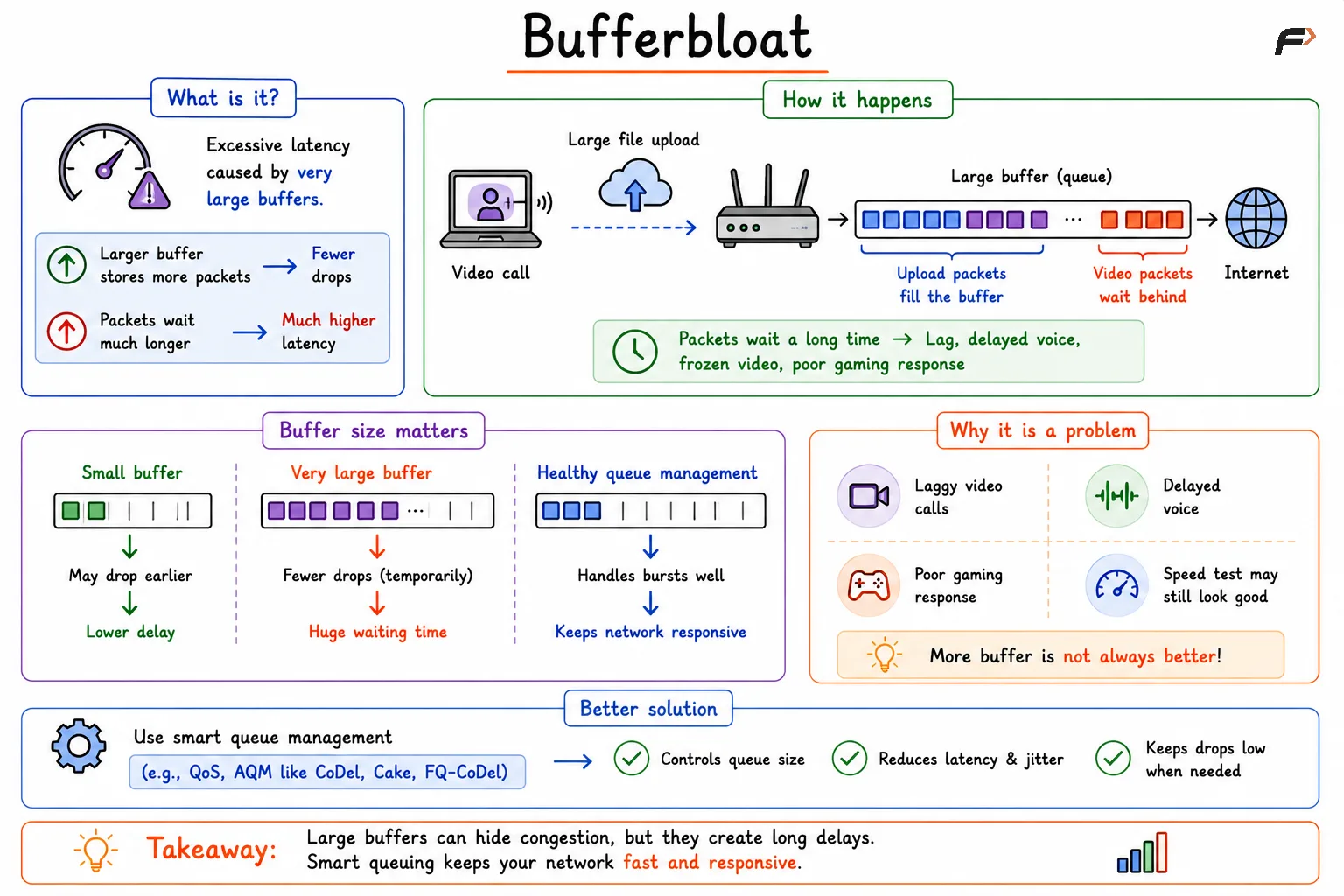
Bufferbloat is excessive latency caused by very large buffers. At first, increasing buffer size may seem helpful because larger buffers can store more packets and reduce packet drops.
The problem is that packets now wait much longer before being forwarded. So packet loss may reduce, but latency becomes much worse.
For example, during a video call, someone starts uploading a large file. Upload packets begin filling the router’s buffer. If the buffer is too large, video packets may sit behind many upload packets before they get forwarded.
The result is lag, delayed voice, frozen video, or poor gaming response, even though the connection may still show good bandwidth in a speed test.
Key idea:
Small buffer: May drop packets earlier but keeps delay lower.
Very large buffer: May reduce drops temporarily but can create huge waiting time.
Healthy queue management: Keeps the network responsive while still handling bursts.
More buffer is not always better. A large buffer can hide congestion for some time, but it often makes latency and jitter much worse.
Bufferbloat
Congestion Collapse Loop
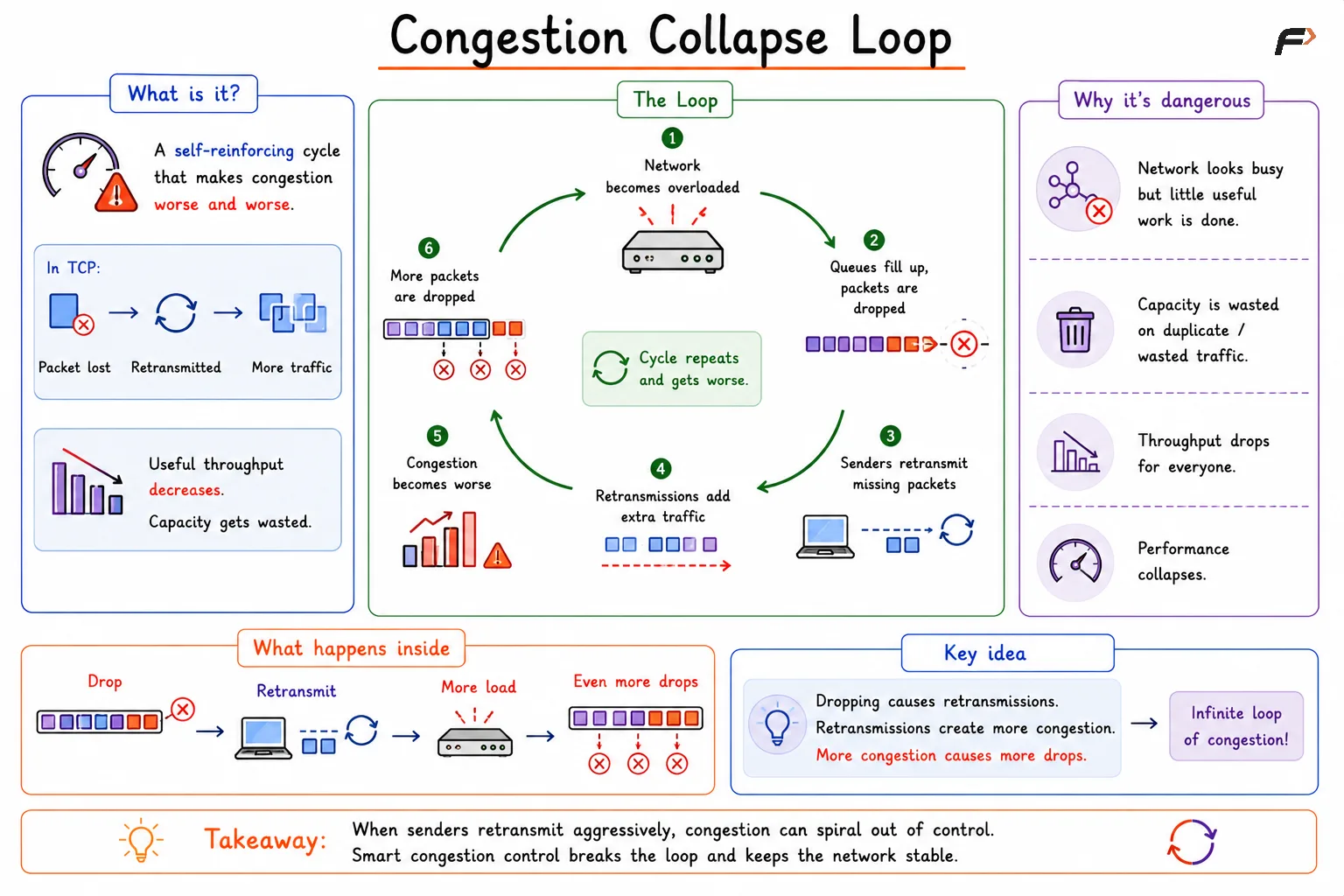
A congestion collapse loop begins when a network is overloaded and packets start getting dropped. In TCP communication, lost packets are retransmitted. But retransmissions add more traffic to the same congested network.
If many senders keep retransmitting aggressively, the network carries more and more duplicate or wasted traffic. Useful throughput decreases because capacity is being consumed by packets that may again be delayed, dropped, or retransmitted.
The loop can be understood like this:
The network becomes overloaded.
Queues fill and packets are dropped.
Senders retransmit missing packets.
Retransmissions add extra traffic.
Congestion becomes worse.
More packets are dropped.
The cycle repeats.
This is dangerous because the network may appear busy, but much of the traffic is not useful progress. The network capacity gets wasted on retransmissions instead of successful data delivery.
Congestion Collapse Loop
Congestion vs Bufferbloat vs Congestion Collapse
These three ideas are related, but they are not the same.
Concept | Meaning | Main Effect |
|---|---|---|
Congestion | Traffic demand exceeds network capacity | Delay, queues, packet loss |
Bufferbloat | Buffers become too large and hold packets for too long | High latency and jitter |
Congestion collapse loop | Packet drops cause retransmissions that add more traffic | Wasted capacity and falling throughput |
Why Congestion Control Matters
Congestion control prevents senders from blindly pushing more traffic into an already overloaded network. When signs of congestion appear, TCP reduces its sending rate and later increases it carefully as the network recovers.
Without congestion control, every sender may continue transmitting aggressively. That would increase packet loss, trigger more retransmissions, and push the network closer to congestion collapse.
Congestion control helps maintain:
Stability: The network gets time to recover from overload.
Fairness: Multiple users can share capacity more reasonably.
Lower packet loss: Senders reduce pressure when congestion appears.
Better useful throughput: More capacity is used for successful delivery instead of repeated retransmissions.
Summary
Network congestion occurs when packets arrive faster than the network can forward them. It first causes queues and higher latency, then may lead to packet loss when buffers become full.
Bufferbloat happens when large buffers hold too many packets for too long, creating high latency and jitter even when packet loss is reduced. Congestion collapse loops occur when packet drops trigger retransmissions, which add more traffic to an already overloaded network. Congestion control is essential because it slows senders down before overload turns into a self-worsening cycle.
Be the first to add a comment.