Introduction
NAT is useful, practical, and extremely common in IPv4 networks. It helps conserve public IP addresses and allows private devices to access public networks.
However, NAT is not perfect. It changes packet address information, and that can make some applications, protocols, and troubleshooting tasks more difficult.
Benefits of NAT
NAT became popular because it solves several practical problems at once.
Conserves public IPv4 addresses: Many hosts can share one public IP.
Supports private addressing: Internal design stays flexible.
Simplifies ISP changes: Internal devices do not need renumbering in many cases.
Adds a basic exposure barrier: External systems usually cannot directly open sessions to internal hosts unless rules exist.
That last point is helpful, but it should not be confused with a full security design. NAT is not a replacement for a firewall, access control, or proper service hardening.
Limitations of NAT
NAT is useful, but it also introduces important limitations.
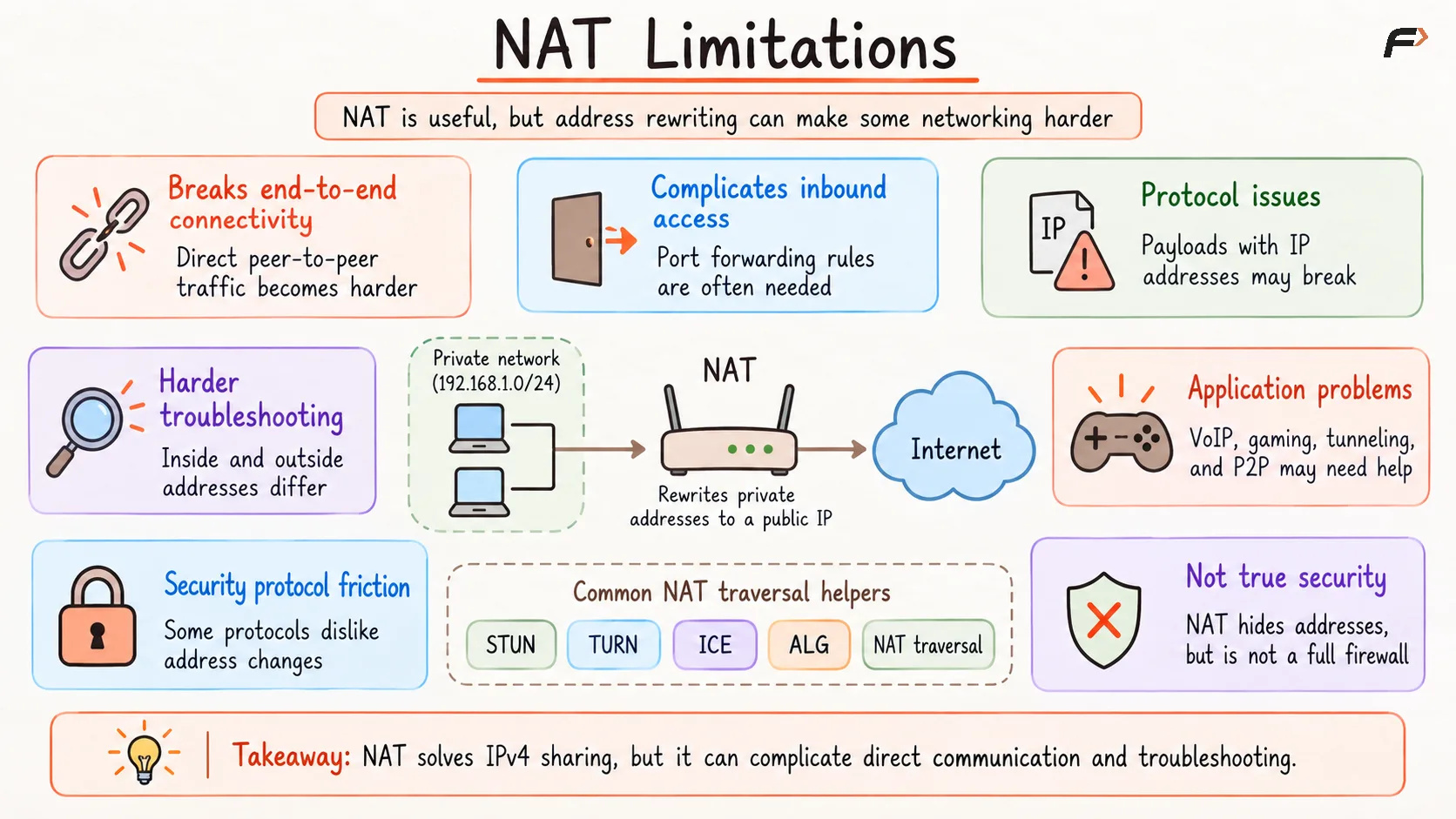
Breaks end-to-end connectivity: Direct peer-to-peer communication becomes harder.
Complicates inbound access: Extra rules such as port forwarding are often needed.
Causes issues for some protocols: Protocols that embed IP addresses in payloads may break unless special handling exists.
Makes troubleshooting harder: Packet addresses seen inside and outside are different.
Creates problems for some applications: VoIP, gaming, tunneling, and peer-to-peer traffic may need NAT traversal techniques.
Can interfere with security protocols: Some protocols do not work cleanly when addresses are modified in transit.
Is not true security: NAT hides addresses, but it does not by itself provide full protection.
This is why technologies such as STUN, TURN, ICE, ALGs, and NAT traversal mechanisms are often discussed in modern application networking.
Nat Limitations
Be the first to add a comment.