Introduction
NAT or Network Address Translation, is one of the most widely used ideas in computer networks. It is usually performed by a router or firewall that sits between a private network and another network, such as the internet.
The main job of NAT is to translate IP address information as packets move across a network boundary. This translation allows devices using private IP addresses to communicate with public networks.
NAT became especially important because IPv4 public addresses are limited. Without NAT, giving every laptop, phone, camera, printer, and server its own public IPv4 address would be difficult and wasteful.
What Is NAT?
NAT is the process of changing one IP address into another while a packet is in transit. In many real networks, this means replacing a private source IP address with a public IP address before the packet is sent to the internet.
A home router is the most familiar example. Devices inside the home may use private IP addresses such as 192.168.1.10, 192.168.1.20, or 10.0.0.15. These addresses are valid inside the local network, but they are not directly routable on the public internet.
When one of these devices opens a website, the router translates the private source address into the router's public IP address. To the internet, the traffic appears to come from the router.
In simple terms, NAT acts as a translation layer between an internal private network and an external public network.
## Private and Public IP Addresses
To understand NAT clearly, it helps to separate private IP addresses from public IP addresses.
Private IP addresses are used inside local networks. Common private IPv4 ranges include:
10.0.0.0/8172.16.0.0/12192.168.0.0/16
These addresses can be reused in many homes, offices, labs, and organizations. A device with a private IP address cannot normally be reached directly from the internet.
Public IP addresses are globally routable. They are used on the internet and must be unique at the global level.
NAT connects these two worlds by allowing private-addressed devices to access public networks through one or more public IP addresses.
Why NAT Is Needed
NAT is needed mainly because public IPv4 addresses are limited. The number of devices connected to networks has grown far beyond what early IPv4 planning expected.
Some key reasons NAT is used are:
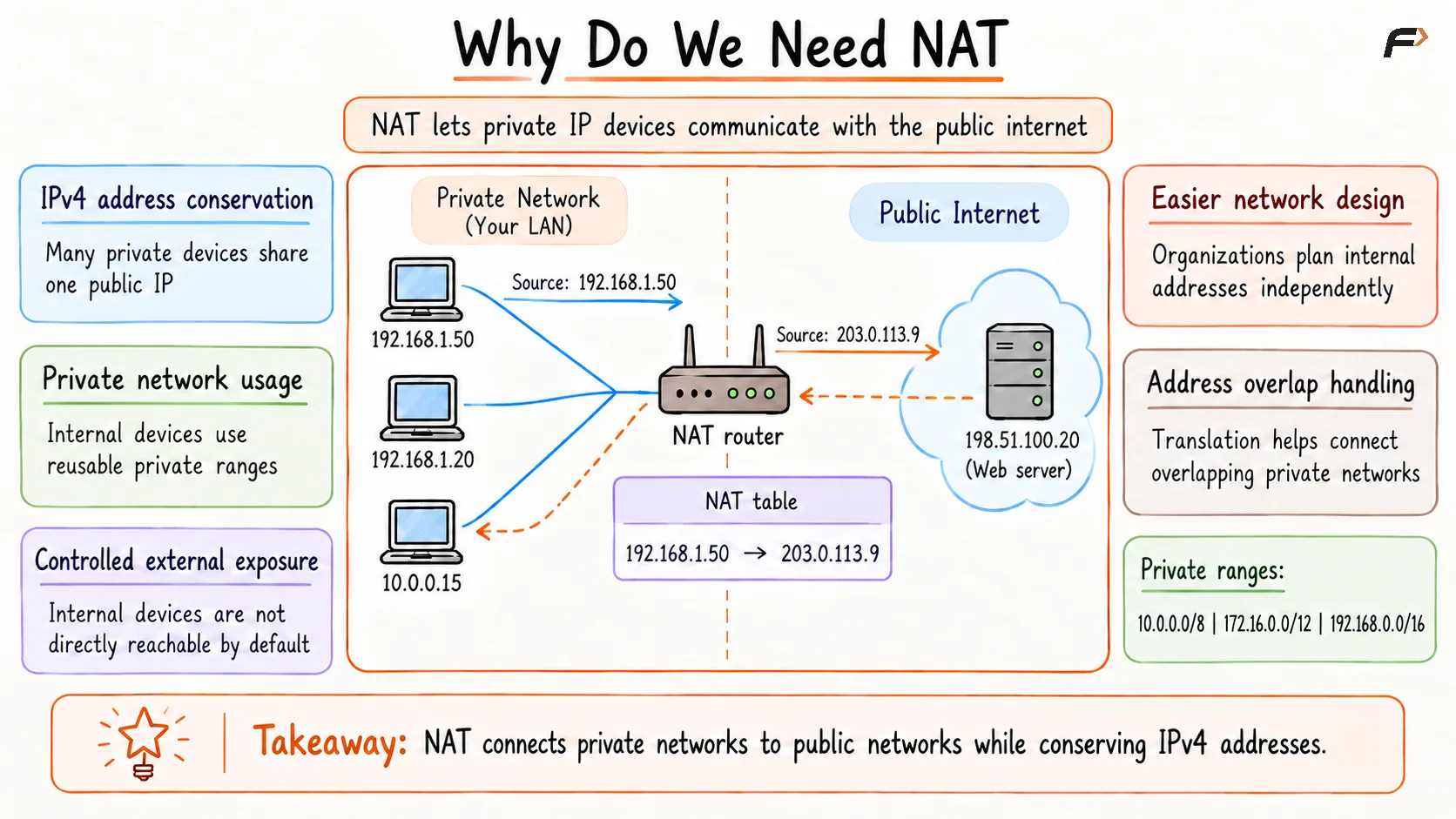
IPv4 address conservation: Many private devices can share one public IPv4 address.
Private network usage: Internal systems can use private address ranges without needing public addresses.
Controlled external exposure: Internal devices are not directly reachable from the internet by default.
Easier internal network design: Organizations can design internal addressing independently from public addressing.
Address overlap handling: Some networks with overlapping private ranges can still be connected using translation techniques.
The biggest practical reason is simple. NAT helps many devices access the internet even when only one or a small number of public IP addresses are available.
A Simple NAT Example
Consider a laptop inside a home network:
Laptop private IP:
192.168.1.50Router public IP:
203.0.113.9Website IP:
198.51.100.20
When the laptop sends a request to the website, the packet starts with source IP 192.168.1.50. Before forwarding it to the internet, the router changes the source IP to 203.0.113.9. The website sends the reply back to 203.0.113.9. The router checks its translation table and forwards the reply to the original laptop at 192.168.1.50.
This is the basic idea behind most home and office internet access.
Why do we need NAT
Benefits of NAT
NAT became popular because it solves several practical networking problems.
It conserves public IPv4 addresses by allowing many hosts to share one public IP. It also lets internal devices use private address ranges, which makes local network planning easier.
NAT can also reduce direct exposure from the internet. In a typical home or office setup, outside systems cannot directly start connections to internal devices unless a specific forwarding rule exists.
However, NAT should not be treated as a complete security solution. It can reduce exposure, but a proper firewall, access control, patching, and service hardening are still required.
Conclusion
NAT is needed because it allows private networks to communicate with public networks while conserving limited IPv4 addresses. It translates packet address information at a router or firewall so that many internal devices can share one or more public IP addresses.
In most real networks, NAT is the reason phones, laptops, and servers with private IP addresses can still access the internet. It is practical, widely used, and important for understanding how modern IPv4 networks operate.
Next, the natural step is to understand NAT packet flow and how a NAT table maps outgoing requests and incoming replies.
Be the first to add a comment.