Introduction
MPLS, or Multiprotocol Label Switching, is a forwarding technology used to move packets more efficiently through a network. It is widely used in service provider backbones and large enterprise networks where traffic needs to be forwarded in a controlled and predictable way.
The simplest idea behind MPLS is that routers inside the network do not repeatedly make full IP routing decisions for every packet. Instead, packets are given labels, and those labels guide them through a predefined logical path.
What Is MPLS?
MPLS is a technique in which packets are forwarded using labels instead of relying only on destination IP lookups at every hop. A short label is attached to the packet when it enters the MPLS network, and routers inside that network use the label to decide where the packet should go next.
So MPLS is still a packet-switched technology. The data continues to move as packets, but forwarding becomes more structured.
In simple terms:
A packet enters the MPLS network
A label is attached to it
Routers forward it using label information
The label may change at each hop
The label is removed before the packet leaves the MPLS network
Why MPLS Is Needed
Traditional IP forwarding works well, but every router has to examine the destination IP address and search its routing table before sending the packet onward. In very large networks, this repeated decision-making becomes more demanding and less predictable.
MPLS was introduced to improve this situation by offering:
Faster forwarding decisions
Predictable traffic paths
Traffic engineering support
Better use of backbone infrastructure
Simpler forwarding inside provider networks
This makes MPLS especially useful where large volumes of traffic must move across controlled network paths.
MPLS - Multiprotocol Label Switching
MPLS and Virtual Circuit Packet Switching
MPLS is one of the most practical real-world examples of virtual circuit packet switching. Before traffic starts flowing, a logical path is established through the network. After that, packets follow that path using labels.
This is similar to virtual circuit packet switching because:
A logical path exists before forwarding begins
Packets follow the same planned route
Intermediate devices use label information rather than full routing lookups
The path stays consistent while traffic is being forwarded
However, MPLS is not circuit switching. It does not create a dedicated physical circuit. The underlying network is still shared.
How MPLS Works
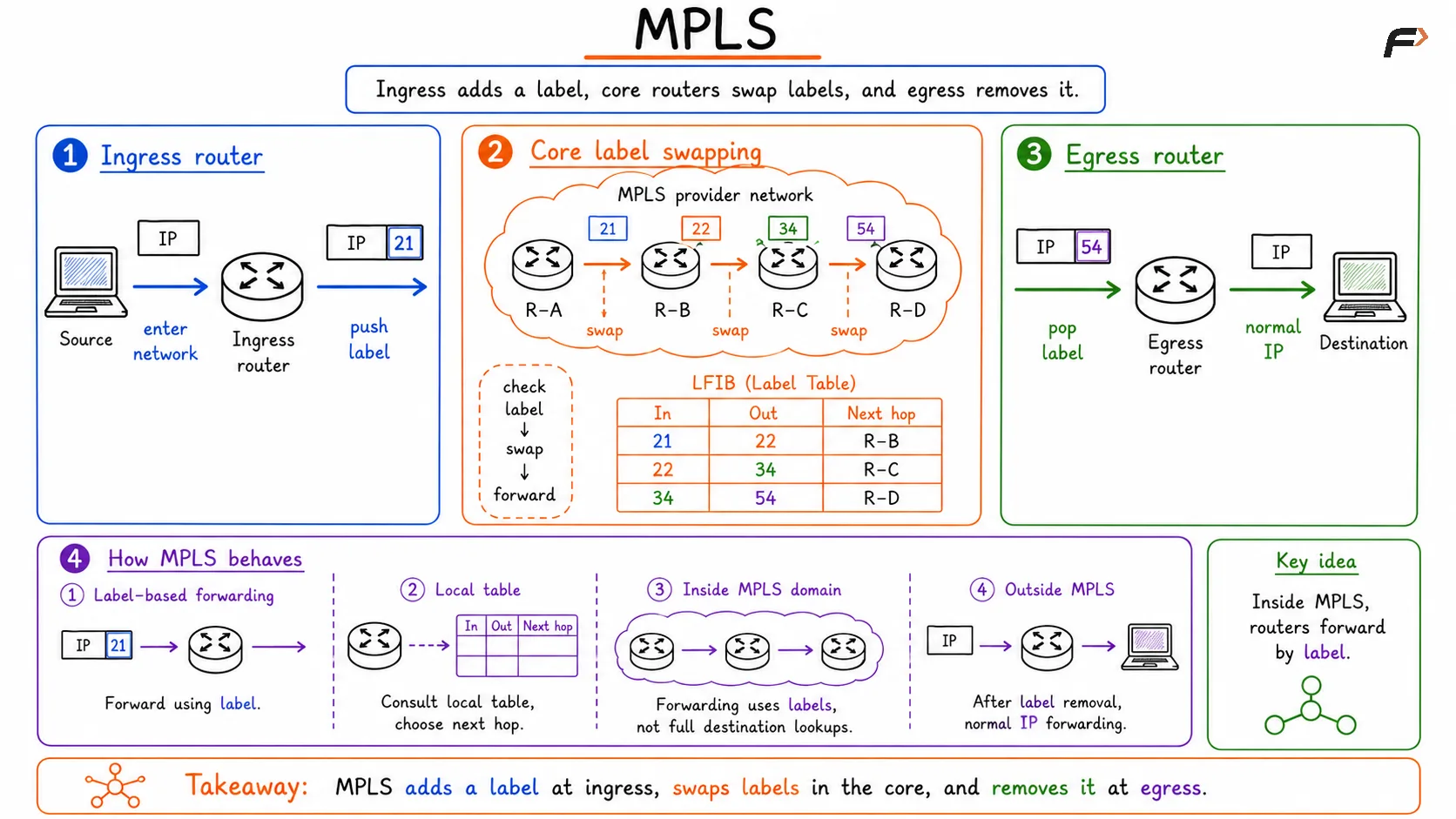
Suppose a packet enters an MPLS-enabled provider network. The first router in that MPLS network adds a label to the packet. From that point onward, the packet is forwarded based on label information.
A simple MPLS flow looks like this:
The IP packet enters the MPLS network.
The ingress router adds an MPLS label.
Core routers forward the packet by swapping labels.
The egress router removes the MPLS label.
Normal IP forwarding continues toward the destination.
This is the basic life cycle of an MPLS packet.
Main MPLS Steps
Label assignment
When a normal IP packet enters the MPLS network, the ingress router attaches a label to it. This label represents how the packet should be forwarded through the MPLS domain.
The packet is now ready for label-based forwarding.
Label-based forwarding
Every MPLS router keeps a forwarding table that maps incoming labels to outgoing labels and next hops.
Instead of asking, “Which destination IP route should I use?”, the router asks, “What should I do with this label?”
That makes forwarding simpler and more predictable inside the MPLS network.
Label swapping
One of the most important MPLS operations is label swapping. A router receives a packet with one label, checks its label forwarding table, replaces that label with another label, and forwards the packet.
For example, the forwarding behavior may look like this:
Incoming Label | Outgoing Label | Next Hop |
|---|---|---|
21 | 22 | Router B |
22 | 34 | Router C |
34 | 54 | Router D |
This means each router only needs to understand the label values relevant to its own local forwarding table.
Label removal
When the packet reaches the egress router, the MPLS label is removed. After that, the packet continues as a normal IP packet toward its final destination.
So MPLS controls forwarding inside its domain, but outside that domain, normal IP routing is used again.
Important MPLS Terms
A few MPLS terms are useful to remember:
Ingress router: The router where the packet enters the MPLS network
Egress router: The router where the packet leaves the MPLS network
Label: A short identifier used for forwarding
Label switching: The process of forwarding packets based on labels
Label-switched path (LSP): The predefined logical route followed through the MPLS network
These terms form the foundation of basic MPLS understanding.
Benefits of MPLS
MPLS became popular because it gives network operators stronger control over traffic behavior.
Predictable forwarding: Traffic can follow planned routes
Reduced forwarding complexity: Core routers use labels instead of repeated IP lookups
Traffic engineering support: Operators can influence how traffic uses available paths
QoS possibilities: Better control helps support different traffic priorities
Efficient backbone use: Providers can keep traffic inside optimized internal paths
These are major reasons MPLS is widely used in ISP and enterprise backbone environments.
Summary
MPLS is a packet-forwarding technology that uses labels to move traffic through predefined logical paths inside a network. Instead of performing full IP lookups at every router, MPLS routers forward packets using labels and label-switched paths.
This makes forwarding faster, more predictable, and more suitable for traffic engineering, QoS, and backbone optimization. MPLS is still a packet-switched technology, but it behaves like a virtual circuit in the way it guides packets through the network.
Be the first to add a comment.