Introduction
Message switching is one of the earliest switching techniques used in communication networks. Unlike packet switching, where data is divided into smaller packets, message switching treats the entire message as one complete unit and forwards it through the network step by step.
This technique is strongly associated with the idea of store-and-forward, because every intermediate node must first receive and store the full message before sending it further.
What Is Message Switching?
Message switching is a switching technique in which the complete message is transmitted as a single unit from source to destination. The message is not broken into packets during transmission.
The sender creates the full message and sends it to the first intermediate node. That node stores the full message, checks the destination information, selects the next hop, and forwards the complete message onward.
The same process continues until the message finally reaches the destination.
Why It Is Called Store-and-Forward
The defining feature of message switching is its store-and-forward behavior.
At every intermediate node, the process looks like this:
Store: Receive and keep the entire message in memory
Process: Read destination and forwarding information
Forward: Send the complete message to the next node
This repeats at every hop until delivery is complete. This is the key reason message switching introduces noticeable delay.
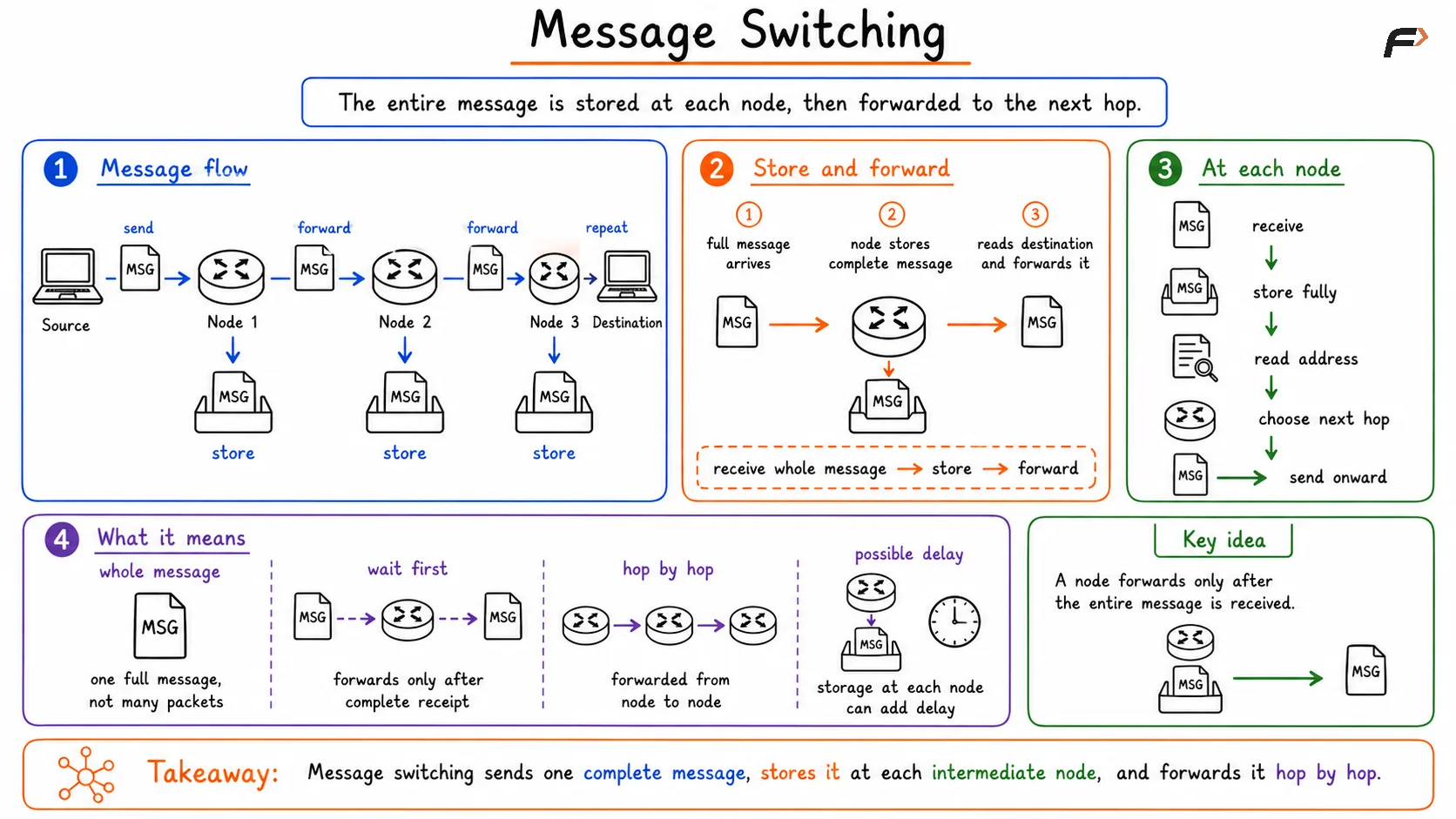
Message Switching
How Message Switching Works
Message switching can be understood in a few simple stages.
Message creation: The sender prepares the complete message
Transmission to first node: The message is sent to the next intermediate device
Storage: That node stores the entire message
Processing: The node reads the destination information
Forwarding: The node sends the full message to the next hop
Repetition: The same process continues until the message reaches the receiver
The important point is that forwarding does not begin until the entire message has been received.
Key Characteristics of Message Switching
Message switching has some clear identifying features:
Entire message as one unit: No packetization is done
No dedicated path: A fixed end-to-end path is not reserved in advance
Store-and-forward operation: Each node stores the complete message before forwarding
Hop-by-hop delivery: The message moves one node at a time
Large storage requirement: Intermediate nodes need enough memory for full messages
These characteristics make it very different from both circuit switching and packet switching.
Why Message Switching Was Useful
Message switching was developed when communication networks were slower, simpler, and less interactive than modern networks.
It was useful because:
No dedicated connection was needed
Messages could wait if the next link was busy
Communication could continue even if the path was not immediately available
The main goal was eventual delivery, not instant response
This made message switching practical for early communication environments such as telegraph and telex systems.
Disadvantages of Message Switching
Message switching also has serious limitations, which is why it is rarely used in modern computer networks.
High delay: Every node must receive the full message before forwarding
Large storage requirement: Intermediate nodes must store whole messages
Poor performance for real-time communication: Voice and video need lower delay
Blocking of smaller traffic: A large message may delay smaller urgent messages
Lower efficiency than packet switching: Modern networks perform better with smaller transferable units
These disadvantages become more serious as message size and traffic volume increase.
Message Switching vs Packet Switching
Message switching and packet switching are both based on store-and-forward ideas, but the unit being forwarded is different.
Aspect | Message Switching | Packet Switching |
|---|---|---|
Unit of transfer | Entire message | Packet |
Storage at each node | Full message must be stored | Only individual packets are stored |
Delay | Higher | Lower |
Memory requirement | Larger | Smaller |
Suitability for real-time traffic | Poor | Better |
Modern use | Mostly historical | Foundation of the Internet |
This comparison is one of the easiest ways to remember why packet switching replaced message switching.
Modern Relevance of Message Switching
Message switching is mostly of historical and conceptual importance today. It is not the main switching model used in the Internet.
Still, it remains important in networking theory because it helps explain:
Store-and-forward communication
Hop-by-hop forwarding
Why packet switching became more practical
How older communication systems worked
A modern analogy is email, where a complete message is received, stored, and then forwarded, although the underlying network today is still packet-switched.
Summary
Message switching is a store-and-forward switching technique in which the entire message is treated as one unit and forwarded from one node to another without being divided into packets. Every intermediate node must first receive and store the full message before forwarding it further.
This approach was useful in early communication systems because it did not require a dedicated path and allowed delayed forwarding. However, it also introduced high delay and large storage requirements, which made it unsuitable for modern real-time and interactive communication. That is why packet switching eventually became the dominant model in modern computer networks.
Be the first to add a comment.