Introduction
People often associate network topology with physical components such as cables, switches, and the way devices are interconnected. Although the physical layout is an important part of network design, it does not tell the whole story. A network is defined not only by its physical structure but also by the path that data takes as it travels between devices.
This communication pattern is known as logical topology. Instead of focusing on physical connections, logical topology describes how data flows through the network. In modern switched networks, the physical infrastructure may remain unchanged, while traffic behavior changes based on MAC address learning, forwarding decisions, VLAN configurations, and security policies. For this reason, understanding logical topology is essential for understanding how a network actually functions.
What Logical Topology Means
Logical topology describes how data flows through a network, how devices communicate, and how traffic is forwarded from one point to another. It does not focus on the actual arrangement of cables and devices. Instead, it focuses on behavior.
In simple terms, physical topology tells us how the network is built, while logical topology tells us how the network works during communication.
Physical topology: The real arrangement of devices, cables, switches, and links.
Logical topology: The way frames, packets, broadcasts, and communication paths behave inside the network.
This difference is very important because two networks may look physically similar but behave very differently.
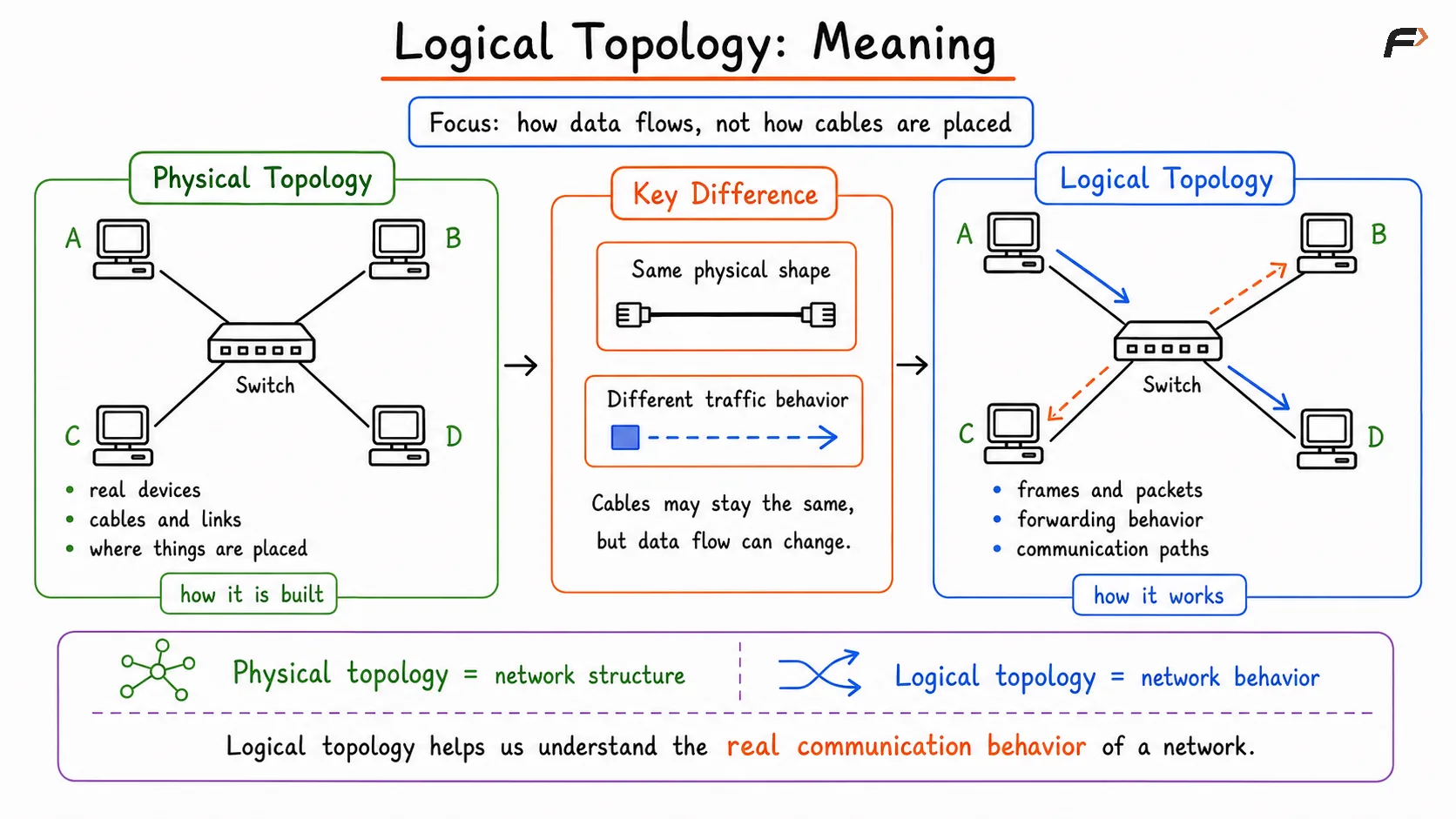
Logical Topology
Why Logical Topology Matters
In modern computer networks, traffic is not forwarded blindly. Switches learn MAC addresses, networks are divided using VLANs, routing happens between logical boundaries, and policies decide who can communicate with whom.
Because of this, the same physical infrastructure can support very different communication behavior. That is why logical topology matters in real network design, troubleshooting, segmentation, and performance understanding.
Understanding Logical Topology with a Switch
Let us take a simple example. Suppose several devices are connected to a switch in a star-shaped physical layout. From the outside, the network looks straightforward because every device connects to the same central switch.
But the logical behavior depends on what the switch knows at that moment.
First-Time Traffic Flow
If device A sends data to device D for the first time, the switch may not yet know where device D is located. If the destination MAC address is not present in the MAC address table, the switch cannot forward the frame directly to one exact port.
So the traffic behavior becomes different:
Device A sends a frame: The switch receives the traffic.
Destination is unknown: The switch checks its MAC table and does not find the required entry.
Traffic is flooded: The frame is sent out through multiple relevant ports.
Destination responds: The switch begins learning from this communication.
This forwarding behavior is part of logical topology. The cables did not change, but the traffic pattern did.
How MAC Learning Changes the Behavior
After that first communication, the switch starts building knowledge about which MAC address is reachable from which port. Once the MAC table is updated, the next transmission behaves differently.
Now the flow becomes much more direct:
MAC learning: The switch stores MAC-to-port information.
Known destination: The switch already knows where device D is connected.
Direct forwarding: The frame is sent only to the correct port.
Less unnecessary traffic: Flooding is reduced.
This is one of the clearest examples of logical topology. The physical topology remains the same, but traffic behavior changes because the switch has learned more about the network.
Logical Topology and VLANs
Logical topology also includes the idea of dividing one physical network into multiple logical networks. This is where VLANs become very important.
A single switch may physically connect many devices, but those devices do not all have to belong to the same logical network. Ports can be grouped into separate VLANs so that communication follows logical boundaries instead of only physical ones.
For example:
Ports 1-3: VLAN 10
Ports 4-6: VLAN 20
Physically, all devices may still be connected to the same switch. Logically, however, they are separated into different virtual networks.
One Physical Switch, Multiple Logical Networks
This is one of the strongest ideas behind logical topology. A single switch can behave like it is supporting multiple separate networks at the same time.
That allows organizations to create cleaner segmentation such as:
VLAN 10: Engineering team
VLAN 20: Sales team
VLAN 30: Management team
Even though users may plug into the same switch, their traffic behavior depends on VLAN membership, not just physical proximity.
Broadcast Domains and Logical Boundaries
Another major part of logical topology is the idea of a broadcast domain. In a simple network, broadcast traffic may reach many devices. But once logical segmentation is introduced, broadcasts are usually limited to their own logical boundary.
That means a broadcast generated in one VLAN does not automatically reach devices in another VLAN. So logical topology influences not only direct communication, but also who receives shared traffic like broadcasts.
This is a big reason why VLANs improve network organization. They help control traffic scope, reduce unnecessary broadcast spread, and separate departments or services more cleanly.
Why Logical Topology Is Important in Modern Networks
Modern networks are not just collections of wires. They are controlled environments where traffic is learned, forwarded, segmented, filtered, and routed based on rules and design choices.
That is why logical topology is essential for understanding:
Traffic flow: How data actually moves across the network.
Switching behavior: How frames are forwarded.
Network segmentation: How VLANs divide the network.
Broadcast control: How traffic is contained within boundaries.
Routing decisions: How communication crosses logical networks.
Security behavior: How policies shape who can talk to whom.
Without logical topology, we only understand the outer shape of a network, not its real communication behavior.
Summary
Logical topology is the communication behavior of a network. It explains how traffic flows, how switches forward frames, how MAC learning changes traffic patterns, how VLANs create logical separation, and how routing boundaries and access policies influence communication.
This is why logical topology is so important in computer networks. The physical structure tells us where devices are connected, but the logical structure tells us how the network actually operates.
Be the first to add a comment.