Introduction
A load balancer receives client requests and forwards them to backend servers. But the important question is: which server should receive the next request?
That decision is made using a load balancing algorithm. Different algorithms distribute traffic differently. Some are simple and fixed, while others look at current server load, active connections, response time, or client identity before choosing a backend.
Why Load Balancing Algorithms Matter
If traffic is distributed poorly, one server may become overloaded while another server remains underused. This can increase latency, reduce throughput, and affect user experience.
A good load balancing algorithm helps with:
Better resource usage: Requests are spread across available backend servers.
Lower response time: Traffic can be sent to less busy or faster servers.
Higher availability: Failed or unhealthy servers can be avoided.
Scalability: More servers can be added behind the load balancer.
Fault tolerance: Traffic can continue flowing even if some servers fail.
Only healthy servers should participate in load balancing. If a backend server is down or failing health checks, the load balancer should avoid sending user traffic to it.
Static vs Dynamic Load Balancing
Load balancing algorithms are commonly grouped into static and dynamic approaches.
Type | Meaning | Examples |
|---|---|---|
Static Load Balancing | Uses fixed rules and does not deeply consider real-time server load | Round Robin, Weighted Round Robin, IP Hash |
Dynamic Load Balancing | Uses current conditions such as active connections, response time, or server load | Least Connections, Least Response Time, Resource-Based |
Static algorithms are usually simpler and faster. Dynamic algorithms are often smarter, but they require more monitoring and decision-making.
Common Load Balancing Algorithms
Round Robin
Round Robin sends requests to servers one by one in rotation.
For example, if there are three servers, requests may be distributed like this:
Request 1 => Server A
Request 2 => Server B
Request 3 => Server C
Request 4 => Server A
Round Robin is simple and works well when all servers have similar capacity and requests take similar time to process. Its drawback is that it does not consider whether a server is already busy.
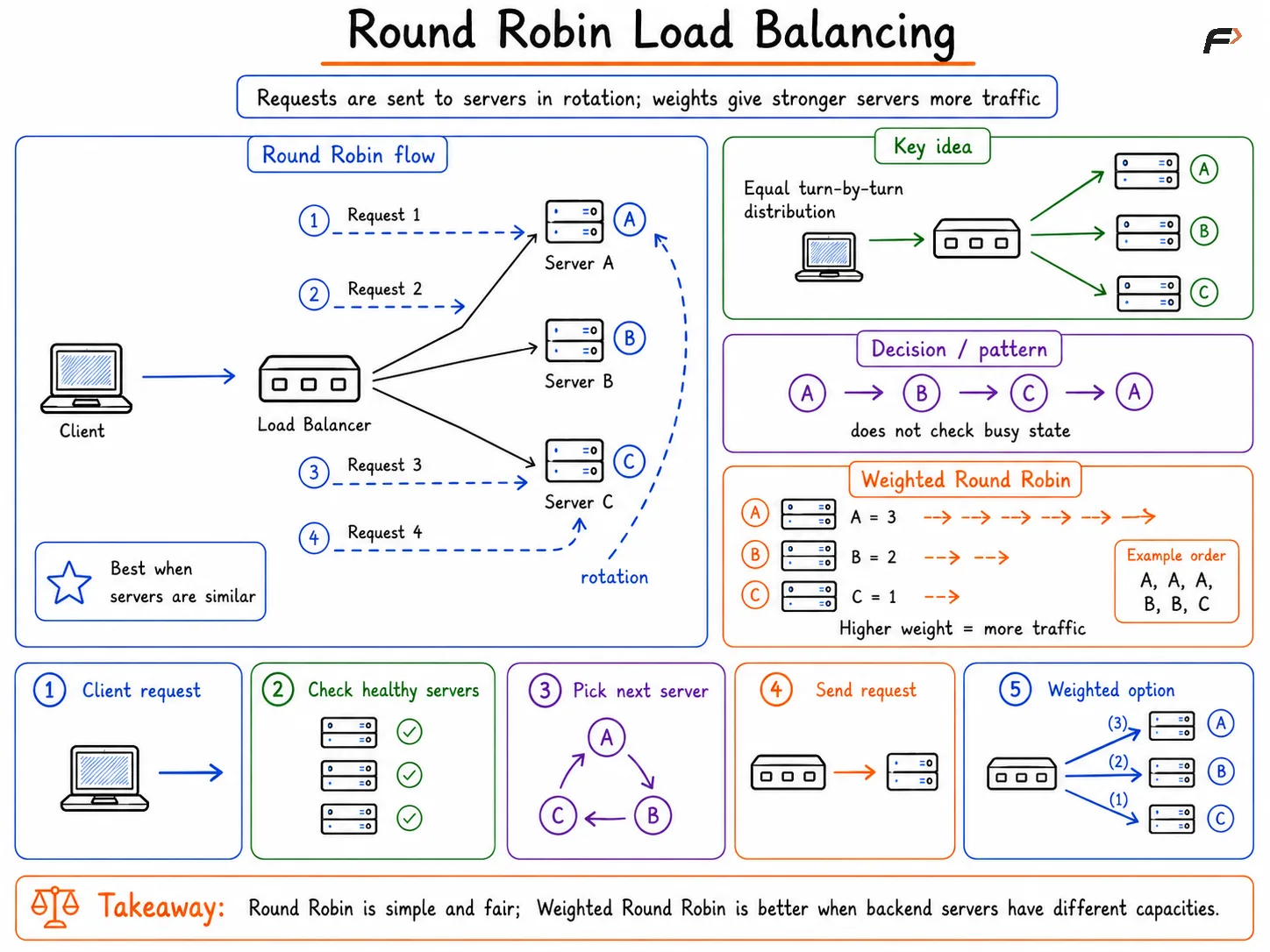
Round Robin Load Balancing
Weighted Round Robin
Weighted Round Robin is similar to Round Robin, but servers are given different weights based on capacity.
For example, if Server A is stronger than Server B, Server A may receive more requests. This is useful when backend servers are not equal in CPU, memory, or processing power.
Higher weight: Server receives more traffic.
Lower weight: Server receives less traffic.
Best use case: Mixed-capacity backend servers.
Least Connections
Least Connections sends the next request to the server with the fewest active connections.
This is useful when requests do not all take the same amount of time. If one server is already handling many long-running requests, the load balancer can choose another server with fewer active connections.
Least Connections is better than simple Round Robin when request duration varies.
Least Response Time
Least Response Time selects the server that is responding fastest, often while also considering active connections.
This algorithm is useful when some servers are slower because of CPU load, database waits, network delay, or heavier request processing. It tries to improve user experience by routing traffic toward faster backends.
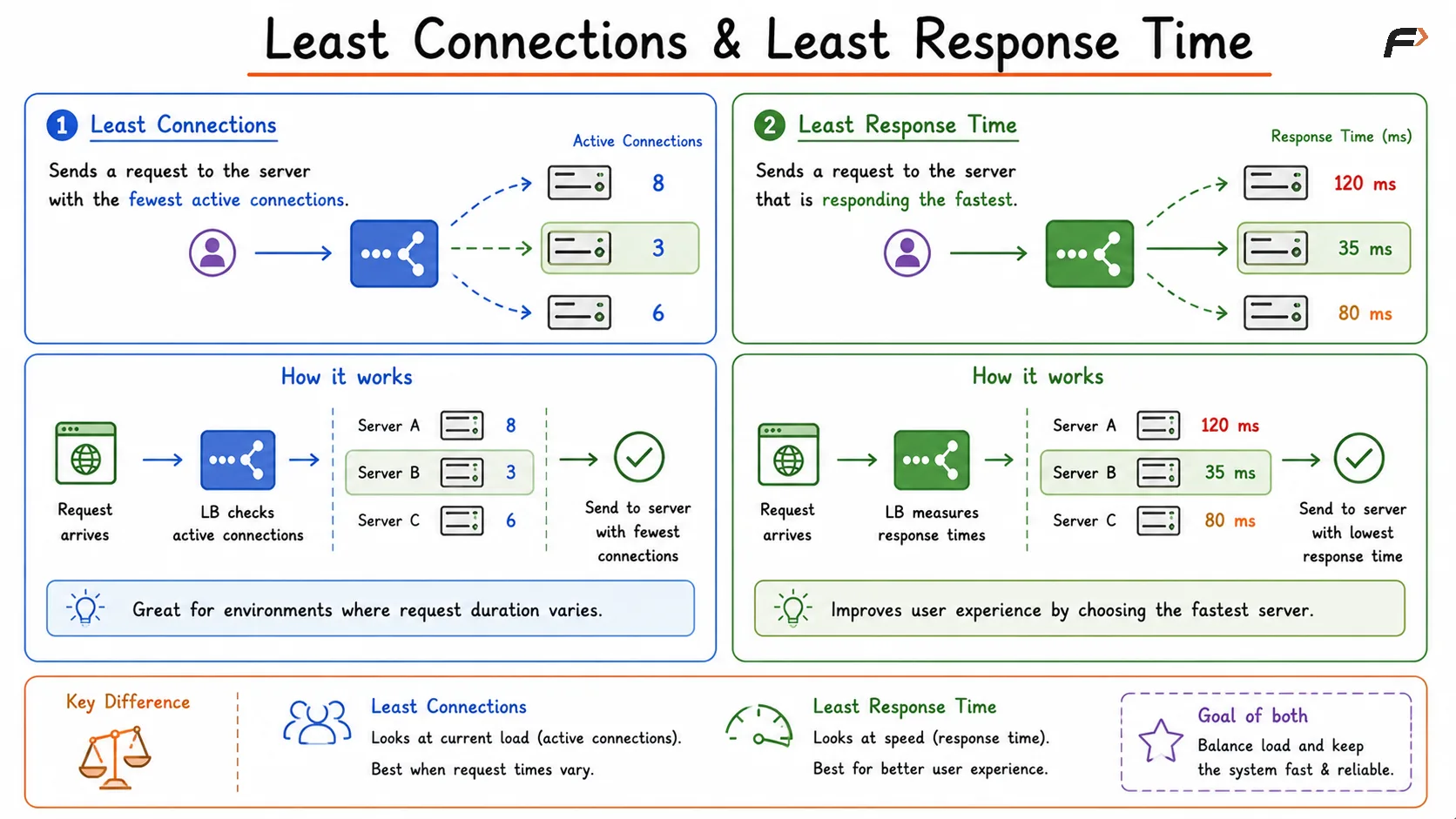
Least Connections and Response Time Load Balancing
IP Hash
IP Hash uses the client’s IP address to choose a backend server. The same client IP usually maps to the same server, as long as the server pool does not change significantly.
This can help with session affinity, where a user should continue reaching the same backend server. However, modern systems often prefer shared session stores or stateless tokens instead of depending heavily on sticky sessions.
Algorithm Comparison
Algorithm | Main Idea | Best Suited For | Main Limitation |
|---|---|---|---|
Round Robin | Rotate requests across servers | Similar servers and similar requests | Ignores current load |
Weighted Round Robin | Send more traffic to stronger servers | Servers with different capacity | Weights must be chosen carefully |
Least Connections | Choose server with fewer active connections | Long-running or uneven requests | Needs connection tracking |
Least Response Time | Choose faster responding server | Performance-sensitive systems | Needs response-time monitoring |
IP Hash | Map same client IP to same server | Basic session affinity | Can create uneven distribution |
Choosing the Right Algorithm
There is no single best load balancing algorithm for every system. The right choice depends on how the application behaves.
Use Round Robin: Servers are similar and requests are simple.
Use Weighted Round Robin: Some servers are more powerful than others.
Use Least Connections: Requests may stay active for different durations.
Use Least Response Time: Fast response is more important and monitoring is available.
Use IP Hash: The same client should usually reach the same backend.
In real production systems, load balancing also depends on health checks, failover, TLS termination, rate limiting, observability, and deployment strategy. The algorithm is important, but it is only one part of the complete load balancing system.
Summary
Load balancing algorithms decide which backend server should handle each incoming request. Round Robin and Weighted Round Robin are simple static approaches, while Least Connections and Least Response Time use current server conditions to make smarter decisions.
IP Hash and Consistent Hashing are useful when request consistency matters, such as session affinity or cache-friendly routing. A good algorithm improves scalability, availability, response time, and resource utilization by preventing traffic from piling up on one server while others remain underused.
Be the first to add a comment.