Introduction
An IPv6 datagram is the packet format used by IPv6 to move data across interconnected networks. It does more than carry application data. It also includes the control information routers and hosts need for forwarding, delivery, and protocol handling.
IPv6 did not just increase the address size from 32 bits to 128 bits. It also redesigned the packet structure to make processing cleaner and more efficient. That redesign is one of the most important differences between IPv4 and IPv6.
Why the IPv6 Datagram Is Different
When IPv6 was introduced, the goal was not only to solve IPv4 address exhaustion. It was also a chance to improve the packet format itself. Over time, engineers saw that the IPv4 header had become harder to process because it included variable length, checksum recalculation, and fragmentation-related fields in every packet.
IPv6 follows a simpler design philosophy:
Fixed base header: Routers always know where the main header ends.
Optional extension headers: Extra functionality is added only when needed.
Cleaner forwarding: Fewer fields need repeated processing at every hop.
This makes the IPv6 datagram easier to handle in modern high-speed networks.
Main Structure of an IPv6 Datagram
An IPv6 datagram has three broad parts:
Base header: The main header that is always present.
Extension headers: Optional headers used only when special processing is required.
Payload: The upper-layer data, such as TCP, UDP, or ICMPv6 information.
The most important point is that the base header is always 40 bytes. It does not grow or shrink like the IPv4 header.
IPv4 vs IPv6 Datagram Design
Feature | IPv4 Datagram | IPv6 Datagram |
|---|---|---|
Base header size | Variable, usually 20 to 60 bytes | Fixed 40 bytes |
Header checksum | Present | Removed |
Fragmentation fields in base header | Present | Moved out of the base header |
Options location | Inside the main header | In extension headers |
Router-side fragmentation | Allowed | Not done by routers |
Broadcast support | Present | Removed |
This table captures the main reason IPv6 forwarding is simpler: the base header carries only essential information.
Fields in the IPv6 Base Header
The IPv6 base header contains these fields:
Version: Identifies the packet as IPv6.
Traffic Class: Helps with traffic priority and congestion-related handling.
Flow Label: Identifies packets that belong to the same flow.
Payload Length: Tells how much data follows the base header.
Next Header: Identifies the next extension header or upper-layer protocol.
Hop Limit: Limits how many routers the packet can cross.
Source Address: The 128-bit IPv6 address of the sender.
Destination Address: The 128-bit IPv6 address of the receiver.
Together, these fields form the fixed 40-byte header.
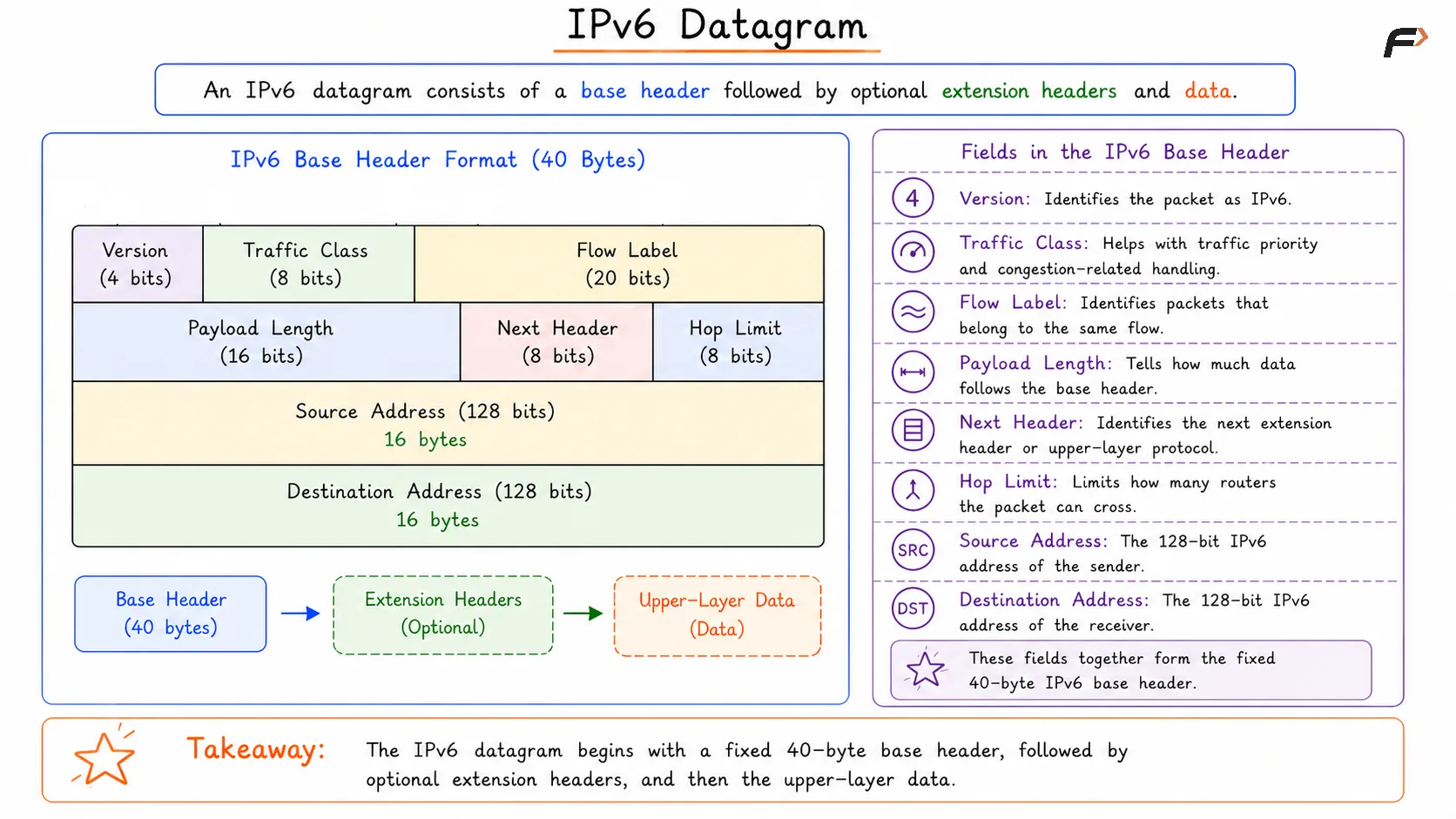
IPv6 Header
Key IPv6 Header Fields
Some fields are central to how IPv6 works:
Version: Its value is 6, which tells the receiver how to interpret the packet.
Traffic Class: Helps the network give different treatment to voice, video, gaming, or standard traffic.
Flow Label: Helps identify packets that belong to the same communication stream.
Payload Length: Shows the size of everything after the base header.
Next Header: Supports chaining by pointing to the next extension header or final transport protocol.
Hop Limit: Works like TTL in IPv4 and prevents endless looping.
These fields keep the base header small while still giving the network the information it needs for forwarding and delivery.
Next Header and Extension Headers
One of the most important design ideas in IPv6 is the Next Header field. Instead of placing every possible feature inside one large header, IPv6 links headers together step by step.
The chain can look like this:
Base header => Extension header => Another extension header
This design keeps the main header simple. If a packet does not need extra features, those extension headers are simply not included. If special processing is required, the needed extension headers are added in order.
Common uses of extension headers include:
Routing information
Fragmentation information
Optional control features
Why IPv6 Removed Some IPv4 Complexity
IPv6 removed or moved several IPv4 features because they created unnecessary processing overhead.
No header checksum: Routers do not have to recalculate a checksum at every hop.
No variable base header: Routers always process a fixed 40-byte structure.
No built-in fragmentation fields in every packet: Fragmentation support appears only when required through extension headers.
No broadcast: IPv6 uses multicast instead of broadcast, which reduces unnecessary traffic.
These changes were made to improve forwarding efficiency and keep the protocol cleaner for long-term growth.
Hop Limit, Payload, and Addresses
The Hop Limit field in IPv6 serves the same general purpose as TTL in IPv4. Every router reduces it by one. If it reaches zero, the packet is discarded. This prevents routing loops from keeping packets alive forever.
The Source Address and Destination Address fields are much larger than in IPv4 because each one is 128 bits long. These two fields take a major portion of the 40-byte header.
The Payload field carries the actual upper-layer data. Depending on the communication, that payload may be:
TCP segment
UDP datagram
ICMPv6 message
Why the IPv6 Header Is Still 40 Bytes
At first, a 40-byte IPv6 header may seem large compared with the 20-byte minimum IPv4 header. But this size makes sense once the address fields are considered.
IPv6 includes:
128-bit source address
128-bit destination address
Those two large address fields alone account for much of the base header size. At the same time, many older IPv4 complexities were removed or shifted into extension headers, which keeps the design more efficient overall.
Summary
An IPv6 datagram is the packet structure used by IPv6 to carry data across networks. It includes a fixed 40-byte base header, optional extension headers, and a payload. The base header contains only the essential fields needed for delivery, such as Version, Traffic Class, Flow Label, Payload Length, Next Header, Hop Limit, Source Address, and Destination Address.
The IPv6 datagram is important because it improves on the older IPv4 design. It removes header checksum processing, avoids variable base-header size, moves optional features into extension headers, and eliminates router-side fragmentation from the main header. This cleaner structure makes IPv6 more scalable and more efficient for modern network routing.
Be the first to add a comment.