Introduction
An IP packet always carries a destination IP address, but that does not always mean only one device will receive it. The way the destination address is interpreted depends on the IP addressing mode being used.
This is why addressing modes matter. They define whether traffic should go to one device, all devices in a local network, a selected group of receivers, or one nearest system chosen from many equivalent servers.
What IP Addressing Modes Mean
An addressing mode defines the delivery pattern of an IP packet. The packet still has a destination IP address, but the network treats that address differently depending on the communication model.
In practice, IP communication can follow four main addressing modes:
Unicast: One sender to one receiver
Broadcast: One sender to all devices in a local broadcast domain
Multicast: One sender to a selected group of interested receivers
Anycast: One sender to one nearest or most preferred receiver among many equivalent systems
These four modes are important because they support very different networking needs.
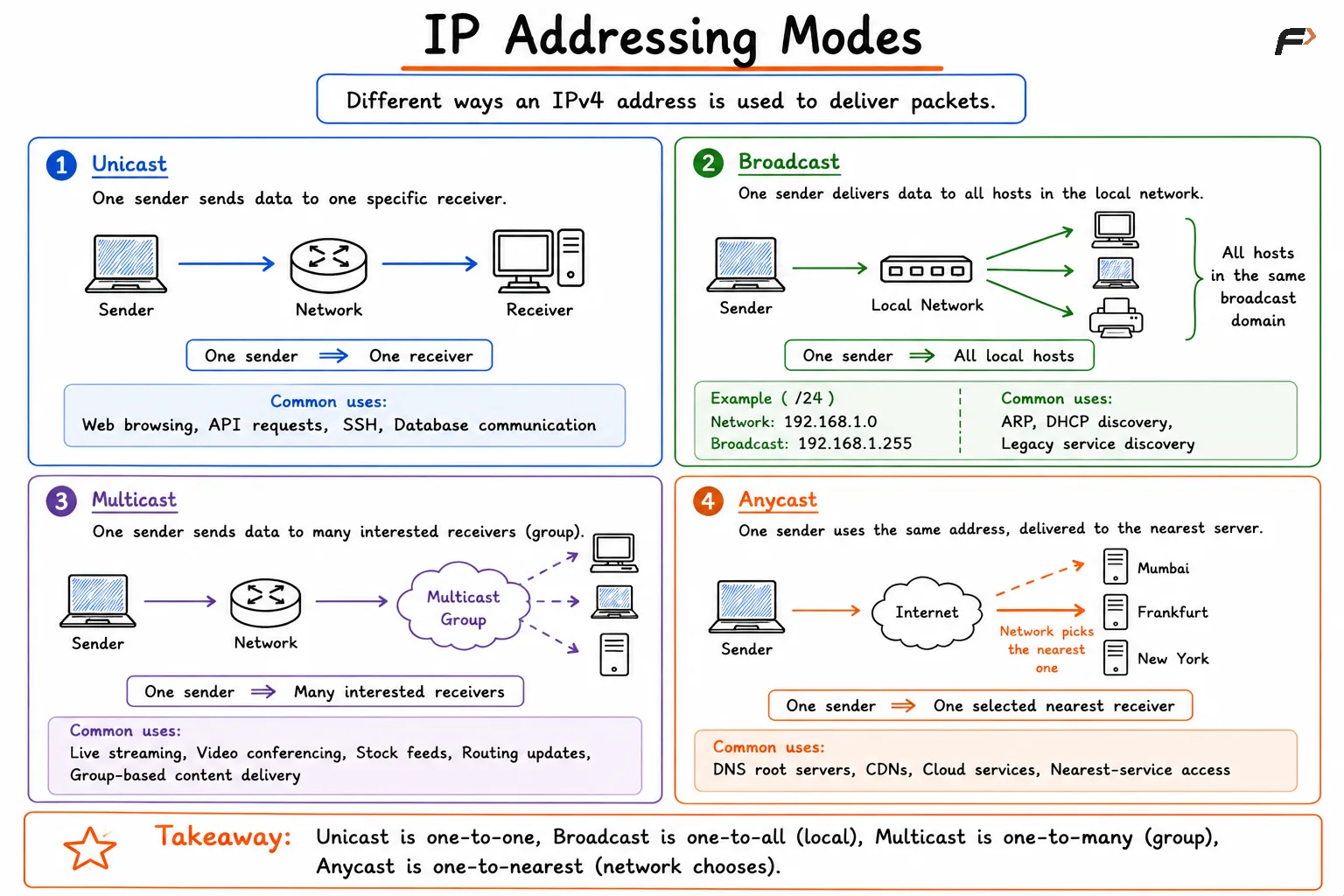
IPv4 Addressing Modes
Unicast
Unicast is the most common addressing mode on the internet. In unicast communication, one sender transmits data to one specific receiver.
The destination IP address identifies exactly one host, and the packet is delivered only to that destination. Most everyday network traffic uses unicast because most applications are built around one-to-one communication.
Common unicast examples include:
Web browsing: A browser communicates with a web server
API requests: A client application talks to a backend server
SSH sessions: One client connects to one remote machine
Database communication: One application exchanges data with one database server
The basic delivery pattern is: One sender => One receiver
Broadcast
Broadcast is used when one sender needs to deliver traffic to every device in the same local broadcast domain. Instead of targeting a single host, the packet is intended for all devices on that local network segment.
This makes broadcast useful for discovery and local network communication, but it also creates more traffic because all devices in the broadcast domain receive it.
Broadcast communication works like this: One sender => All local hosts
One important rule is that broadcast traffic is usually local. Routers do not forward broadcast traffic by default. If broadcasts crossed routers freely, networks would quickly become overloaded with unnecessary traffic.
A common IPv4 broadcast example is a /24 network such as:
Network address:
192.168.1.0Broadcast address:
192.168.1.255
If traffic is sent to 192.168.1.255, all devices in that subnet can receive it.
Common broadcast uses include:
ARP requests
DHCP discovery
Legacy local service discovery
Because broadcast can create unnecessary load, large networks use routers and VLANs to limit the size of broadcast domains.
Multicast
Multicast sits between unicast and broadcast. It is used when one sender wants to deliver the same data to multiple receivers, but only to those receivers that are actually interested.
Instead of sending separate unicast copies to each receiver, multicast allows a single transmission to reach a selected group. Devices that want the traffic join a multicast group, and only members of that group receive the packets.
The delivery pattern is: One sender => Many interested receivers
This is useful when the same content must reach many recipients at nearly the same time without wasting bandwidth on repeated identical transmissions.
Common multicast use cases include:
Live video streaming
Video conferencing
Stock market data feeds
Routing protocol updates
Group-based content delivery
A simple example is a stock exchange publishing price updates. The sender creates the update once, sends it to a multicast group, and all subscribed receivers get it without the source transmitting separate copies to each one.
Anycast
Anycast is different from the other three modes. In anycast, multiple servers share the same service address, but traffic is delivered to only one of them.
The network chooses the receiver based on routing decisions, usually sending traffic to the nearest or most preferred server. So the destination address may be the same everywhere, but the actual physical server that receives the traffic depends on network routing.
The delivery pattern is: One sender => One selected nearest receiver
This makes anycast useful for performance, redundancy, and global service distribution.
Common anycast use cases include:
DNS root servers
Content Delivery Networks, CDNs
Globally distributed cloud services
Nearest-service access models
For example, if a service has servers in Mumbai, Frankfurt, and New York, users in India may be directed to Mumbai, while users in Europe may be directed to Frankfurt. The address appears the same, but routing sends each user to a different physical server.
Multicast vs Anycast
Multicast and anycast are often confused because both can involve multiple systems. However, they solve different networking problems.
Aspect | Multicast | Anycast |
|---|---|---|
Delivery pattern | One sender to many selected receivers | One sender to one selected receiver |
Receiver count | Multiple devices receive the packet | Only one device receives the packet |
Selection method | Devices join the multicast group | Routing chooses the nearest or most preferred server |
Main purpose | Group communication | Nearest-server service delivery |
Common use cases | Streaming, conferencing, routing updates | DNS, CDNs, distributed services |
The easiest way to remember the difference is:
Multicast: One transmission reaches multiple interested receivers
Anycast: One transmission reaches one receiver chosen from many equivalent systems
Summary
IP addressing modes define how a destination IP address should be interpreted during packet delivery. Unicast sends traffic to one receiver, broadcast sends it to all devices in a local broadcast domain, multicast sends it to a selected group of interested receivers, and anycast sends it to one nearest or most preferred receiver among multiple equivalent systems.
These modes are important because the same packet structure can support very different communication patterns. Understanding unicast, broadcast, multicast, and anycast makes it much easier to understand local discovery, group communication, nearest-server routing, and how modern networks optimize traffic delivery.
Be the first to add a comment.