Introduction
The transport layer sits above the network layer and solves a very practical problem in computer networks. Getting data to the correct machine is not enough. Once that data reaches the destination device, the system must still decide which application or process should receive it.
That is why the transport layer is so important. It takes communication beyond device-to-device delivery and makes true application-to-application communication possible.
Why the Transport Layer Is Needed
The network layer uses IP addresses to deliver packets to the correct host. That works well for identifying machines, but a machine usually runs many services at the same time.
A laptop may be using a browser, email app, music app, and video meeting app together. A server may be running a web server, database, and cache service at the same time. If a packet reaches that machine, the operating system still needs a way to decide exactly where the data should go.
This is the gap filled by the transport layer.
Network layer: Delivers data to the correct machine using IP addresses.
Transport layer: Delivers data to the correct process or application inside that machine.
How the Transport Layer Identifies Applications
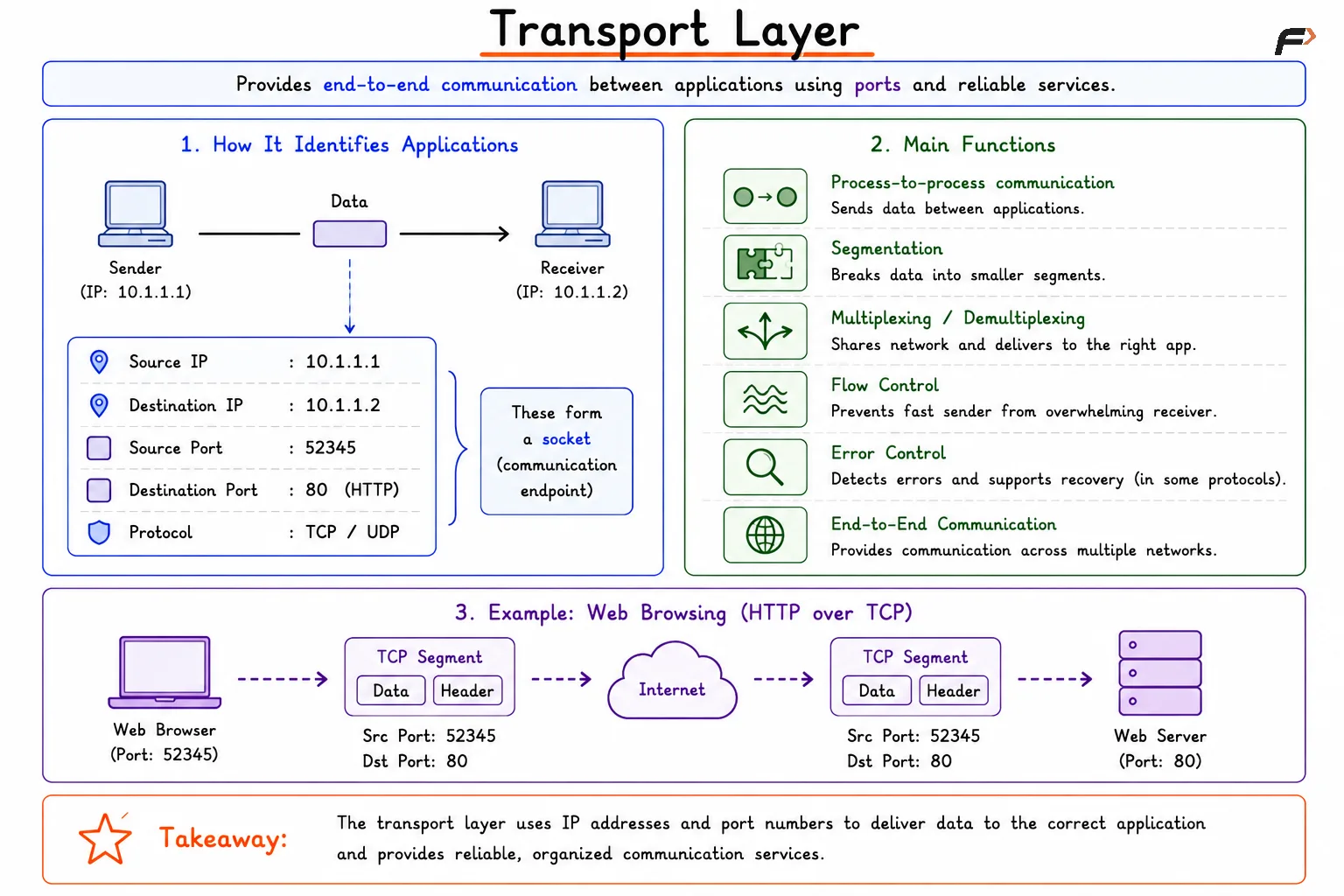
The transport layer uses port numbers to identify the correct sending and receiving processes. While the IP address tells the network which machine should receive the packet, the port number tells the operating system which application should receive the data.
A complete transport-level communication usually includes:
Source IP address: Identifies the sender machine.
Destination IP address: Identifies the receiver machine.
Source port number: Identifies the sending application.
Destination port number: Identifies the receiving application.
Protocol: Identifies whether the communication uses TCP or UDP.
Together, these values help create a communication endpoint often referred to as a socket. This makes transport layer communication precise and organized, especially when many applications are active at once.
Transport Layer Introduction
Main Functions of the Transport Layer
The transport layer is not only about port numbers. It also provides several important services that make data delivery more useful for applications.
Process-to-process communication: Sends data from one application process to another.
Segmentation: Breaks larger data into smaller units so it can be transmitted efficiently.
Multiplexing and demultiplexing: Allows many applications to share the network and ensures incoming data is delivered to the correct application.
Flow control: Prevents a fast sender from overwhelming a slow receiver.
Error control: Helps detect delivery issues and, in some protocols, supports retransmission.
End-to-end communication: Provides communication between applications across multiple networks.
These functions are especially important in real-world internet communication, where many apps, devices, and services operate at the same time.
TCP and UDP at the Transport Layer
The two most common transport layer protocols are TCP and UDP. Both work at the same layer, but they are designed for different communication needs.
Feature | TCP | UDP |
|---|---|---|
Communication type | Connection-oriented | Connectionless |
Reliability | Reliable delivery | Best-effort delivery |
Ordering | Maintains order | No delivery order guarantee |
Speed and overhead | More overhead | Lower overhead |
Common use cases | Web, email, file transfer | Streaming, DNS, voice, gaming |
TCP is used when reliable delivery matters. UDP is preferred when speed and lower delay matter more than perfect reliability.
Why the Transport Layer Matters
Without the transport layer, the network could only move data to devices, not to the correct applications inside those devices. Modern computing depends on many applications communicating at the same time, and that is only possible because the transport layer provides structure to that communication.
The Transport Layer forms the basis for understanding concepts such as ports, sockets, TCP, UDP, flow control, and reliable data transfer. It is an essential layer that supports communication between applications and is widely used in web browsing, messaging, streaming, file transfer, and other Internet services.
Summary
The transport layer is responsible for process-to-process and end-to-end communication in computer networks. It works above the network layer and uses port numbers, sockets, TCP, and UDP to ensure that data reaches the correct application rather than just the correct machine.
It also supports key functions such as segmentation, multiplexing, demultiplexing, flow control, and error control. In short, the network layer gets the packet to the host, and the transport layer gets the data to the right process inside that host.
Be the first to add a comment.