Introduction
IPv6, or Internet Protocol Version 6, is the newer version of the Internet Protocol used at the Network Layer. It was designed to solve the biggest long-term limitation of IPv4: the shortage of available addresses as the internet kept expanding.
As networks grew from a world of computers and servers into a world of smartphones, cloud systems, always-connected devices, and IoT networks, IPv4 address space became too limited for future growth. IPv6 was introduced as a long-term solution that not only expands address space but also improves several parts of protocol design.
Why IPv6 Was Needed
IPv4 uses 32-bit addresses, which gives a limited address space. At one time that seemed more than enough, but the number of internet-connected systems increased much faster than early designers expected.
Today, address demand comes from:
Personal devices: Laptops, smartphones, tablets
Infrastructure systems: Routers, switches, firewalls, servers
Cloud platforms: Virtual machines, containers, internet-facing services
IoT environments: Cameras, sensors, smart appliances, embedded devices
To slow down address exhaustion, IPv4 relied heavily on NAT, which allowed many private devices to share a smaller number of public IPv4 addresses. NAT helped IPv4 survive much longer, but it was still a workaround. IPv6 was designed to solve the problem at the protocol level.
IPv4 vs IPv6 Address Size
The biggest technical difference between IPv4 and IPv6 is the address size.
Protocol | Address Size |
|---|---|
IPv4 | 32 bits |
IPv6 | 128 bits |
This increase gives IPv6 an extremely large address space. In practical terms, it removes address scarcity as a design limitation and allows much larger and more scalable network planning.
What IPv6 Provides
Like IPv4, IPv6 still performs the basic Network Layer functions required for communication across networks. It provides:
Logical addressing: Devices receive Layer 3 addresses
Packet delivery: Traffic can move across multiple networks
Router forwarding: Routers can send packets toward the next hop
But IPv6 also introduces major improvements:
Much larger address space
A different address format
Simplified protocol design
Reduced dependence on NAT
Better long-term scalability
This is why IPv6 is not just a bigger version of IPv4. It is a redesigned protocol built for modern internet growth.
IPv6 Address Format
An IPv6 address is 128 bits long and is written in hexadecimal notation. Instead of dotted decimal like IPv4, IPv6 uses eight groups separated by colons.
Example: 2001:0db8:85a3:0000:0000:8a23:0370:7334
This format works like this:
8 groups total
16 bits per group
4 hexadecimal digits per group
Colon-separated representation
Hexadecimal is used because writing 128 bits directly in binary or full decimal form would be too long and difficult to read.
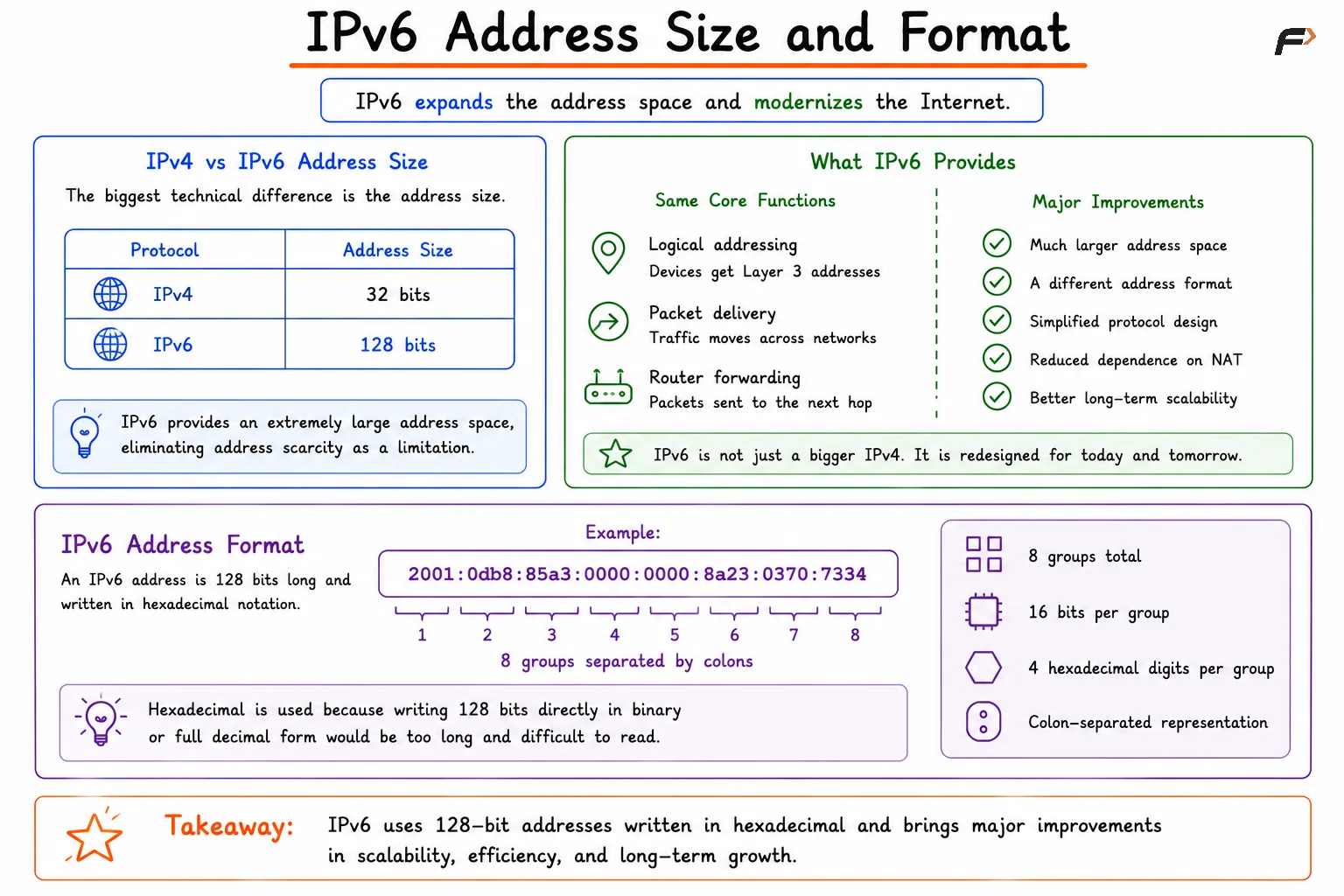
IPv6 Address Size and Format
IPv6 Shortening Rules
Even in hexadecimal, IPv6 addresses can be long. To make them easier to read, IPv6 uses two standard shortening rules.
Remove leading zeros:
0db8becomesdb8,0370becomes370Compress one continuous zero block with
::i.e. A long zero sequence can be shortened once in an address
For example: 2001:db8:85a3:0000:0000:0000:370:7334
can be written as: 2001:db8:85a3::370:7334
The :: notation can be used only once in a single IPv6 address. If it appeared multiple times, the missing zero groups would become ambiguous.
IPv6 Prefix Length and Common Prefixes
IPv6 also uses prefix notation, just like CIDR in IPv4. A prefix length tells how many leading bits belong to the network portion.
Example: /64
This means:
First 64 bits: Network portion
Remaining 64 bits: Interface or host portion
Some common IPv6 prefixes are:
/128: Single address
/64: Standard host network size
/48: Common organizational allocation
/32: Larger provider allocation
The use of prefix lengths makes IPv6 consistent with modern classless addressing and routing practices.
IPv6 Addressing Modes
IPv6 continues to support three major IP addressing modes:
Unicast: One sender to one receiver
Multicast: One sender to multiple interested receivers
Anycast: One sender to one nearest or most preferred receiver among many equivalent systems
One important design change is that IPv6 removes broadcast. Instead of using broadcast traffic, IPv6 relies more on multicast groups. This reduces unnecessary traffic and improves efficiency on the local network.
SLAAC and Automatic Configuration
One of the most practical improvements in IPv6 is SLAAC, or Stateless Address Auto Configuration. SLAAC allows devices to configure their own IPv6 addresses automatically without requiring manual setup for every host.
A simple SLAAC process looks like this:
Router advertises prefix => Device receives prefix => Device builds its address => IPv6 address is configured
This makes deployment easier, especially in large or dynamic environments. It also reduces administrative effort for routine host addressing.
IPv6 and NAT
Because IPv6 provides such a large address space, devices can usually receive their own globally unique addresses. That means IPv6 does not depend on NAT in the same way IPv4 does.
This helps restore a cleaner end-to-end communication model, where devices and services can communicate more directly without requiring address translation as a basic survival mechanism.
That does not mean security disappears without NAT. Security still comes from:
Firewalls
Access control policies
Filtering rules
Segmentation and security design
NAT and security are not the same thing, and IPv6 networks can still be protected properly without depending on address translation.
Summary
IPv6 is the newer Internet Protocol built to replace IPv4 as internet growth continues. It expands address size from 32 bits to 128 bits, uses hexadecimal notation, supports prefix-based addressing, removes broadcast, and introduces improvements such as SLAAC and reduced reliance on NAT.
Its importance goes beyond just having more addresses. IPv6 provides a more scalable, modern, and efficient foundation for internet communication across enterprise networks, cloud systems, mobile infrastructure, data centers, and IoT environments.
Be the first to add a comment.