Introduction
The application layer is the topmost layer of the network model. It is the layer closest to the user, because this is where real network services such as web browsing, email, file transfer, messaging, and name resolution are understood and handled.
The lower layers help move data from one place to another, but they do not understand whether that data is a webpage request, an email, a file, or a DNS query. The application layer gives that communication structure and meaning.
Why the Application Layer Is Needed
A network can carry bits, frames, packets, and segments, but applications need more than simple delivery. A browser needs rules for requesting a webpage. An email service needs rules for sending and receiving messages. A file transfer service needs rules for moving files correctly.
This is why the application layer exists. It provides the standard way in which software applications communicate over a network.
In practical terms, it defines:
What kind of message is being sent: such as a web request, email, or file transfer command
How communication should happen: including request and response behavior
How two applications understand each other: using standard protocols and formats
How user-facing services work on a network: so different systems can communicate reliably
What the Application Layer Does
The main role of the application layer is to enable communication between software applications across the network. It acts as the interface between user applications and the rest of the TCP/IP stack.
A few important responsibilities of the application layer are:
Providing network services to applications: It supports services such as web access, email, file sharing, and name resolution.
Defining application layer protocols: It uses standard protocols so different devices and software can communicate.
Organizing requests and responses: It helps applications exchange structured data in a meaningful way.
Making network communication useful to users: This is the layer where transmitted data becomes something the user can actually understand and use.
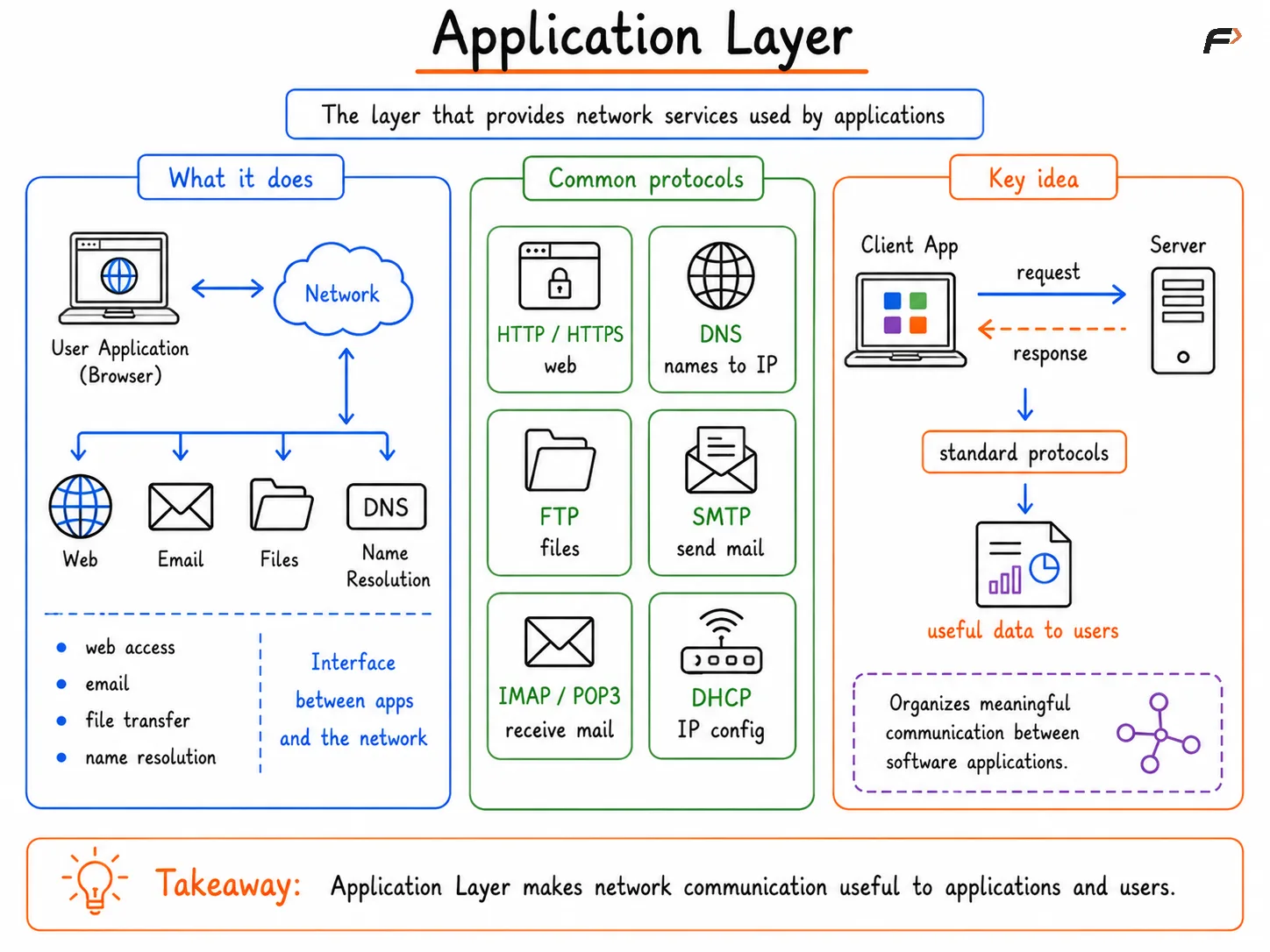
Application Layer
Common Application Layer Protocols
Many well-known internet protocols work at the application layer. Each one is designed for a specific kind of service.
Protocol | Purpose |
|---|---|
HTTP / HTTPS | Used for web browsing and web communication |
DNS | Converts domain names into IP addresses |
FTP | Transfers files between systems |
SMTP | Sends email between mail servers |
POP3 / IMAP | Retrieves and manages email |
DHCP | Helps devices receive IP configuration automatically |
These protocols show that the application layer is not one single program. It is a collection of rules and services that support different types of network communication.
Application Layer and User Interaction
This is the layer users experience most directly, even if they do not realize it. When someone opens a browser, sends an email, joins a video call, or downloads a file, the visible action is happening through an application, but the rules that make that communication possible are handled at the application layer.
For example:
A browser uses application layer protocols to request a webpage.
An email app uses application layer protocols to send and receive messages.
A file transfer tool uses application layer protocols to move data between hosts.
A DNS service uses application layer communication to find the IP address of a domain name.
So while lower layers focus on delivery, the application layer focuses on service and meaning.
Encapsulation and Decapsulation
When an application creates data, that data does not travel across the network in its original form. Each lower layer adds its own header information before forwarding it.
This downward process is called encapsulation.
At the receiving side, each layer removes the information meant for it and passes the remaining data upward. This reverse process is called decapsulation.
By the time the data reaches the application layer on the receiving machine, it is no longer just raw transmitted data. It becomes something meaningful such as a webpage, an email message, a file, or a chat message.
Application Layer Example
Suppose a user opens a browser and requests a website.
The browser creates the request at the application layer.
The request is passed downward through the transport, network, data link, and physical layers.
The data travels across the network to the destination server.
At the receiving side, the data moves upward through the layers.
The server application interprets the request and sends back the response.
This example shows a very important point: the lower layers help in delivery, but the application layer is where the communication becomes understandable to the actual software.
Summary
The application layer is the top layer of the TCP/IP model and is responsible for user-facing network communication. It allows software applications to exchange data using standard rules and protocols such as HTTP, DNS, FTP, and SMTP.
It acts as the bridge between applications and the network stack, organizes requests and responses, and gives meaning to transmitted data. In simple terms, the lower layers move the data, and the application layer makes that data useful.
Be the first to add a comment.