Introduction
Wi-Fi is the common name people use for wireless networking, but the technology behind it is defined by a family of standards called IEEE 802.11. These standards describe how wireless devices communicate over radio waves in a Wireless Local Area Network, or WLAN.
Over time, IEEE 802.11 has evolved through many versions. Each new generation improves some combination of speed, coverage, efficiency, reliability, latency, device capacity, and wireless spectrum usage.
What Is IEEE 802.11?
IEEE 802.11 is a family of wireless networking standards created for WLAN communication. It defines how devices such as laptops, phones, tablets, access points, smart TVs, printers, and IoT devices communicate over Wi-Fi.
IEEE 802.11 mainly defines two important layers:
Physical Layer: Handles how bits are transmitted using radio waves.
MAC Layer: Handles how devices share the wireless medium and exchange frames.
Together, these layers decide how Wi-Fi devices send, receive, coordinate, and manage wireless communication.
PHY Layer and MAC Layer
The Physical Layer, or PHY layer, deals with the actual wireless signal. It defines how digital data is converted into radio waves and transmitted through the air.
The PHY layer includes concepts such as:
Frequency bands: 2.4 GHz, 5 GHz, and 6 GHz.
Channels: Smaller sections inside a frequency band.
Channel width: How much spectrum a channel uses.
Modulation: How data is encoded onto wireless signals.
Data rates: The maximum possible transmission capability.
Antenna techniques: Technologies such as MIMO and beamforming.
The MAC layer manages access to the shared wireless medium. Since many Wi-Fi devices use the same air space, the MAC layer helps coordinate when devices can transmit.
The MAC layer handles:
Discovery: Finding nearby Wi-Fi networks.
Authentication and association: Joining an access point.
Frame handling: Organizing wireless communication.
Acknowledgements: Confirming that frames were received.
Retransmissions: Resending lost or corrupted frames.
Roaming support: Helping devices move between access points.
In simple terms, PHY decides how signals travel through the air, while MAC decides how devices share that air.
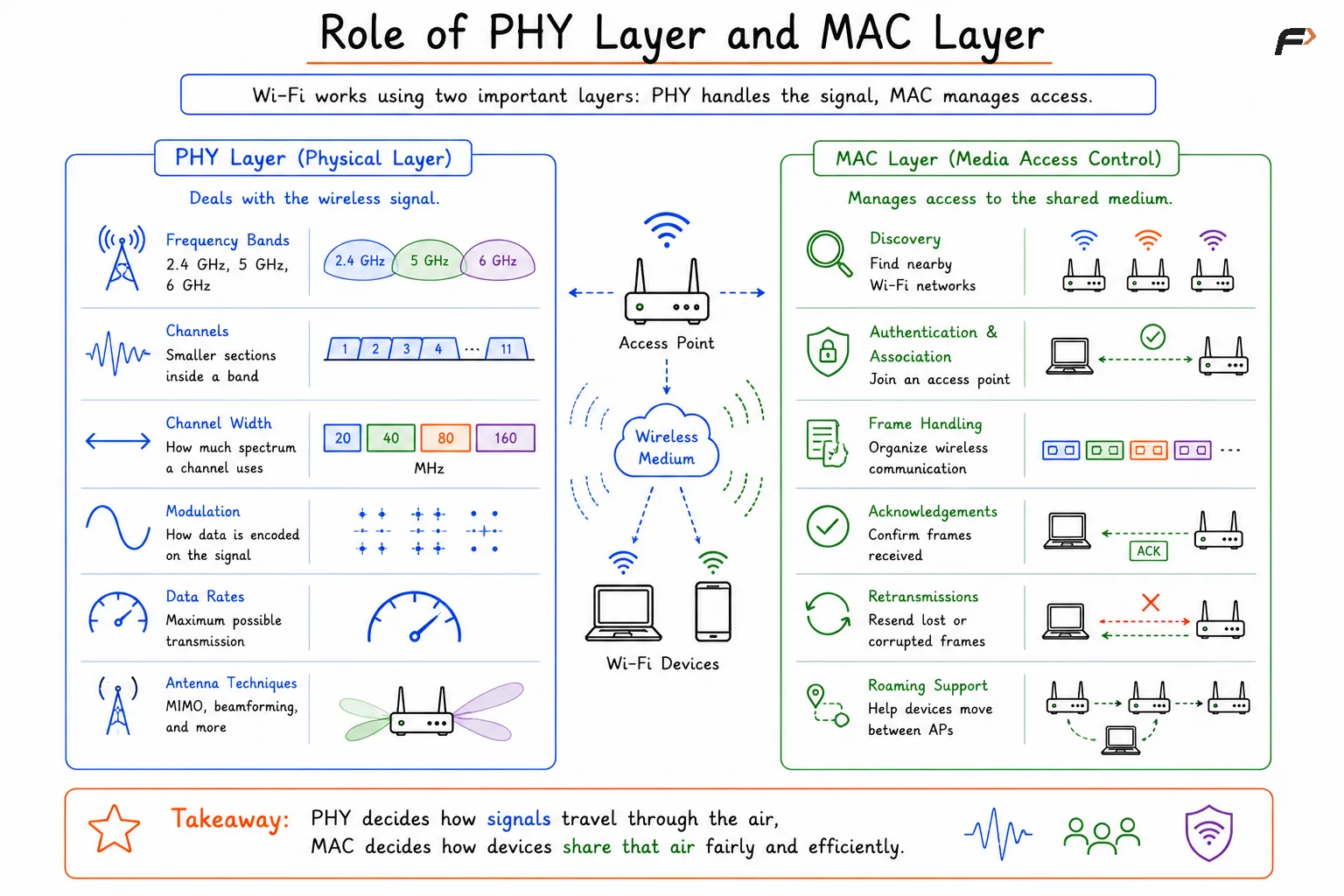
Role of PHY Layer and MAC Layer
IEEE vs Wi-Fi Alliance
IEEE and the Wi-Fi Alliance are related, but they do different jobs.
Organization | Main Role |
|---|---|
IEEE | Creates the technical 802.11 standards |
Wi-Fi Alliance | Certifies devices, tests interoperability, and creates consumer-friendly branding |
IEEE defines the engineering rules. The Wi-Fi Alliance helps ensure that products from different vendors work together and gives standards simpler generation names.
For example:
IEEE Standard | Wi-Fi Generation Name |
|---|---|
802.11n | Wi-Fi 4 |
802.11ac | Wi-Fi 5 |
802.11ax | Wi-Fi 6 / Wi-Fi 6E |
802.11be | Wi-Fi 7 |
This naming makes it easier to compare devices without memorizing technical standard names.
Early Wi-Fi Standards
Before Wi-Fi generations became common branding, early standards were known by their IEEE names.
Standard | Band | Key Idea |
|---|---|---|
802.11a | 5 GHz | Higher speed for its time, but shorter range |
802.11b | 2.4 GHz | Early widely adopted Wi-Fi standard |
802.11g | 2.4 GHz | Better speed while keeping 2.4 GHz coverage |
These early standards helped Wi-Fi become practical for homes, offices, campuses, and public hotspots. Later generations built on this foundation with better throughput, multi-antenna systems, wider channels, and smarter spectrum usage.
Wi-Fi 4, Wi-Fi 5, Wi-Fi 6, and Wi-Fi 7
Modern Wi-Fi generations are easier to understand when viewed as an evolution of goals. Earlier generations focused heavily on increasing speed. Newer generations also focus on capacity, efficiency, latency, and dense-device performance.
Generation | IEEE Standard | Main Bands | Important Improvements |
|---|---|---|---|
Wi-Fi 4 | 802.11n | 2.4 GHz and 5 GHz | MIMO, better throughput, 40 MHz channels |
Wi-Fi 5 | 802.11ac | 5 GHz | Wider channels, beamforming, MU-MIMO, higher speeds |
Wi-Fi 6 | 802.11ax | 2.4 GHz and 5 GHz | OFDMA, better efficiency, TWT, BSS Coloring, 1024-QAM |
Wi-Fi 6E | 802.11ax | 6 GHz added | Wi-Fi 6 features extended into cleaner 6 GHz spectrum |
Wi-Fi 7 | 802.11be | 2.4 GHz, 5 GHz, 6 GHz | 320 MHz channels, Multi-Link Operation, 4K-QAM, lower latency |
Wi-Fi 6E is not a separate protocol generation like Wi-Fi 7. It is Wi-Fi 6 extended into the 6 GHz band, which provides more spectrum and less congestion where available.
Key Technologies Across Generations
Each generation introduced improvements that changed how wireless networks perform.
MIMO: Uses multiple antennas to send and receive multiple spatial streams.
MU-MIMO: Allows an access point to communicate with multiple clients more efficiently.
Beamforming: Focuses wireless signal energy toward a client instead of radiating equally in all directions.
OFDMA: Divides a channel into smaller resource units so multiple devices can be served more efficiently.
Target Wake Time: Helps battery-powered devices sleep and wake on schedule.
BSS Coloring: Helps devices identify nearby networks and reduce unnecessary waiting in dense environments.
Multi-Link Operation: Used in Wi-Fi 7 to let devices use multiple links for better throughput, latency, and reliability.
These technologies show how Wi-Fi evolved from simply becoming faster to becoming smarter and more efficient.
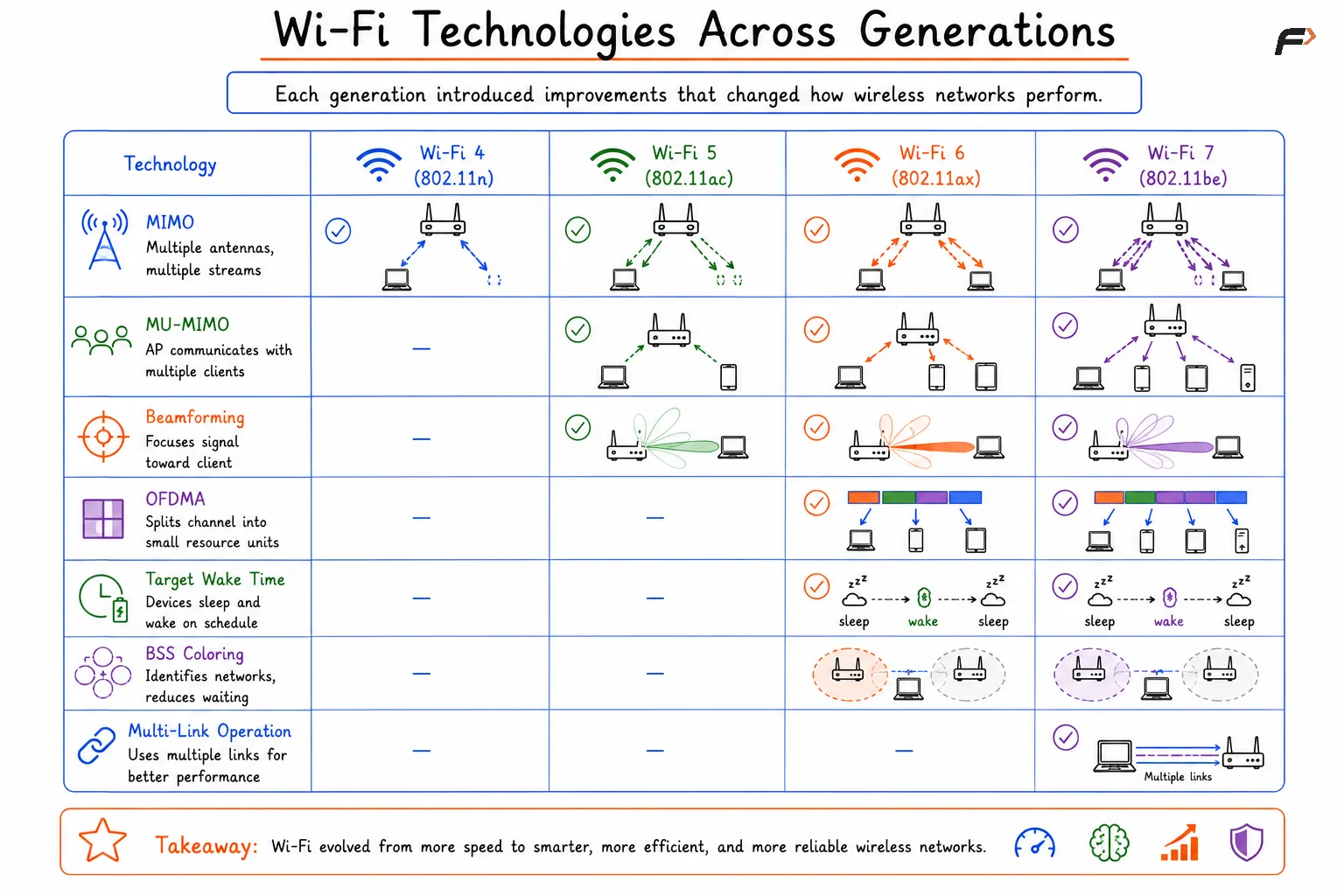
Wi-Fi Technologies Across Generations
Advertised Speed vs Real Wi-Fi Speed
Wi-Fi devices often advertise speeds such as hundreds of Mbps or multiple Gbps. These numbers usually represent maximum theoretical PHY-layer data rates under ideal conditions.
Actual user speed is usually lower because real environments are affected by many factors.
Distance from access point: Signal weakens as distance increases.
Walls and obstacles: Concrete, glass, metal, and furniture reduce signal quality.
Interference: Nearby Wi-Fi networks and wireless devices affect performance.
Channel width: Wider channels can improve speed but may suffer in crowded environments.
Device capability: Older phones or laptops may not support newer features.
Number of users: Wi-Fi airtime is shared among connected devices.
Protocol overhead: Acknowledgements, encryption, retries, and management frames consume capacity.
Internet plan: The ISP connection may be slower than the Wi-Fi link.
So, advertised Wi-Fi speed describes capability, not guaranteed real-world throughput.
Summary
IEEE 802.11 is the standard family that defines how Wi-Fi works at the PHY and MAC layers. The PHY layer handles radio transmission, frequency bands, modulation, channels, and data rates, while the MAC layer manages discovery, association, frame exchange, acknowledgements, retransmissions, and shared-medium access.
Wi-Fi generations provide simpler names for major IEEE standards. Wi-Fi 4 introduced MIMO, Wi-Fi 5 improved high-speed 5 GHz performance, Wi-Fi 6 focused on efficiency and dense networks, Wi-Fi 6E extended Wi-Fi 6 into 6 GHz, and Wi-Fi 7 adds higher throughput, lower latency, wider channels, and Multi-Link Operation.
Be the first to add a comment.