Introduction
Routing protocols inside an autonomous system are usually explained through two major approaches: Distance Vector Routing and Link State Routing. One focuses more on simplicity, while the other focuses more on complete topology awareness and faster convergence. Hybrid Routing stands between these two ideas.
The purpose of Hybrid Routing is to combine useful characteristics from both approaches. It tries to keep routing practical and efficient without taking on all the complexity of a full link state model. The most common protocol discussed in this category is EIGRP, or Enhanced Interior Gateway Routing Protocol.
What Is Hybrid Routing?
Hybrid Routing is a routing approach that blends ideas from more than one routing philosophy. In networking, it mainly refers to combining selected advantages of Distance Vector Routing and Link State Routing.
Its general aim is to bring together:
The simplicity of Distance Vector Routing
The efficiency of Link State Routing
Faster convergence behavior compared to traditional distance vector protocols
In simple terms, Hybrid Routing tries to create a balanced approach rather than strictly following only one model.
Why Hybrid Routing Is Needed
To understand why Hybrid Routing exists, it helps to look at the limitations of the two major approaches.
Distance Vector Routing
Distance Vector Routing is easy to understand and easy to deploy. Routers learn about destinations from their neighbors and update their routing tables based on those advertisements.
Protocols such as RIP follow this approach.
But this simplicity comes with limitations:
Metric limitation: RIP uses hop count as its metric.
Network size limitation: RIP allows a maximum hop count of 15.
Scalability limitation: It does not perform well in larger networks.
Convergence limitation: Route changes can take longer to settle.
Link State Routing
Link State Routing works differently. Routers learn the full network topology and then calculate the best path independently.
A common example is OSPF.
Link State Routing provides strong scalability and fast convergence, but it also introduces more complexity.
Some trade-offs are:
Higher resource use: More CPU and memory are needed.
Greater complexity: Configuration and troubleshooting are usually more involved.
Topology overhead: Routers maintain a broader view of the network.
Hybrid Routing appears as a middle path between these two styles.
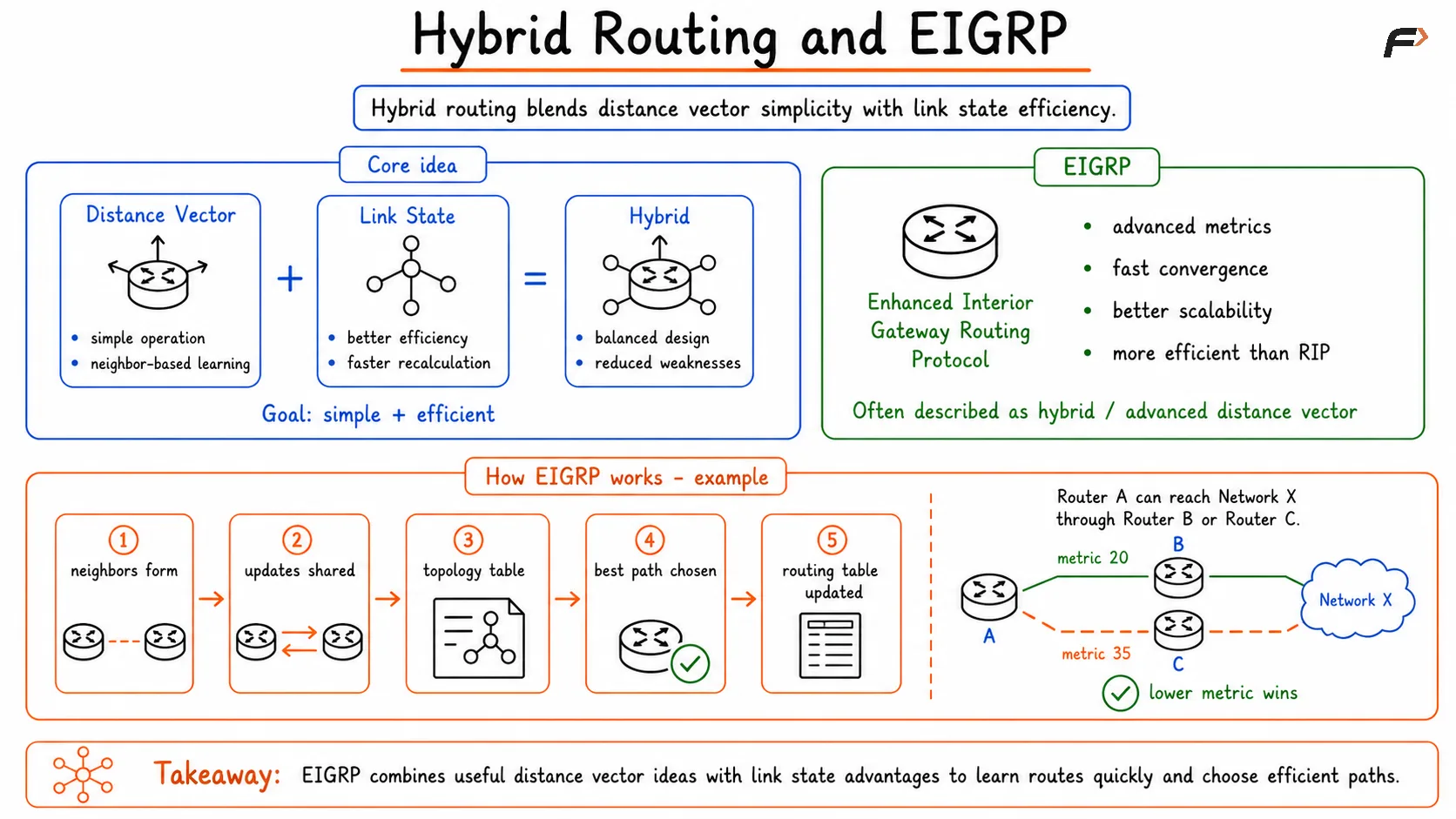
Hybrid Routing and EIRGP
The Core Idea of Hybrid Routing
The main philosophy of Hybrid Routing can be summarized like this:
Distance Vector side: Keep some operational simplicity.
Link State side: Gain better efficiency and faster route recalculation.
Overall goal: Reduce weaknesses found in older distance vector protocols.
A short way to express it is:
Hybrid Routing = Some Distance Vector ideas + Some Link State advantages
The exact internal mechanisms can vary by protocol, but the central idea is this balance.
EIGRP
The best-known example of Hybrid Routing is EIGRP, which stands for Enhanced Interior Gateway Routing Protocol.
EIGRP is often described as a hybrid protocol because it combines characteristics associated with both Distance Vector and Link State Routing. It is also commonly described as an advanced distance vector protocol because it improves traditional distance vector behavior with more efficient route handling.
Key Characteristics of EIGRP
Compared to traditional distance vector protocols such as RIP, EIGRP offers several improvements:
Advanced metrics: It supports richer metrics instead of relying only on hop count.
Faster recalculation: Route changes can be handled more efficiently.
Better scalability: It works better in larger and more complex networks.
Improved efficiency: Routing behavior is more optimized than basic distance vector protocols.
Because of these features, EIGRP is considered a more capable routing solution than traditional protocols like RIP.
Summary
Hybrid Routing acts as a bridge between Distance Vector Routing and Link State Routing. It tries to combine the simplicity of one with the efficiency and faster convergence of the other.
EIGRP is the most common example of this approach. It sits between RIP and OSPF in terms of capability and complexity, offering advanced metrics, better route recalculation, and improved scalability while remaining more manageable than a full link state protocol.
Be the first to add a comment.