Introduction
Hybrid encryption is a cryptographic approach that combines symmetric encryption and asymmetric encryption. It is used because both methods are useful, but neither is perfect on its own.
Symmetric encryption is very fast for protecting large amounts of data, but sharing the secret key safely is difficult. Asymmetric encryption helps solve the key exchange problem, but it is slower and not ideal for encrypting large data continuously.
Why Hybrid Encryption Exists
Hybrid encryption exists to combine the strengths of both cryptographic techniques. It uses asymmetric cryptography during the secure setup phase and symmetric encryption during the actual data transfer phase.
The idea is simple:
Asymmetric cryptography creates a secure beginning. Symmetric encryption handles fast communication after that.
This gives modern systems both security and performance.
Technique | Strength | Limitation |
|---|---|---|
Symmetric encryption | Fast and efficient for large data | Secret key must be shared safely |
Asymmetric encryption | Helps with secure key exchange and identity | Slower for bulk data encryption |
Hybrid encryption | Combines secure setup with fast data transfer | Requires proper implementation and key handling |
How Hybrid Encryption Works
In hybrid encryption, the actual message or data is usually encrypted using symmetric encryption. Before that can happen, both parties need a shared secret key or session key.
A simple flow looks like:
Asymmetric setup => Shared session key created => Symmetric encryption protects data
The asymmetric part helps establish or protect the shared key. Once both sides have the same session key, symmetric encryption is used for the rest of the communication because it is much faster.
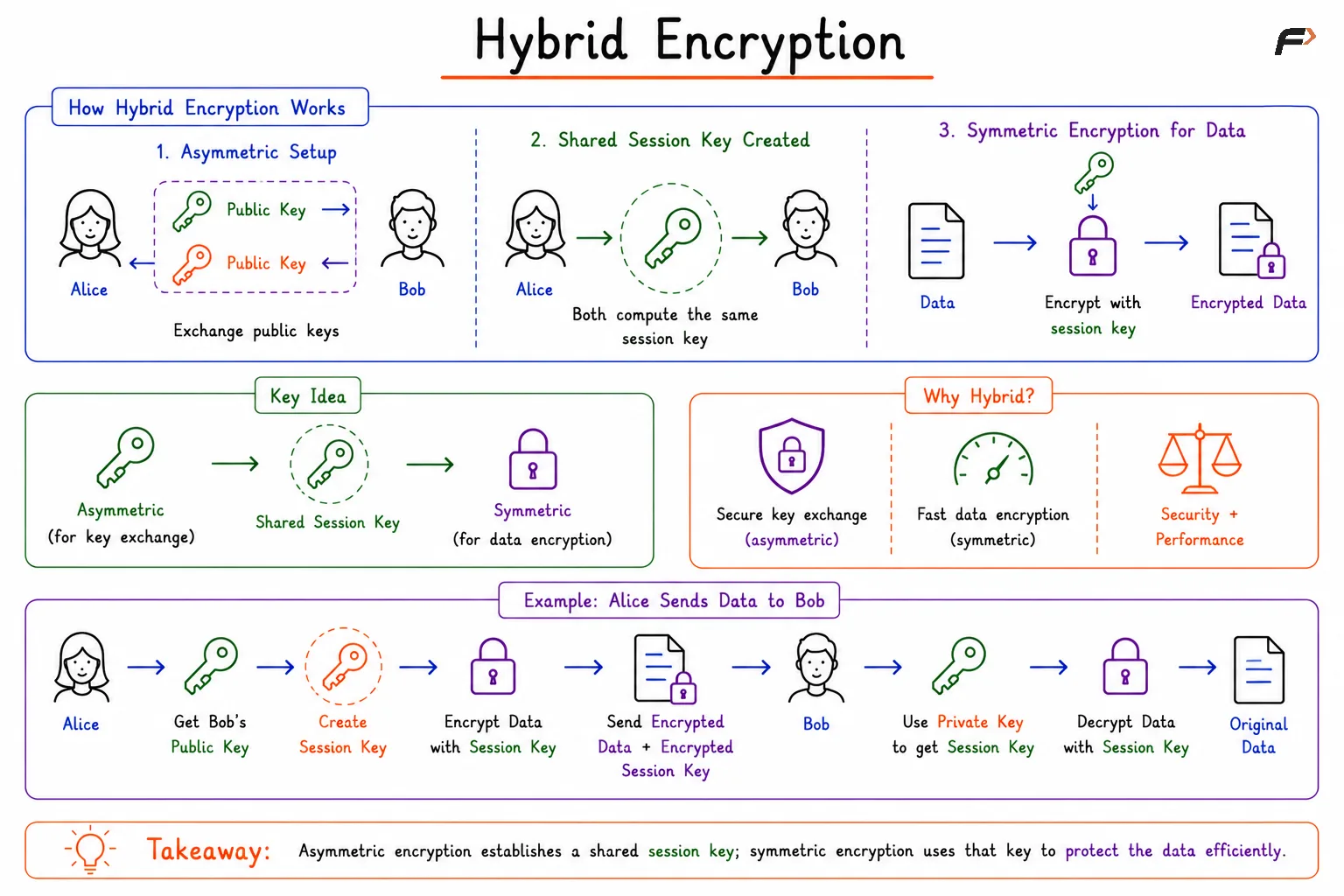
Hybrid Encryption
Role of Symmetric and Asymmetric Encryption
Hybrid encryption clearly separates the responsibility of both methods.
Asymmetric encryption: Used during the initial secure setup, key exchange, or key protection.
Symmetric encryption: Used to encrypt and decrypt the actual data after the shared key is available.
Session key: A temporary symmetric key used for one secure communication session.
Public and private keys: Used to safely establish trust or protect the symmetric key.
Encryption performance: Improved because large data is handled using fast symmetric encryption.
This design is practical because most real communication involves more than a small message. Web pages, files, API responses, videos, and application data need efficient encryption.
Why Hybrid Encryption Is Practical
Hybrid encryption is widely used because it matches how real systems work. Secure communication needs both safe key establishment and fast data transfer.
Hybrid encryption provides:
Secure key establishment: The shared key does not need to be sent openly.
Fast communication: Symmetric encryption handles the actual data efficiently.
Better scalability: Large amounts of traffic can be encrypted without excessive overhead.
Real-world usefulness: HTTPS, TLS, VPNs, secure messaging, and many application security systems use this approach.
Balanced security design: It avoids depending completely on only one cryptographic method.
Summary
Hybrid encryption combines asymmetric encryption and symmetric encryption to create secure and efficient communication. Asymmetric cryptography is used for the secure setup or key exchange phase, while symmetric encryption is used for encrypting the actual data.
This approach solves a practical problem: symmetric encryption is fast but has a key exchange challenge, while asymmetric encryption helps with secure key establishment but is slower. Hybrid encryption brings both together and is commonly used in TLS, HTTPS, VPNs, secure messaging, and modern network security systems.
Be the first to add a comment.