Introduction
Wi-Fi devices share the same wireless medium. Phones, laptops, tablets, printers, smart TVs, and access points all communicate using radio waves, and devices on the same channel must take turns using the air.
If two devices transmit at the same time, their signals may interfere with each other. This can corrupt frames, waste airtime, increase latency, and force retransmissions. To reduce this problem, Wi-Fi uses CSMA/CA, which stands for Carrier Sense Multiple Access with Collision Avoidance.
Why Wi-Fi Uses Collision Avoidance
Older shared Ethernet used CSMA/CD, where devices could transmit and detect collisions while sending data. Wi-Fi cannot rely on this approach because wireless communication behaves differently.
A wireless device usually cannot transmit and listen properly at the same time on the same channel. Its own transmitted signal is much stronger than the weak signals it might need to hear from other devices.
Feature | Wired Ethernet CSMA/CD | Wi-Fi CSMA/CA |
|---|---|---|
Main approach | Detect collisions after they happen | Try to avoid collisions before sending |
Medium | Cable | Radio spectrum |
Collision feedback | Device can detect collision while transmitting | Device usually depends on missing ACK |
Common method | Transmit, detect, retry | Listen, wait, back off, transmit |
Main goal | Collision detection | Collision avoidance |
Because detecting collisions is difficult in wireless networks, Wi-Fi tries to reduce the chance of collisions before transmission begins.
What Is CSMA/CA?
CSMA/CA is the medium access method used by Wi-Fi devices to share a wireless channel.
The name breaks down like this:
Carrier Sense: Listen to the wireless channel before transmitting.
Multiple Access: Many devices share the same radio medium.
Collision Avoidance: Devices follow waiting and backoff rules to reduce simultaneous transmissions.
The basic idea is simple: listen before talking, wait if someone else is talking, and use random backoff so multiple devices do not all speak at the same moment.
How CSMA/CA Works
A Wi-Fi device does not usually transmit immediately when it has data. It follows a controlled process to reduce collision probability.
The main steps are:
Channel sensing: The device checks whether the wireless channel is currently busy.
Interframe spacing: If the channel is idle, the device waits for a short defined interval before competing for access.
Random backoff: The device chooses a random timer so multiple waiting devices do not transmit together.
Frame transmission: When the backoff timer reaches zero, the device sends its frame.
Acknowledgement: The receiver sends an ACK if the frame is received correctly.
This process helps many devices share the same Wi-Fi channel without constant interference.
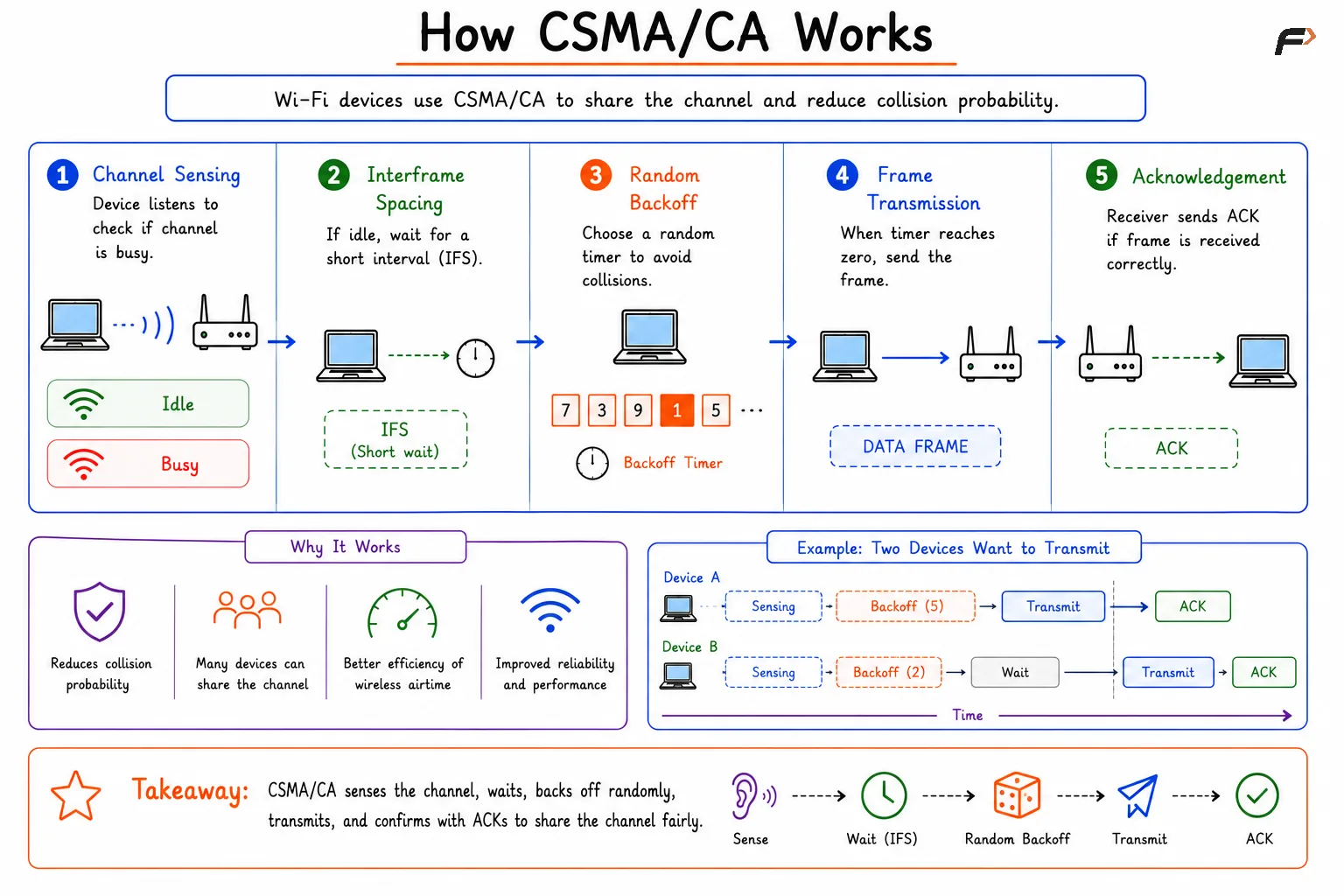
How CSMA-CA Works
Random Backoff and Contention Window
Random backoff is one of the most important parts of Wi-Fi collision avoidance. If several devices are waiting for the channel to become free, they should not all transmit immediately after it becomes idle.
Each device chooses a random number from a range called the contention window. The device then counts down while the channel remains idle.
For example:
Device | Random Backoff |
|---|---|
Phone | 3 slots |
Laptop | 7 slots |
Tablet | 2 slots |
The tablet transmits first because its timer reaches zero first. The others pause or continue later depending on channel activity.
If transmissions fail repeatedly, Wi-Fi can increase the contention window. This spreads future attempts over a wider time range and reduces the chance of repeated collisions.
ACKs and Retransmissions
Wi-Fi uses acknowledgements to confirm successful frame delivery. After a receiver gets a frame correctly, it sends an ACK back to the sender.
If the sender does not receive an ACK, it assumes the transmission failed. The reason may be collision, interference, weak signal, frame corruption, or receiver unavailability.
When no ACK is received:
Failure is assumed: The sender treats the frame as lost or corrupted.
Retransmission is scheduled: The frame is sent again later.
Backoff is used again: The sender waits before retrying.
Airtime is consumed: Repeated failures reduce overall Wi-Fi performance.
This is why collisions and interference matter so much in Wi-Fi. A failed frame does not only affect one packet; it also causes retries and wastes shared airtime.
Hidden Node Problem
CSMA/CA works well when devices can hear each other. But wireless networks can have a hidden node problem.
Suppose Client A and Client B can both hear the access point, but they cannot hear each other because of distance or walls. From Client A’s point of view, the channel may appear idle. From Client B’s point of view, the channel may also appear idle.
Both may transmit at the same time, and their frames can collide at the access point.
This is called a hidden node problem because the clients are hidden from each other even though both are connected to the same access point.
RTS/CTS Mechanism
RTS/CTS is an optional Wi-Fi mechanism used to reduce collisions in hidden node situations. It works like a small reservation process before actual data transmission.
RTS stands for Request To Send. CTS stands for Clear To Send.
Here is what happens:
RTS: The client asks for permission to transmit.
CTS: The access point replies and announces that the medium is reserved.
Other devices wait: Devices that hear the CTS remain silent for the reserved duration.
Data is sent: The client sends the actual data frame.
ACK confirms success: The access point acknowledges successful reception.
RTS/CTS adds overhead, so it is not always used for every frame. It is most useful when hidden nodes or large frames make collisions expensive.
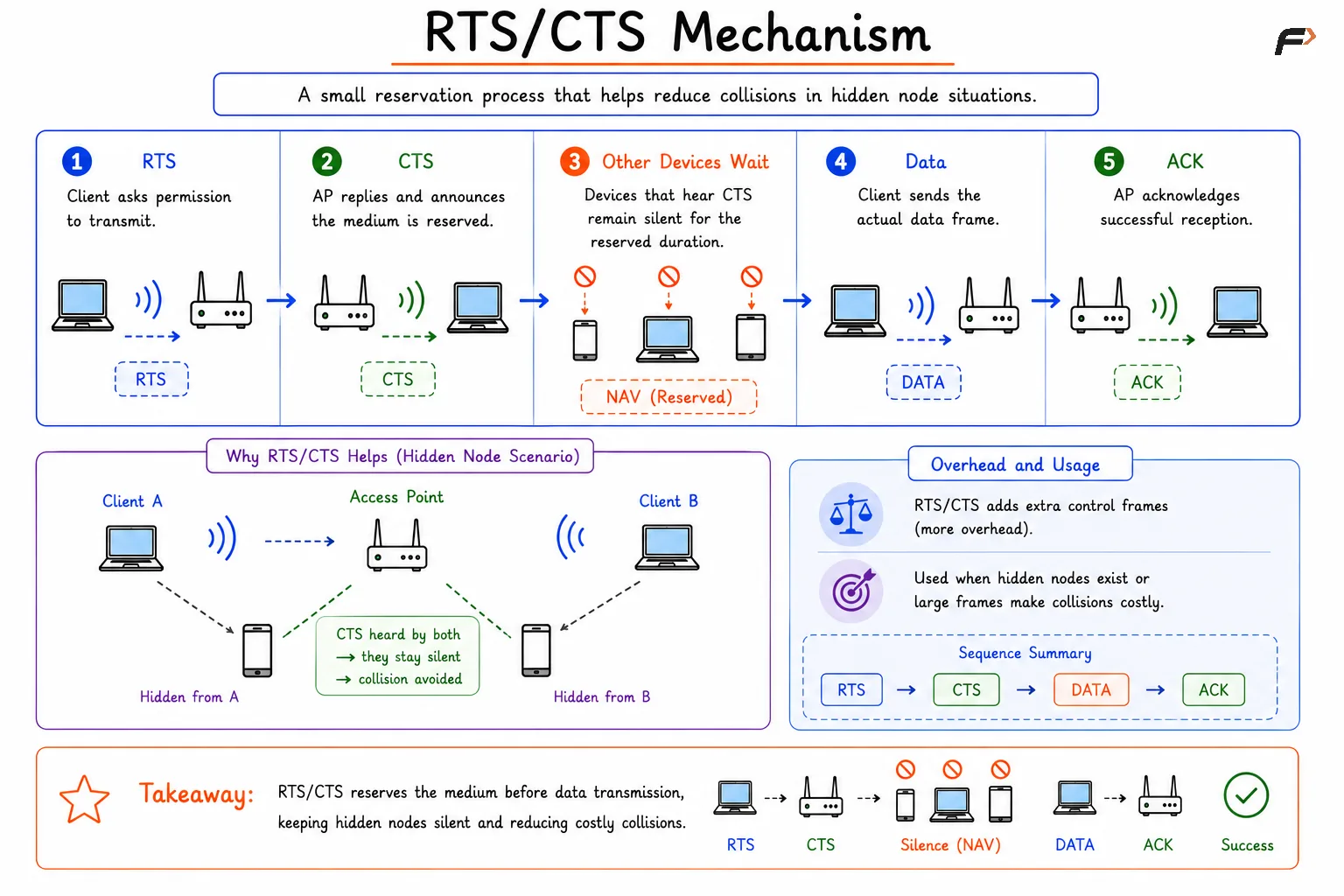
RTS and CTS Mechanism
Why Collisions Still Happen
CSMA/CA reduces collisions, but it cannot completely eliminate them. Wireless communication is affected by signal quality, interference, distance, obstacles, and device placement.
Collisions or failed transmissions may still happen because:
Two devices choose the same backoff: Randomness reduces risk but does not remove it completely.
Hidden nodes exist: Devices may not hear each other before transmitting.
Interference corrupts frames: Non-Wi-Fi signals or nearby networks may disturb transmission.
Weak signals cause errors: Low SNR can make frames harder to decode.
Crowded channels increase contention: More active devices means more competition for airtime.
Wi-Fi is designed to handle these failures through ACKs, retries, and backoff, but too many failures can reduce speed and increase latency.
Summary
Wi-Fi avoids collisions using CSMA/CA, which makes devices listen before transmitting, wait if the channel is busy, use random backoff, transmit only when allowed, and depend on ACKs to confirm successful delivery.
Unlike older shared Ethernet, Wi-Fi focuses on collision avoidance because wireless devices cannot reliably detect collisions while transmitting. RTS/CTS can further reduce hidden node problems by reserving the medium before data transmission. Together, CSMA/CA, random backoff, ACKs, retransmissions, and RTS/CTS help many wireless devices share the same radio channel more efficiently.
Be the first to add a comment.