Introduction
Whenever data travels across a network, it usually passes through multiple intermediate devices before reaching the destination. The method used to move that data through the network is called switching.
The three fundamental switching techniques are circuit switching, packet switching, and message switching.
What Are Switching Techniques?
Switching techniques define how a network handles data transmission between source and destination. Different techniques were developed because networks can move data in different ways depending on the goal, such as dedicated communication, efficient sharing, or store-and-forward delivery.
The three main techniques are:
Circuit switching: A complete path is established before data transfer begins
Packet switching: Data is divided into packets and forwarded independently
Message switching: The full message is treated as one unit and stored and forwarded hop by hop
Each technique solves the communication problem differently.
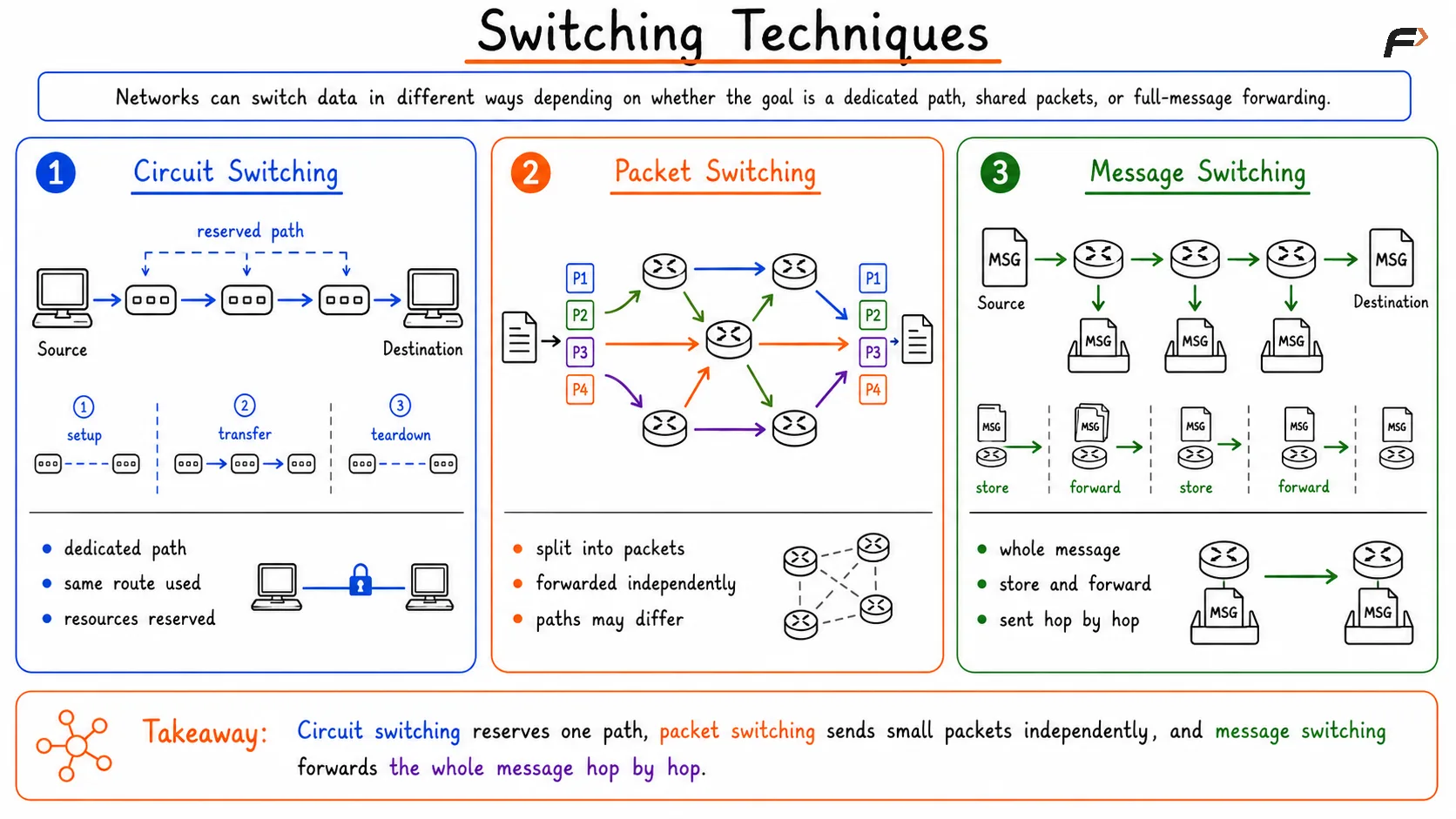
Switching Techniques - Circuit, Packet and Message Switching
Circuit Switching
Circuit switching creates a dedicated path between source and destination before any actual data is sent. The network first checks whether it can reserve resources along the route. Only after the full path is established does communication begin.
You can think of it as a private road reserved for one communication session. As long as the session continues, that path remains dedicated.
Key points of circuit switching
Dedicated path: One fixed route is established in advance
Reserved resources: Bandwidth and links are held for that session
Continuous transmission: Data flows once the path is ready
Predictable path: All data follows the same route
The biggest strength of circuit switching is stable communication after setup. The main drawback is that reserved resources may remain unused during silent periods, which reduces efficiency.
Packet Switching
Packet switching works in a much more flexible way. Instead of reserving a full path first, the original data is divided into smaller units called packets. Each packet carries destination information and moves through the network independently.
Routers examine packets at each hop and decide where to send them next. Because of this, different packets from the same communication may travel through different routes.
Key points of packet switching
No dedicated path: The network does not reserve one fixed route beforehand
Packet-based transmission: Data is broken into smaller manageable units
Independent forwarding: Each packet is handled separately
Dynamic path selection: Different packets may take different routes
Reassembly at destination: The original data is rebuilt after arrival
Packet switching is the foundation of modern computer networks because it uses network resources efficiently and supports many users at the same time.
Message Switching
Message switching does not break the data into packets. Instead, the entire message is treated as one unit. Each intermediate node first receives the complete message, stores it, decides the next hop, and then forwards it further.
This is called the store-and-forward approach.
Key points of message switching
Whole message as one unit: No packetization is done
Store-and-forward behavior: Each node stores the full message before forwarding
Hop-by-hop decision making: Forwarding decisions happen at each intermediate node
Higher delay for large messages: A node must receive the entire message before sending it onward
Message switching is important historically and conceptually, though modern computer networks rely much more on packet switching.
Summary
Switching techniques describe how data moves through a network. Circuit switching creates a dedicated path before communication begins, packet switching divides data into packets that travel independently, and message switching sends the entire message as one unit using store-and-forward delivery.
These three techniques form the basic foundation of network communication theory. Among them, packet switching is the most important in modern computer networks, but all three are useful for understanding how networks evolved and how data transmission can be organized.
Be the first to add a comment.