Introduction
Communication systems can transmit data in different ways depending on how devices exchange information. Two common communication modes are half duplex and full duplex. These modes determine whether data can travel in one direction at a time or in both directions simultaneously.
They define how communication takes place between connected devices and play an important role in the design and operation of modern communication and networking systems.
Half Duplex Communication
In half duplex communication, data can flow in both directions, but only one direction can be active at a time. A device can either transmit or receive data, requiring the communication channel to alternate between sending and receiving operations.
This mode of communication is similar to a walkie-talkie, where one person speaks while the other listens, and both parties cannot communicate simultaneously.
Key Characteristics
Supports bidirectional communication between devices.
Only one device can transmit data at any given moment.
The same communication channel is shared for sending and receiving.
Devices may need to wait before transmitting, which can introduce delays.
Common examples of half duplex communication include walkie-talkies, traditional radio communication systems, and older Ethernet networks that used hubs.
Full Duplex Communication
In full duplex communication, both devices can transmit and receive data simultaneously. This enables continuous two-way communication without requiring either side to wait for the other to finish transmitting.
A telephone conversation is a common example of full duplex communication, where both participants can speak and listen at the same time.
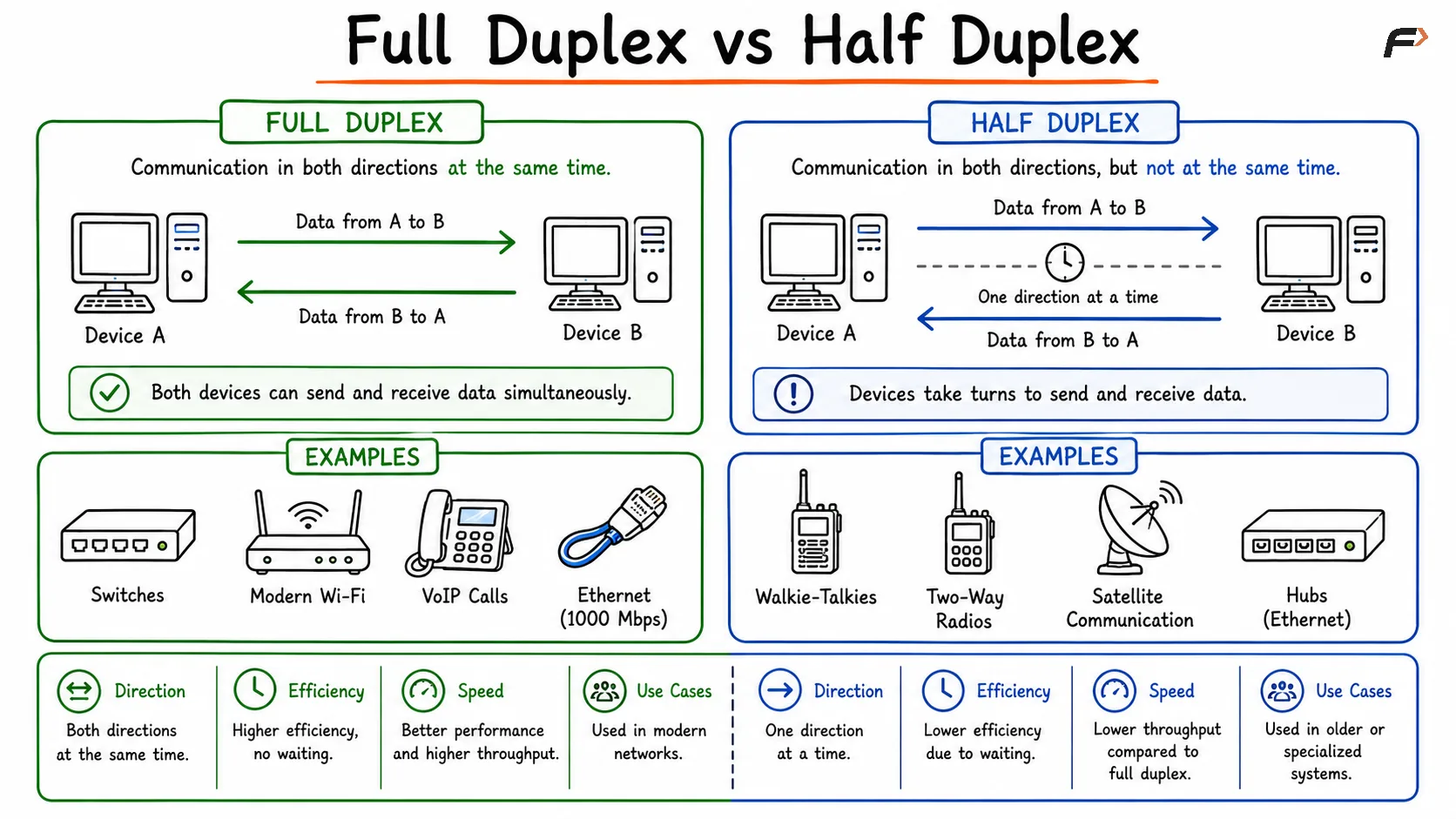
Comparison between full duplex and half duplex communication, showing simultaneous two-way data transfer in full duplex versus one-direction-at-a-time communication in half duplex, along with common examples and key differences.
Key Characteristics
Supports simultaneous transmission and reception of data.
Provides more efficient utilization of available bandwidth.
Reduces communication delays and waiting time.
Improves overall network performance and responsiveness.
Modern switched Ethernet networks, telephone systems, VoIP communication, and many fiber-optic communication systems operate using full duplex communication.
Half Duplex vs Full Duplex
Feature | Half Duplex | Full Duplex |
|---|---|---|
Data Flow | Both directions, but one at a time. | Both directions simultaneously. |
Transmission | Send or receive. | Send and receive together. |
Channel Usage | Shared between both directions. | Dedicated for simultaneous communication. |
Performance | Lower efficiency. | Higher efficiency. |
Delay | Higher due to waiting. | Lower due to parallel communication. |
Collision Possibility | Possible in shared-medium environments. | No collisions during simultaneous communication. |
Examples | Walkie-talkies, legacy Ethernet hubs. | Switch-based Ethernet, telephones, VoIP. |
Summary
Duplex communication enables two devices to exchange data and is classified into half duplex and full duplex based on the direction of data transmission. In half duplex communication, data travels in both directions but only one direction at a time, whereas full duplex communication allows simultaneous transmission and reception of data.
Half duplex communication is suitable for applications where simultaneous communication is not required, while full duplex communication offers faster, more efficient, and uninterrupted data exchange. As a result, full duplex is widely used in modern networking and communication systems due to its better performance and reduced communication delays.
Be the first to add a comment.