Introduction
Fiber optic cable is a high-speed transmission medium that carries data using light signals instead of electrical signals. It consists of thin strands of glass or plastic through which light travels with very little signal loss, making fiber one of the fastest and most reliable communication technologies used in modern networks.
Layers of a Fiber Optic Cable
Layer | Description | Purpose |
|---|---|---|
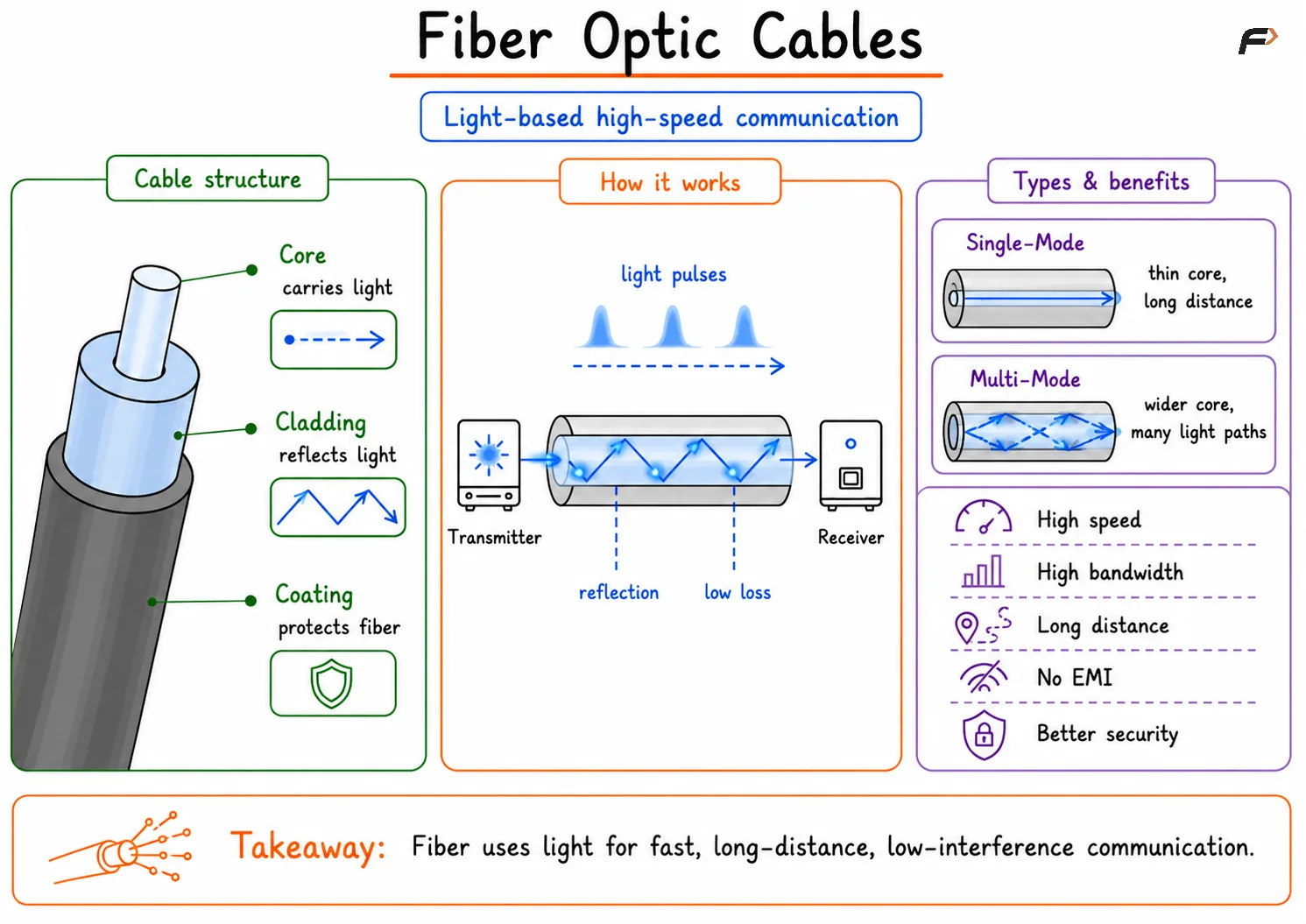
Core | The innermost glass or plastic portion of the fiber. | Carries the light signals that transmit data. |
Cladding | The layer surrounding the core. | Reflects light back into the core to keep it moving forward. |
Coating | The outer protective layer. | Protects the fiber from moisture, scratches, and physical damage. |
How Fiber Optic Cables Work
Data is transmitted as pulses of light through the core of the fiber cable. The surrounding cladding reflects the light back into the core, allowing it to continue traveling over long distances with minimal loss of signal strength. This mechanism enables high-speed communication and supports long-distance data transmission.
Fiber Optic Cables
Key Features of Fiber Optic Cables
Supports extremely high-speed data transmission.
Provides very high bandwidth capacity.
Offers long-distance communication with minimal signal loss.
Immune to electromagnetic interference (EMI).
Provides better security since tapping fiber links is difficult.
Types of Fiber Optic Cables
Fiber optic cables are primarily classified into Single Mode Fiber (SMF) and Multi-Mode Fiber (MMF). Single Mode Fiber uses a small core and a single light path, making it suitable for long-distance, high-bandwidth communication, while Multi-Mode Fiber uses a larger core that allows multiple light paths and is commonly used for shorter-distance communication within buildings, campuses, and data centers.
Single Mode vs Multi-Mode Fiber
Aspect | Single Mode Fiber (SMF) | Multi-Mode Fiber (MMF) |
|---|---|---|
Core Size | Smaller core with a single light path. | Larger core supporting multiple light paths. |
Distance | Suitable for long-distance communication. | Suitable for shorter-distance communication. |
Bandwidth | Very high bandwidth capacity. | Good bandwidth but lower than SMF. |
Light Source | Typically uses lasers. | Typically uses LEDs or VCSELs. |
Cost | Generally more expensive. | Usually more cost-effective. |
Common Fiber Connectors
Different fiber installations use different connector types depending on the application and network environment.
Connector | Full Name | Common Use |
|---|---|---|
SC | Subscriber Connector / Standard Connector | Telecom systems, patch panels, and traditional fiber deployments. |
LC | Lucent Connector | Modern switches, routers, and data centers. |
ST | Straight Tip | Older LAN and campus networking environments. |
FC | Ferrule Connector | Telecom and long-distance communication systems. |
MPO / MTP | Multi-fiber Push-On Connector | High-density and high-speed data center environments. |
Summary
Fiber optic cable is a high-speed communication medium that transmits data as light signals through thin glass or plastic fibers instead of electrical signals. It consists of a core, cladding, and protective coating, allowing light to travel long distances with minimal signal loss. Fiber optics provide high bandwidth, fast data transfer, resistance to electromagnetic interference, and enhanced security, making them ideal for modern communication networks.
Fiber optic cables are mainly of two types: Single Mode Fiber (SMF), which uses a small core for long-distance, high-bandwidth communication, and Multi-Mode Fiber (MMF), which uses a larger core for shorter-distance applications such as buildings and data centers. Common connectors include SC, LC, ST, FC, and MPO/MTP, each designed for different networking environments and installation requirements.
Be the first to add a comment.