Introduction
When data is sent across a network, it does not move directly from an application onto a cable or wireless signal. It passes through multiple networking layers, and each layer adds information required for its own responsibility.
This process is called encapsulation. At the receiver side, the reverse process happens. Each layer reads and removes its own information before passing the remaining data upward. This reverse process is called decapsulation.
Encapsulation: Each layer adds its own header, and sometimes a trailer, as data moves down the network stack.
Decapsulation: Each layer removes and processes its own header as data moves up the network stack.
Why Encapsulation Is Needed
A browser may create an HTTP request, but the network needs more than just the request data to deliver it properly. Different layers add different information so the data can reach the correct device and the correct application.
Encapsulation helps answer important questions:
Which application should receive the data?
Which port number should be used?
Which IP address should the data go to?
How should the data move across different networks?
Which device should receive it on the local network?
How should the data be converted into physical signals?
Each networking layer solves one part of the communication problem. Encapsulation keeps these responsibilities organized.
Encapsulation Process
As data moves from the sender’s application toward the network medium, each layer adds its own information.
Application Layer: Creates the original data, such as an HTTP request, email message, chat message, or DNS query.
Transport Layer: Adds TCP or UDP information, including source and destination port numbers. With TCP, this layer may also handle sequencing, acknowledgements, retransmission, and flow control.
Network Layer: Adds IP addressing information, including source IP, destination IP, TTL, and protocol details. This allows routers to forward the packet across networks.
Data Link Layer: Wraps the IP packet inside a frame using MAC addresses and error-detection information such as FCS.
Physical Layer: Converts the frame into bits and transmits them as electrical signals, light pulses, or radio waves.
A simple encapsulation flow is:
Application Data => Segment/Datagram => Packet => Frame => Bits
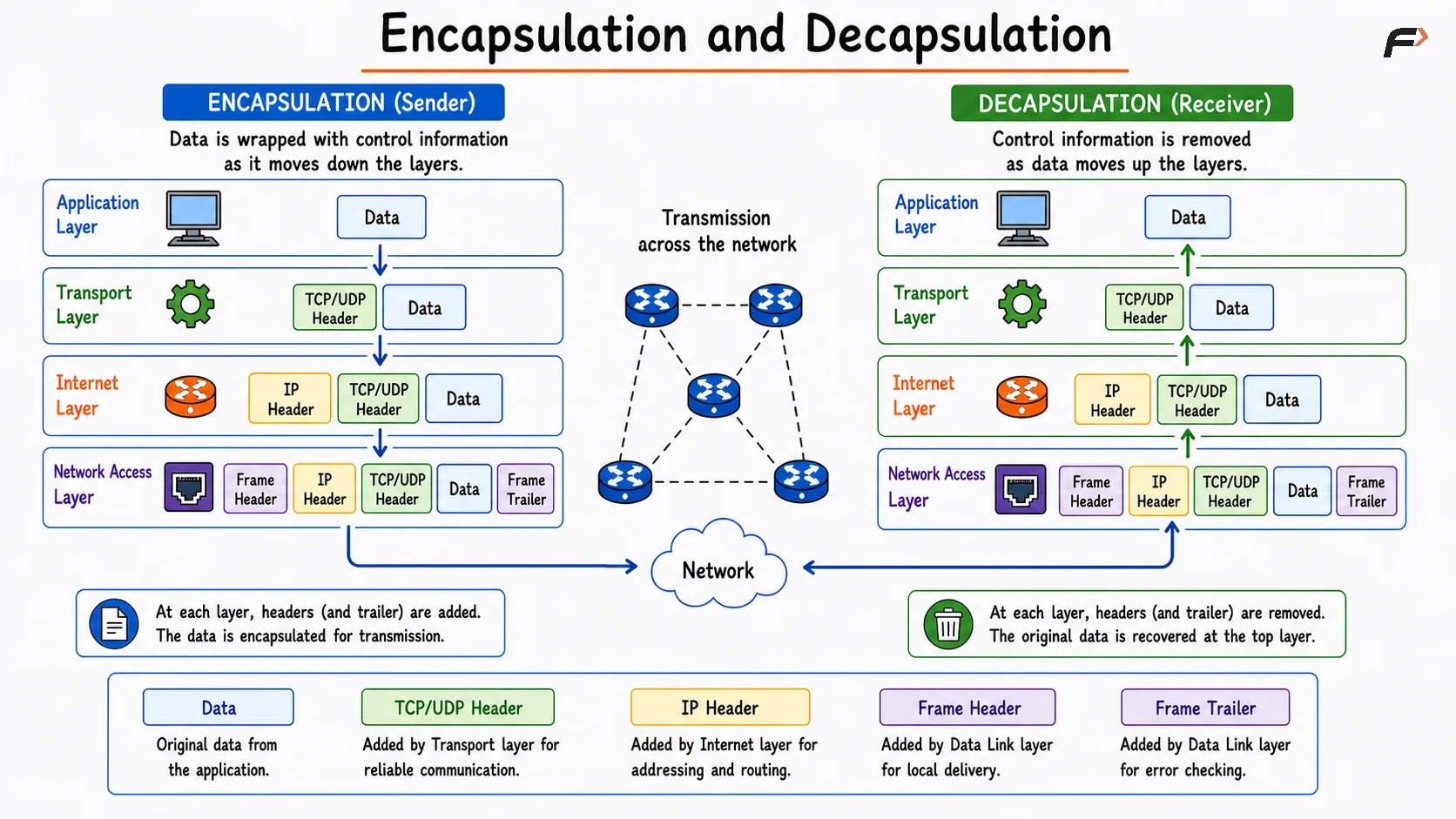
Side-by-side view of encapsulation and decapsulation, showing how protocol headers are added as data moves down the network layers at the sender and removed in reverse order as the receiver reconstructs the original data.
Decapsulation Process
When the data reaches the destination device, the process happens in reverse. Each layer reads its own information, removes it, and passes the remaining data to the next layer above.
Physical Layer: Receives signals from the medium and converts them back into bits.
Data Link Layer: Reconstructs the frame, checks the destination MAC address, verifies error-detection information, and passes the IP packet upward.
Network Layer: Reads the IP header, checks whether the packet has reached the correct destination, and passes the transport data upward.
Transport Layer: Uses port numbers to deliver data to the correct application. In TCP, it may also reorder segments and handle reliability.
Application Layer: Receives the original meaningful data, such as an HTTP response, DNS response, or email message.
Encapsulation vs Decapsulation
Aspect | Encapsulation | Decapsulation |
|---|---|---|
Direction | Sender side, moving down the layers | Receiver side, moving up the layers |
Main action | Adds headers and sometimes trailers | Removes headers and trailers |
Purpose | Prepares data for network transmission | Reconstructs original application data |
Example flow | Data => Segment => Packet => Frame => Bits | Bits => Frame => Packet => Segment => Data |
Summary
Encapsulation is the process of adding layer-specific information as data moves down the network stack. Transport headers, IP headers, MAC addresses, and physical signals all help the data travel correctly.
Decapsulation is the reverse process at the receiver. Each layer removes and processes its own information until the original application data is restored and delivered to the correct application.
Be the first to add a comment.