Introduction
Dynamic routing is the routing approach used when networks need to adjust automatically as conditions change. Instead of depending on a network administrator to manually enter every route, routers exchange routing information with one another and update their routing tables over time.
This is important because real networks are rarely fixed. Links can fail, routers can be added, costs can change, and better paths can appear. A network that cannot react to those changes quickly becomes difficult to operate.
What Dynamic Routing Means
Dynamic routing is a routing method in which routers use routing protocols to discover networks, share route information, and automatically update routing tables. The key idea is that route learning happens through communication between routers, not only through manual configuration.
A simple way to think about it is:
Routers share information: They exchange routing updates.
Routers learn routes: They build knowledge of reachable destinations.
Routers adapt to changes: They update routes when the topology changes.
That ability to keep adjusting over time is what makes routing dynamic.
Why Dynamic Routing Is Needed
Static routing works well in small and predictable environments, but larger networks change too often for manual routing to remain practical. If every route had to be typed and updated by hand, operations would become slow, error-prone, and difficult to scale.
Dynamic routing exists because networks need to handle:
Link failures: A working path can disappear unexpectedly.
Path recovery: A failed route may become available again later.
Network growth: New routers and new networks may be added.
Changing path quality: Bandwidth, delay, congestion, or policy can affect route choice.
Operational scale: Large networks cannot be maintained efficiently through manual routes alone.
This is why dynamic routing is a standard requirement in enterprise, ISP, and internet-scale environments.
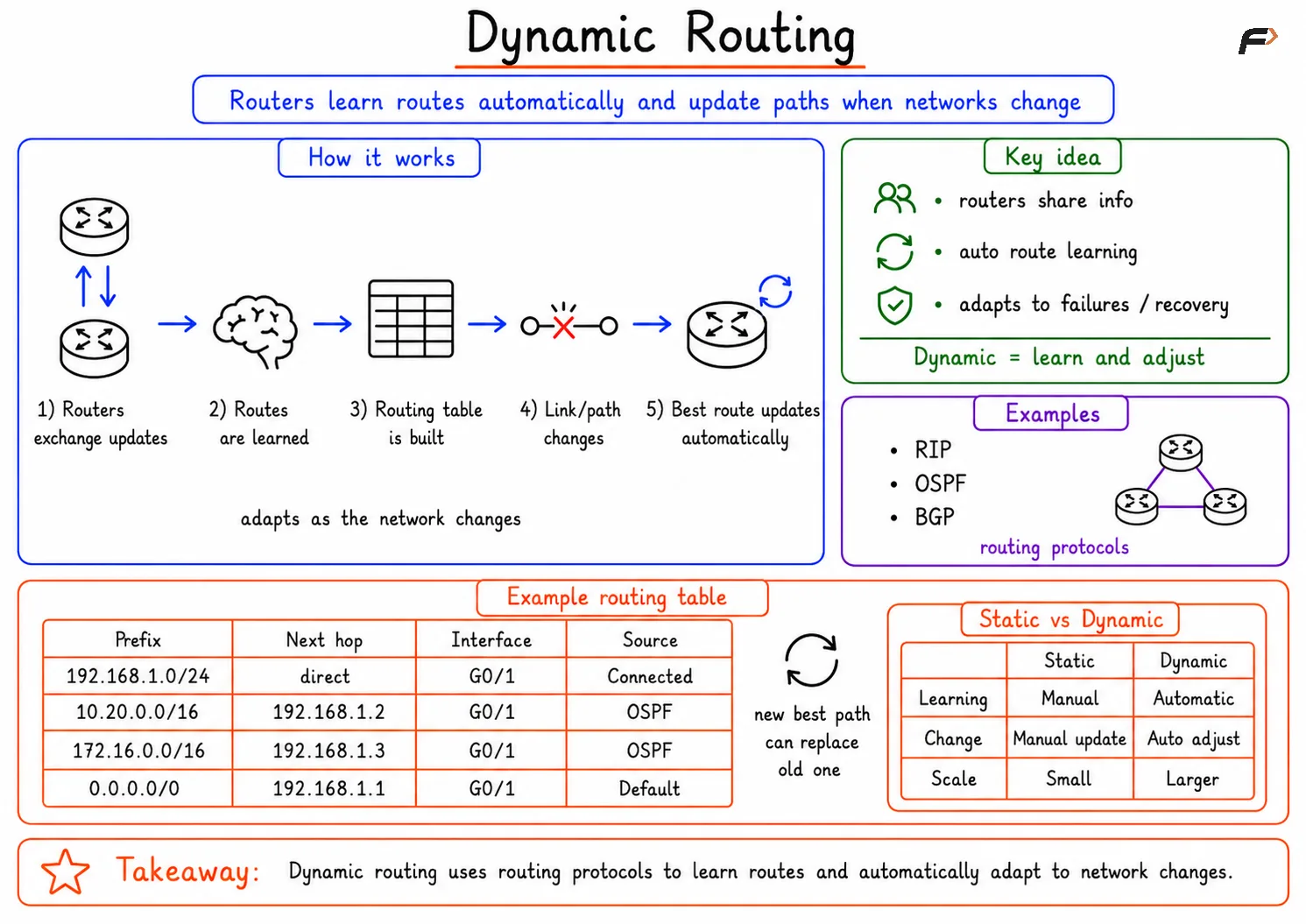
Dynamic Routing
Static Routing vs Dynamic Routing
Aspect | Static Routing | Dynamic Routing |
|---|---|---|
Route creation | Manual | Automatic |
Route updates | Manual | Automatic |
Response to topology changes | No automatic adaptation | Adapts through routing protocols |
Best fit | Small, stable networks | Larger or changing networks |
Operational overhead | Low in small networks, difficult at scale | More protocol overhead, easier at scale |
Scalability | Limited | Stronger |
Static routing gives strict control and simplicity for small setups. Dynamic routing gives automation and adaptability for real-world network growth.
How Dynamic Routing Helps a Network
Dynamic routing improves network behavior because routers can react without waiting for a human to reconfigure them.
Its major benefits include:
Automatic route discovery: Routers learn reachable networks on their own.
Automatic adaptation: Route changes happen when failures or recoveries occur.
Better scalability: The network can grow without requiring every route to be typed manually.
Reduced manual configuration: Administrators do not need to manage every path by hand.
Improved path selection: Routing protocols can choose better routes based on defined metrics or policies.
This makes dynamic routing essential in networks where availability and scalability matter.
Interior and Exterior Routing
Dynamic routing protocols are often grouped into two major categories: Interior Gateway Protocols and Exterior Gateway Protocols. The difference depends on where the protocol operates.
Before that, one key term is important: an Autonomous System, or AS, is a collection of networks and routers managed by one administrative authority, such as a company, ISP, or cloud provider.
Category | Full Form | Where It Operates | Common Goal | Examples |
|---|---|---|---|---|
IGP | Interior Gateway Protocol | Inside one autonomous system | Efficient internal path selection | RIP, OSPF, EIGRP |
EGP | Exterior Gateway Protocol | Between autonomous systems | Inter-domain routing across organizations | BGP |
IGPs focus on routing inside one administrative domain. EGPs focus on routing between different administrative domains.
Common Dynamic Routing Protocol Families
Dynamic routing protocols do not all work the same way. They are often grouped by how they learn and calculate routes.
Distance Vector
Distance vector protocols learn routes mainly from neighboring routers. A router asks its neighbors what destinations they know and what cost is associated with those destinations.
The router then chooses the best route based on the information received from its neighbors.
Main idea: Learn destinations and distance from neighbors
Typical example: RIP
General behavior: Simpler design, but less detailed view of the full network
Link State
Link state protocols work differently. Instead of learning only neighbor distance information, routers build a broader view of the network topology and then calculate the best path themselves.
Main idea: Learn the network layout and compute the best path
Typical example: OSPF
General behavior: Better visibility and faster reaction in larger networks
Hybrid
Hybrid protocols combine ideas from more than one routing approach. They aim to balance efficiency, scalability, and convergence behavior.
Main idea: Blend useful features from different routing models
Typical example: EIGRP
General behavior: Tries to combine simplicity with better adaptation
Why BGP Is Special
Among all routing protocols, BGP is especially important because it is the main protocol used for large-scale internet routing between autonomous systems.
Inside one organization, the shortest or lowest-cost path is often the main concern. Between different organizations, routing becomes more complex because decisions may also depend on:
Business policies
Administrative control
Traffic engineering
Peering relationships
Internet-scale routing design
That is why BGP is different from protocols like RIP or OSPF. It is not focused only on shortest paths. It is designed for policy-driven inter-domain routing.
Summary
Dynamic routing is a routing method in which routers automatically exchange routing information, learn reachable networks, and update routing tables as network conditions change. It exists because real networks are not static. Links fail, paths recover, new devices are added, and route quality can change over time.
Its major strengths are automation, scalability, and adaptability. Dynamic routing protocols are commonly grouped into IGP and EGP categories, with well-known examples such as RIP, OSPF, EIGRP, and BGP. Together, these protocols help modern networks keep routing information current and make packet delivery far more practical in changing environments.
Be the first to add a comment.