Introduction
Distance vector routing is one of the oldest and most important approaches in dynamic routing. It was designed around a simple idea: routers do not need to know the full network map. Instead, they can learn routes gradually by talking only to their immediate neighbors.
This makes the method easy to understand and historically very important. At the same time, it also creates some clear limitations, especially when the network becomes large or changes too often.
What Distance Vector Routing Means
Distance vector routing is a dynamic routing approach in which each router shares its knowledge of reachable destinations with neighboring routers. The router does not advertise the full topology. It only advertises how far destinations are and through which direction they can be reached.
The name itself explains the idea:
Distance: The cost or metric required to reach a destination
Vector: The direction or next hop used to reach that destination
So a router is essentially telling its neighbors two things:
How far a destination is
Which direction should be used to reach it
Core Idea Behind Distance Vector Routing
At the heart of distance vector routing is a simple question:
How far is every destination from me?
Each router keeps trying to answer that question for all known destinations. It does that by exchanging route information with its neighbors, comparing available paths, and gradually updating its routing table.
Over time, routers learn better routes and the network moves toward a stable state. This process is called convergence.
Bellman-Ford Intuition
Distance vector routing is based on the intuition of the Bellman-Ford algorithm. A router does not build a complete map of the entire network. Instead, it depends on:
Its directly connected neighbors
The cost to those neighbors
The route information those neighbors advertise
The router then calculates its best path by combining local knowledge with neighbor information. This makes the whole process distributed and iterative.
How Route Selection Works
Suppose a router wants to reach a particular destination network. Several neighbors may advertise paths to that destination. The router evaluates each option using a simple idea:
Cost to neighbor + Neighbor's advertised cost to destination = Total path cost
The router compares these total costs and chooses the path with the smallest value.
In simple terms, the router asks: Which neighbor gives me the cheapest path to this destination?
The path with the lowest total cost becomes the preferred route.
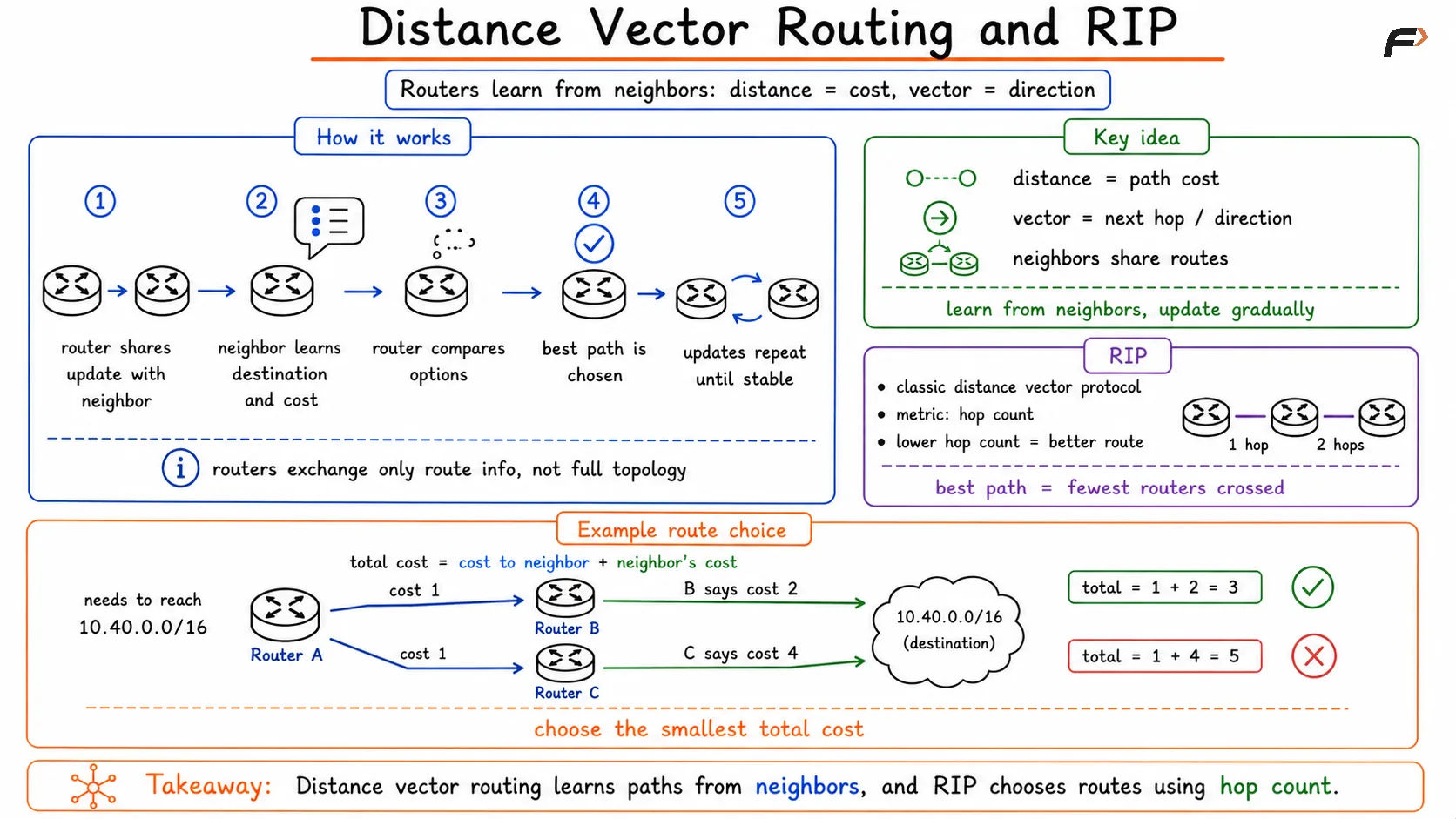
Distance Vector Routing and RIP
Why Routers Trust Neighbor Information
A distance vector router does not verify the entire path for itself. It trusts the route information provided by neighboring routers. If a neighbor says it can reach a destination with a certain cost, that information is used in the calculation.
This means the router does not need to know:
Every intermediate router on the path
The full network topology
All possible links in the network
This neighbor-based trust is one reason distance vector routing is simple, but it is also one reason it can be less efficient in large or changing environments.
RIP as the Classic Example
The best-known example of a distance vector routing protocol is RIP, or Routing Information Protocol. RIP became widely known because it followed the distance vector model in a very direct and easy-to-understand way.
RIP uses a very simple metric:
Hop count
A hop is one router that a packet must pass through. The lower the hop count, the better the route is considered.
For example:
Path A: 3 hops
Path B: 5 hops
RIP selects Path A because it has the smaller hop count.
RIP and the 15-Hop Limitation
One of the most important limitations of RIP is its maximum hop count. RIP allows a maximum distance of 15 hops. If a route requires more than that, RIP treats it as unreachable.
That means:
1 to 15 hops: Reachable
16 hops: Unreachable or infinity
This limitation made RIP easy to implement, but it also made it unsuitable for large modern networks.
Advantages of Distance Vector Routing
Distance vector routing became popular because it offered a simple and practical routing method, especially in early or smaller networks.
Its main advantages are:
Simple design: Easy to understand and explain
Easy implementation: Fewer complexities than topology-heavy protocols
Limited knowledge requirement: Routers do not need the full network map
Useful in small networks: Can work well in stable and compact environments
Lower conceptual overhead: The decision process is straightforward
This simplicity is the biggest reason distance vector routing remained important in networking history.
Limitations of Distance Vector Routing
The same simplicity that makes distance vector routing easy to understand also creates several weaknesses.
Its main limitations are:
No complete topology knowledge: Routers cannot see the full network structure
Heavy dependence on neighbor advertisements: Wrong or delayed information can affect route quality
Slow convergence: Route updates can take time to spread across the network
Scalability limits: It works poorly in medium or large modern networks
Metric simplicity in older protocols: Protocols like RIP use hop count only, which ignores bandwidth, delay, or quality
These issues are why more advanced protocols such as OSPF became more common in larger enterprise environments.
Summary
Distance vector routing is a dynamic routing method in which routers exchange route information with neighboring routers and calculate the best path using distance metrics and next-hop direction. It is based on Bellman-Ford ideas and works by trusting neighbor advertisements instead of building a complete map of the entire network.
Its biggest strengths are simplicity and ease of implementation, especially in small networks. Its biggest weaknesses are slow convergence, limited topology awareness, and poor scalability in larger environments. RIP is the classic example of a distance vector routing protocol, which makes this routing model one of the foundational concepts in computer networking.
Be the first to add a comment.