Introduction
Datagram packet switching is one of the most important ideas in computer networking because it explains how the Internet actually moves data. Instead of creating one fixed path before transmission begins, the network breaks data into packets and treats each packet as an independent unit.
This gives the network flexibility. Packets can be forwarded according to current routing information, shared bandwidth can be used efficiently, and communication can continue even when routes change.
What Is Datagram Packet Switching?
Datagram packet switching is a type of packet switching in which every packet is handled independently by the network. There is no dedicated path reserved before communication starts.
Each packet, or datagram, carries enough information for routers to decide where it should go next. Because of this, the network does not need to remember a fixed path for the whole communication session.
In simple terms:
Data is divided into packets
Each packet is forwarded independently
Routers make hop-by-hop decisions
The destination reassembles the original data
This is the basic model used by IP networks.
Why It Is Called a Datagram
A datagram is a self-contained packet. It carries the information needed for forwarding, such as source and destination addressing, along with the payload.
For example:
IPv4 packet: Often called an IPv4 datagram
IPv6 packet: Often called an IPv6 datagram
The key idea is that the datagram is independent. A router does not need to know about earlier or later packets from the same message in order to forward the current one.
How Datagram Packet Switching Works
Suppose a user sends a file, loads a webpage, or makes an API request. The original data is first divided into multiple packets. These packets then enter the network one by one.
A simple flow looks like this:
The data is divided into datagrams.
The datagrams enter the network.
Routers forward the datagrams independently.
The datagrams reach the destination.
The receiver reassembles the original data.
At each router:
The router reads the destination IP address
It checks the routing table
It chooses the next hop
It forwards the packet through the appropriate interface
This process repeats until the datagram reaches the destination network.
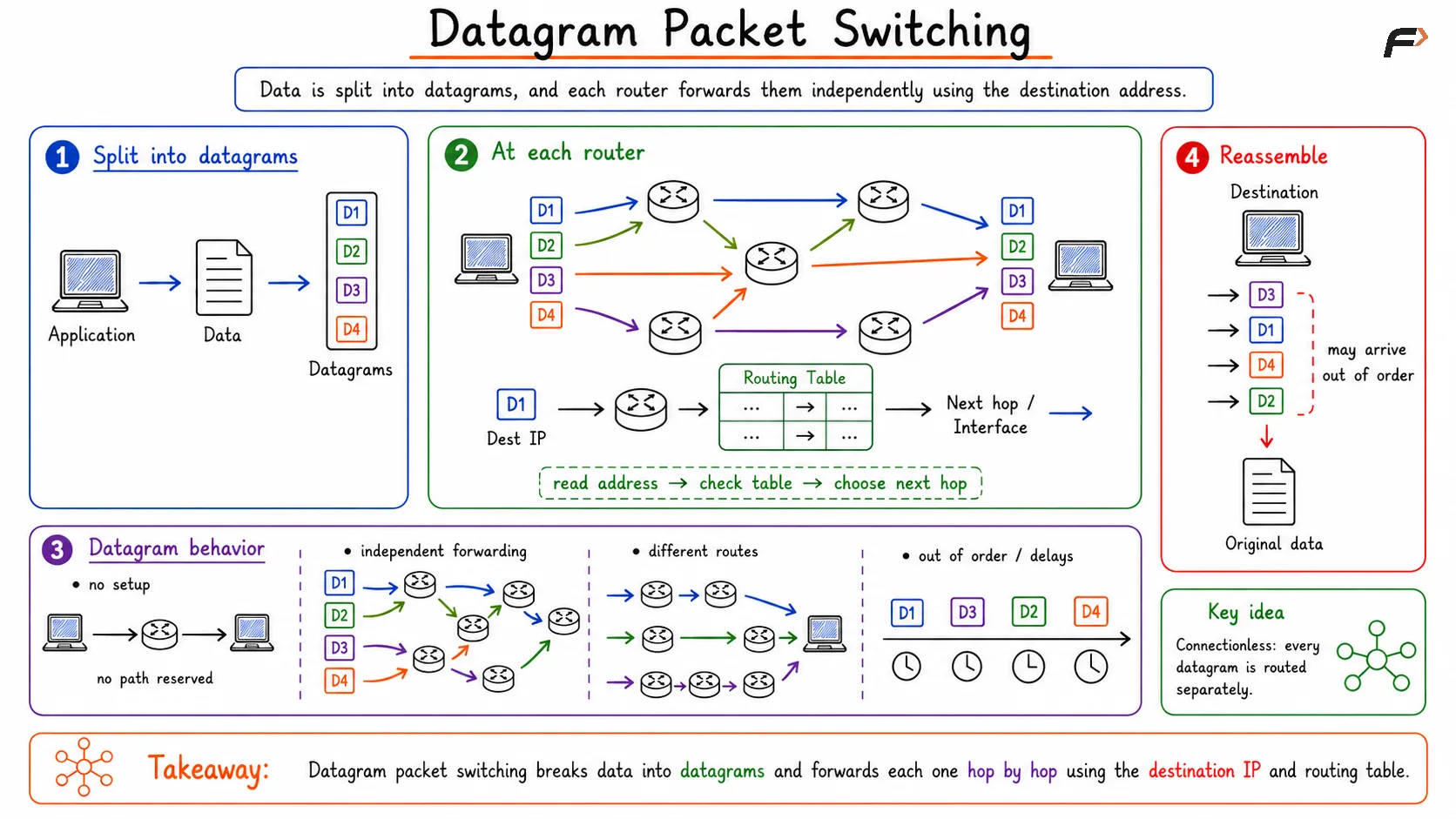
Datagram Packet Switching
Can Packets Take Different Paths?
Yes. That is one of the defining features of datagram packet switching.
Since every packet is forwarded independently, different packets from the same communication can take different routes. This can happen because of routing changes, load conditions, failures, or changing path availability.
For example:
Packet 1 may follow Path A
Packet 2 may follow Path B
Packet 3 may again follow Path A
In practice, packets from the same flow often follow the same path for some time because routing remains stable, but the network is not forced to keep them together.
Advantages of Datagram Packet Switching
Datagram switching became the foundation of modern IP networking because it offers several practical benefits:
Flexibility: Packets can adapt to changing network conditions
Scalability: It works well in very large distributed networks
Efficient resource use: No dedicated bandwidth is reserved unnecessarily
Fast start of communication: No circuit setup is required before sending
Robustness: Alternate routes can be used when failures happen
These properties are especially important in real-world internet communication, where conditions keep changing.
Limitations of Datagram Packet Switching
Even though datagram switching is efficient, it also has some limitations because the network treats each packet independently.
Out-of-order arrival: Packets may reach the destination in a different order
Variable delay: Some packets may face more delay than others
Packet loss: Congestion or failures can cause packets to be dropped
No built-in delivery guarantee: The network forwards packets on a best-effort basis
No reserved bandwidth: Communication quality is not guaranteed by the datagram model itself
This is why higher-layer protocols are often needed for reliability.
Reliability and Higher-Layer Protocols
Datagram packet switching itself does not guarantee that packets will arrive, arrive in order, or arrive only once. Its job is forwarding, not full reliability.
Protocols such as TCP handle the reliability layer when needed. TCP can provide:
Retransmission
Ordering
Flow control
Congestion control
So a simple way to remember this is:
Datagram switching: Moves packets
TCP: Makes communication reliable when required
Datagram vs Virtual Circuit Packet Switching
Packet switching is commonly discussed in two forms: datagram packet switching and virtual circuit packet switching.
Aspect | Datagram Packet Switching | Virtual Circuit Packet Switching |
|---|---|---|
Path setup | No fixed path is established first | A logical path is selected before data transfer |
Packet handling | Each packet is routed independently | Packets usually follow the chosen logical path |
Flexibility | Higher | Lower than datagram switching |
Common example | Internet IP networks | Virtual-circuit style packet networks |
The modern Internet mainly follows the datagram model.
Summary
Datagram packet switching is a packet-switching method where each packet is treated as an independent datagram and forwarded hop by hop using routing information. There is no dedicated path, no reserved bandwidth, and no requirement that all packets follow the same route.
This makes datagram packet switching flexible, scalable, and efficient for shared networks like the Internet. Even though it can lead to packet loss, variable delay, and out-of-order delivery, higher-layer protocols such as TCP help provide reliability when applications need it.
Be the first to add a comment.