Introduction
Cryptography is the practice of protecting information using mathematical techniques. In computer networks, it helps keep data safe while it moves between users, devices, servers, and applications.
Networking is responsible for moving data from one place to another. Cryptography is responsible for protecting that data so unauthorized people cannot read it, modify it, or pretend to be someone else.
Why Cryptography Is Needed
The internet is a public and untrusted network. When data travels from a client to a server, it may pass through Wi-Fi routers, Internet Service Providers, backbone networks, and several intermediate routers.
If this data is sent without protection, anyone with access to the communication path may try to observe or manipulate it. This is dangerous when the data contains passwords, messages, banking details, personal information, or business records.
Cryptography helps solve this problem by converting readable data into protected form using algorithms and keys. Some basic terms related to cryptography are:
Plaintext: The original readable data.
Ciphertext: The scrambled unreadable data after encryption.
Key: A secret value used to encrypt or decrypt data.
Encryption: The process of converting plaintext into ciphertext.
Decryption: The process of converting ciphertext back into plaintext.
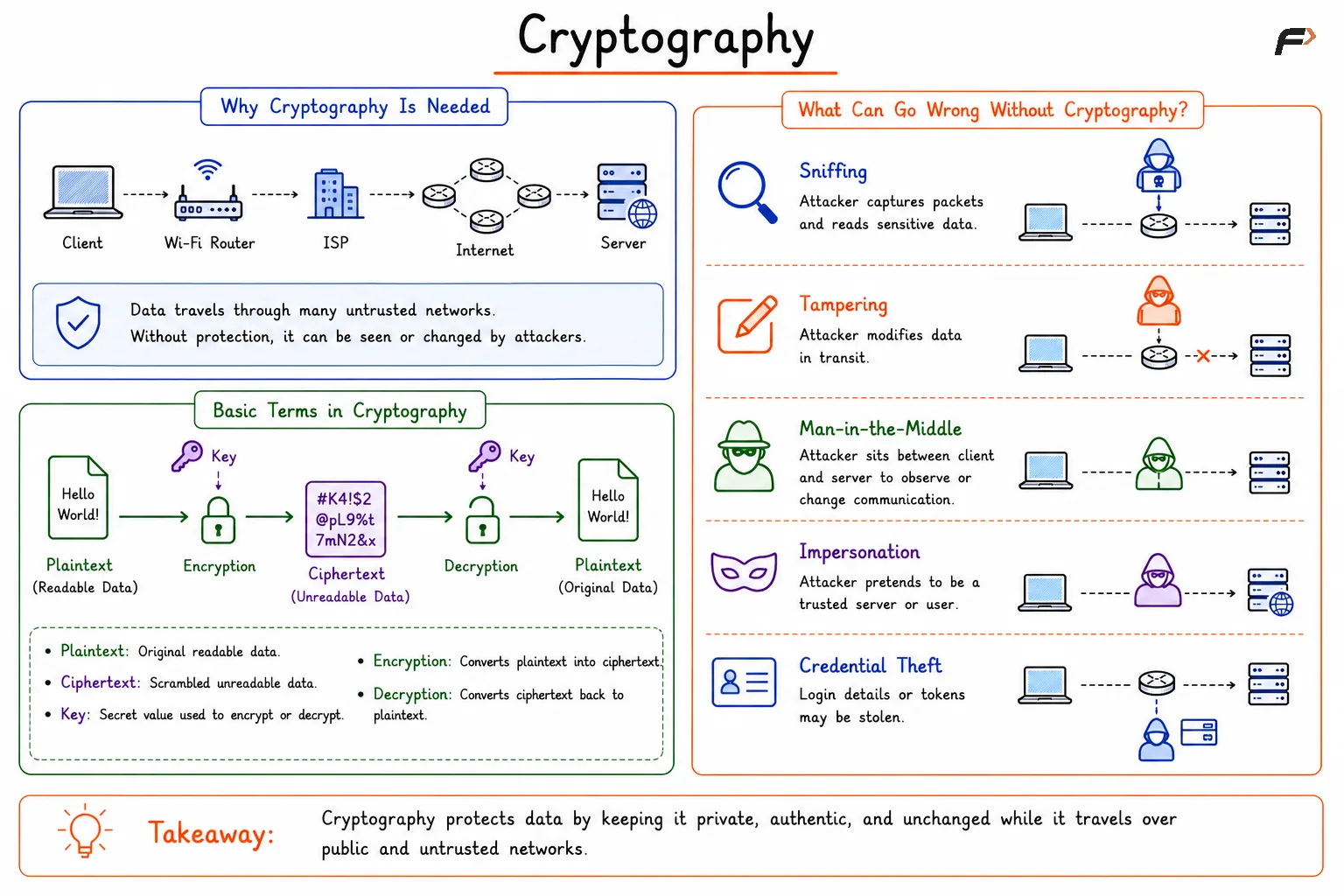
Basics of Cryptography
What Can Go Wrong Without Cryptography?
Without cryptography, network communication becomes easier to attack. The data may still reach the destination, but it may no longer be private, authentic, or unchanged.
Common risks include:
Sniffing: An attacker captures network packets and reads sensitive information such as passwords, messages, or tokens.
Tampering: An attacker modifies data while it is traveling through the network.
Man-in-the-middle attack: An attacker secretly sits between the client and server and observes or changes communication.
Impersonation: An attacker pretends to be a trusted website, server, or user.
Credential theft: Login details or session tokens may be stolen if transmitted without protection.
Main Goals of Cryptography
Cryptography supports several security goals, but three of the most important ones in networks are confidentiality, integrity, and authentication.
Goal | Meaning | Example |
|---|---|---|
Confidentiality | Keeps data secret from unauthorized parties | Encrypting passwords or banking data in transit |
Integrity | Ensures data has not been modified | Detecting changes in a transaction request |
Authentication | Verifies the identity of a user, device, or server | Confirming that a browser is connected to the real bank website |
Together, these properties form the base of secure network communication.
Cryptography in Real Networks
Cryptography is used in many common networking technologies. Most secure communication on the internet depends on it in some form.
Examples include:
HTTPS: Protects web traffic between browsers and websites.
TLS: Provides encryption, integrity, and authentication for secure communication.
VPN: Creates an encrypted tunnel over the public internet.
SSH: Provides secure remote login and command execution.
Secure messaging: Protects messages so only intended parties can read them.
Digital signatures: Help verify authenticity and detect tampering.
Hashing: Helps verify data integrity and securely store passwords when used properly.
The exact cryptographic methods may differ across systems, but the purpose remains the same: protect data and establish trust over untrusted networks.
What Cryptography Does Not Solve
Cryptography is powerful, but it is not a complete security solution by itself. It protects data and communication, but it cannot fix every security problem.
Weak passwords still matter: Encryption does not help if attackers easily guess user credentials.
Application bugs still matter: Cryptography does not fix SQL injection, XSS, or insecure logic.
Compromised devices still matter: If a user’s device has malware, encrypted communication may still be abused.
Poor key management is dangerous: Strong encryption becomes weak if keys are leaked or stored carelessly.
Cryptography works best when combined with secure coding, authentication, access control, monitoring, firewalls, and good operational security.
Summary
Cryptography is essential in network security because data often travels across public and untrusted networks. It protects communication by keeping data confidential, detecting tampering, and verifying the identity of communicating parties.
Encryption, keys, hashing, digital signatures, HTTPS, TLS, VPNs, and SSH all rely on cryptographic ideas. Cryptography does not secure everything on its own, but it forms the foundation that makes private, trusted, and secure communication possible across modern computer networks.
Be the first to add a comment.