Introduction
Coaxial cable is a guided transmission medium used to carry high-frequency electrical signals. It consists of a central conductor surrounded by multiple insulating and protective layers, allowing data to be transmitted efficiently while minimizing interference from external sources.
Structure of a Coaxial Cable
A coaxial cable is made up of several layers, each serving a specific purpose in signal transmission and protection.
Core (Central Conductor): The innermost conductor that carries the actual data signal. It is typically made of copper or a copper-coated material.
Insulation (Dielectric Layer): Surrounds the central conductor and maintains separation between the conductor and the shield while preventing signal leakage.
Metallic Shield: A conductive layer that protects the signal from external electromagnetic interference (EMI) and helps contain the signal within the cable.
Outer Jacket: The outer protective covering that shields the cable from physical damage, moisture, and environmental wear.
Key Characteristics
Layered Construction: Consists of a central conductor, insulating dielectric, metallic shield, and outer protective jacket.
High Resistance to Interference: The metallic shielding protects signals from electromagnetic interference (EMI) and radio frequency interference (RFI).
Supports High-Frequency Signals: Suitable for transmitting high-frequency data, video, and audio signals.
Reliable Signal Transmission: Maintains signal quality with low signal loss over relatively long distances.
High Bandwidth: Capable of carrying large amounts of data efficiently.
Durable and Robust: The outer jacket provides protection against physical damage and environmental factors.
Versatile Applications: Commonly used in cable television (CATV), broadband Internet, radio communication systems, CCTV, and computer networking.
Better Performance than Twisted Pair: Offers improved shielding and reduced interference compared to many other copper-based transmission media.
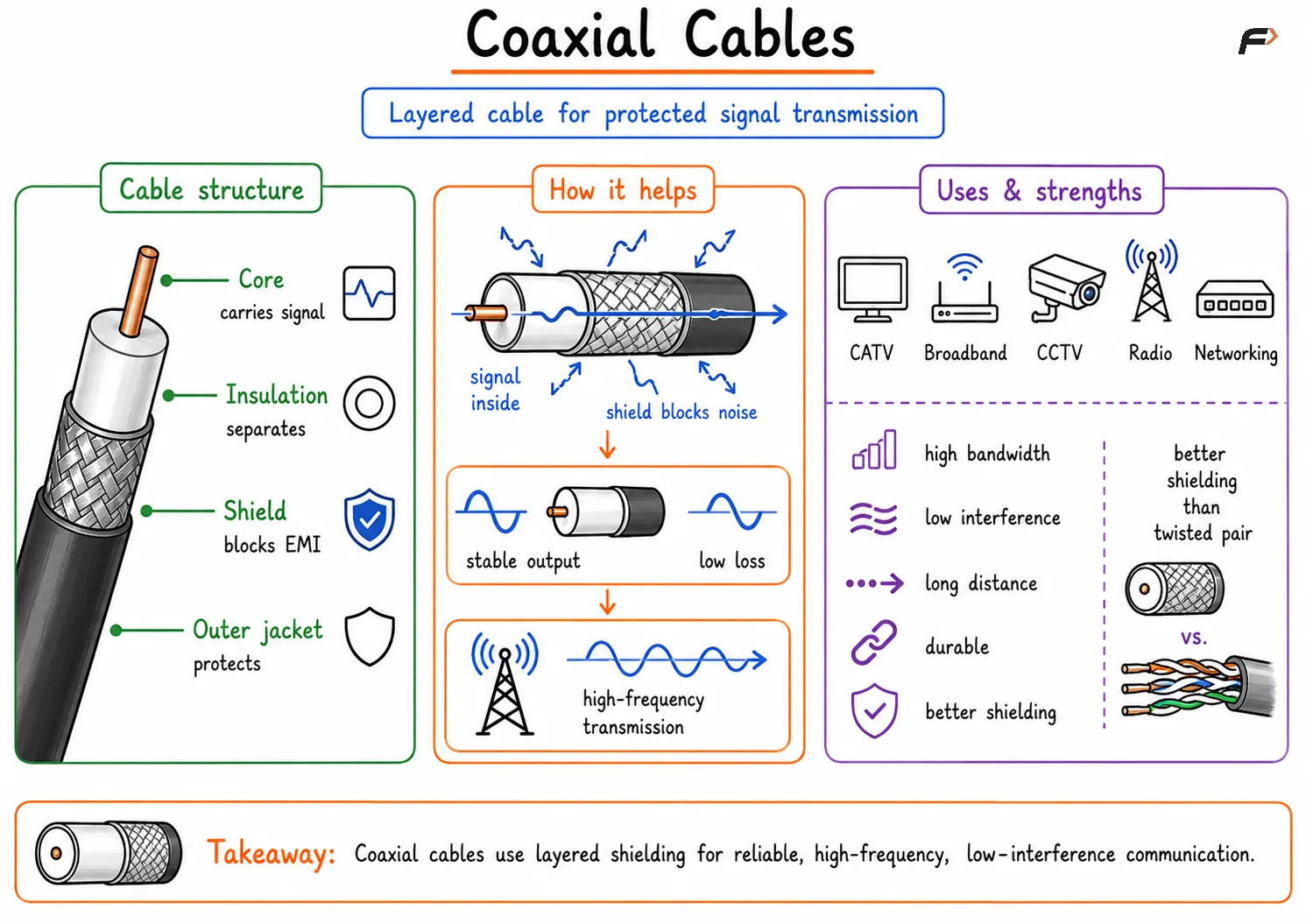
Coaxial Cables
Type of Coaxial Cables
Feature | Thick Coaxial Cable (Thicknet) | Thin Coaxial Cable (Thinnet) |
|---|---|---|
Cable Thickness | Thicker and more rigid. | Thinner and more flexible. |
Transmission Distance | Supports longer communication distances. | Supports shorter communication distances. |
Signal Loss | Lower attenuation and better signal quality. | Higher attenuation compared to thick coax. |
Durability | More durable and resistant to interference. | Less durable but easier to handle. |
Common Usage | Used in early backbone and long-distance Ethernet networks. | Used in smaller Ethernet LAN deployments. |
Example Standard | 10BASE5 | 10BASE2 |
Common Coaxial Connectors
Connector | Full Name | Locking Style | Common Use |
|---|---|---|---|
BNC | Bayonet Neill-Concelman | Twist-lock | Older networking systems, CCTV installations, and radio equipment. |
F-Type | F-Connector | Threaded / Screw-on | Cable television, broadband Internet, and set-top boxes. |
N-Type | N-Connector | Threaded | RF systems, outdoor communication systems, and wireless infrastructure. |
SMA | SubMiniature Version-A | Threaded | Antennas, Wi-Fi equipment, and RF devices. |
TNC | Threaded Neill-Concelman | Threaded | Communication systems and radio-frequency applications. |
Summary
Coaxial cable is a guided transmission medium that carries high-frequency electrical signals through a central copper conductor surrounded by insulation, a metallic shield, and an outer protective jacket. This layered design reduces signal loss and protects against electromagnetic interference (EMI), making coaxial cables reliable for transmitting television, broadband internet, radio, and networking signals.
Coaxial cables are available in two main types: Thick Coaxial Cable (Thicknet), which supports longer distances with lower signal loss, and Thin Coaxial Cable (Thinnet), which is more flexible and suitable for shorter-distance networks. Common connectors such as BNC, F-Type, N-Type, SMA, and TNC are used in different applications, including cable TV, CCTV, broadband, antennas, and radio-frequency communication systems.
Be the first to add a comment.