Introduction
In computer networks, communication between systems follows structured roles and patterns. To understand how applications like browsers, mobile apps, and APIs work, we need to clearly understand the roles of systems that request services and those that provide services.
Client
A client is a device or software application that requests services, data, or resources from another system. It serves as the initiator of communication and typically represents the user-facing side of an application. Whenever a user opens a website, refreshes a mobile app, or sends an API request, the client generates a request and waits for a response from another system.
Clients are responsible for initiating communication but generally do not perform the heavy processing associated with storing large amounts of data or executing complex business logic. Instead, they rely on other systems to provide the required functionality.
Common examples include a web browser requesting a webpage from a web server, a mobile application fetching data from an API, or tools such as Postman sending requests to test backend services.
Server
A server is a device or software application that provides services to requesting systems. Unlike a client, a server continuously listens for incoming requests and responds by processing those requests and returning the appropriate results.
Servers are responsible for handling business logic, storing and retrieving data, performing computations, and managing resources required by applications. Modern servers are designed to handle multiple clients simultaneously, allowing thousands or even millions of users to access services at the same time.
For example, a web server may deliver HTML pages for a website, while an API server may process requests and return JSON responses. In most applications, servers act as the central systems that provide functionality and data to clients.
Peer
A peer is a device or application that can function as both a client and a server. Rather than following a strictly centralized model, peers communicate directly with one another and can both request services and provide services depending on the situation. This creates a more decentralized and collaborative form of communication.
In peer-to-peer systems, each participant contributes resources such as storage, bandwidth, or processing power while simultaneously consuming resources provided by other peers.
Examples include devices participating in a BitTorrent network where users both download and upload files, WebRTC-based video calls where participants exchange media streams directly, and blockchain networks where nodes validate, store, and share transaction data with one another. Because every participant can contribute to the network, peer-to-peer architectures can improve scalability and reduce dependence on a central server.
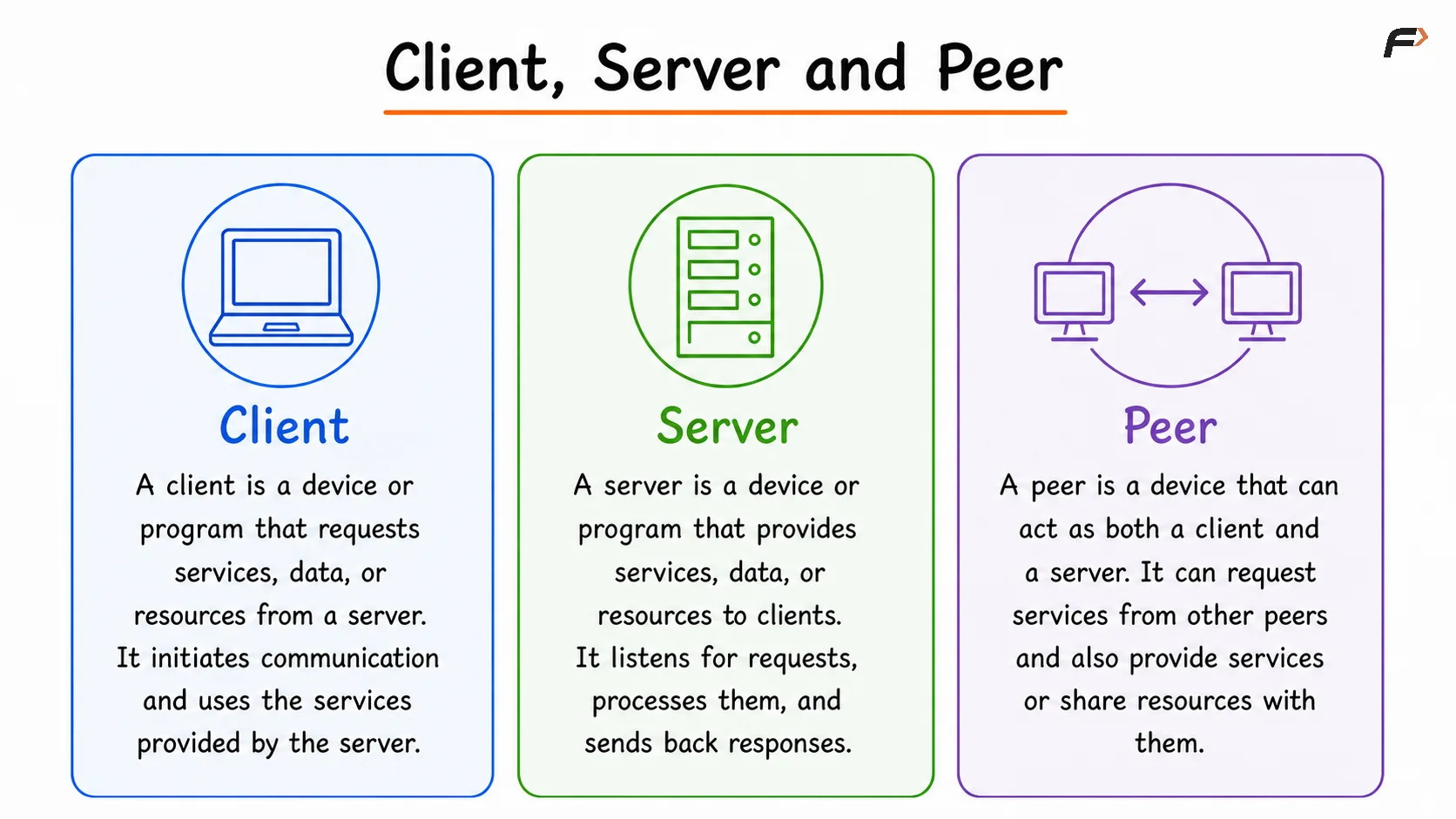
Comparison diagram showing the roles of a client, server, and peer in a network. Clients send requests for services, servers process and respond to those requests, while peers communicate directly with one another, acting as both clients and servers to share resources.
How Devices Communicate?
The primary purpose of a computer network is to allow devices to communicate and exchange information efficiently. This communication follows well-defined models and protocols, involves various types of networked devices, and relies on dividing data into smaller units for transmission. Understanding how this process works is essential for understanding modern technologies such as the Internet, web browsers, APIs, cloud services, and distributed systems.
Client-Server Architecture
Client–server architecture is a communication model in which one system, known as the client, requests services or resources, while another system, known as the server, processes those requests and provides the required responses. This architecture is widely used in modern computing and serves as the foundation for websites, mobile applications, APIs, cloud platforms, and enterprise systems.
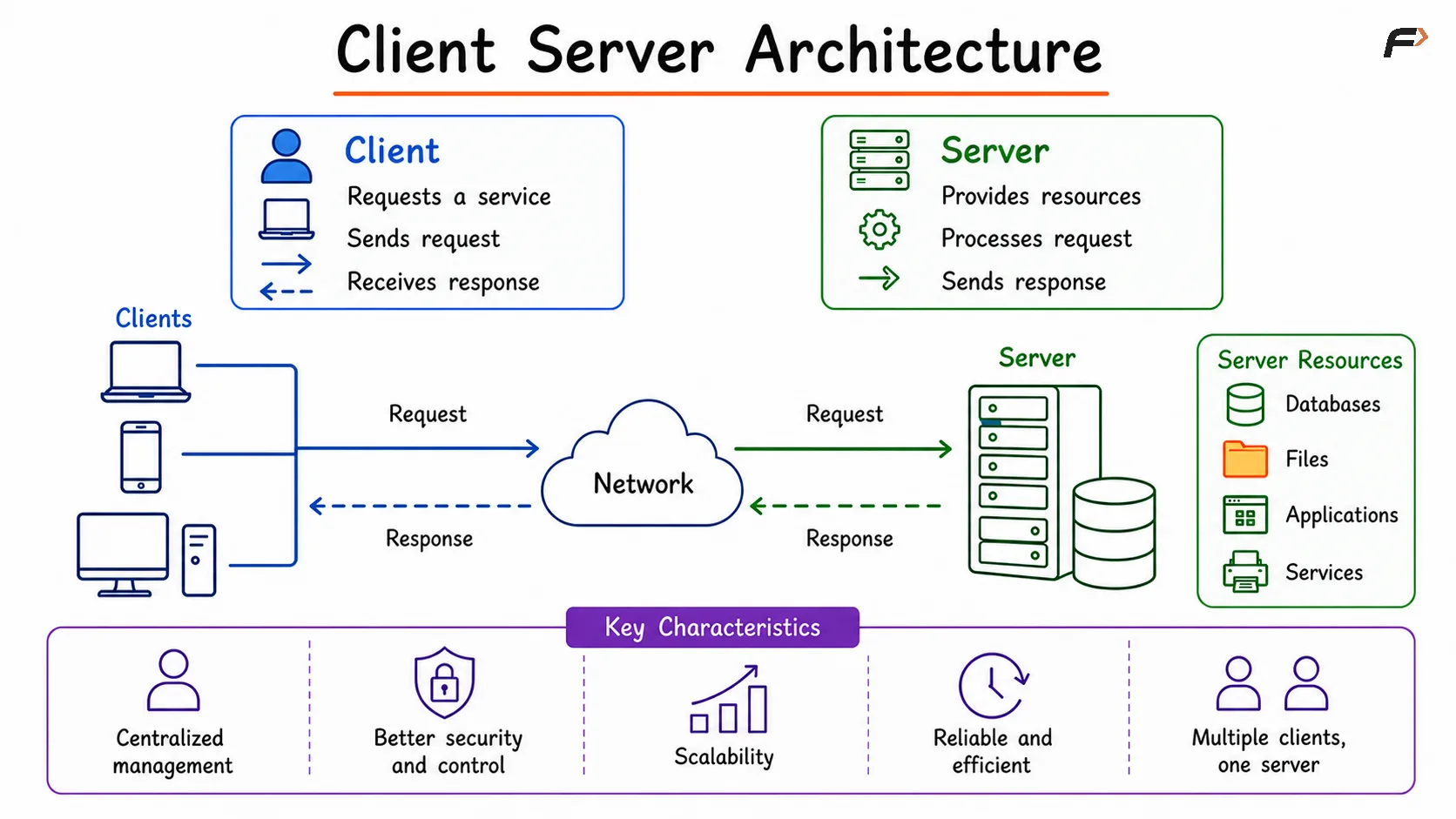
Conceptual diagram of a client-server architecture, where multiple client devices send requests to a centralized server that processes the requests and returns data or services, illustrating centralized communication and resource management.
Core Principles
The client is responsible for initiating communication whenever it needs data, functionality, or access to a service. The server listens for incoming requests, processes them, and returns appropriate responses. This separation of responsibilities allows clients to focus on user interaction while servers handle data storage, business logic, and computational tasks.
Common examples of client–server communication include a web browser requesting a webpage from a web server, a mobile application fetching user information from an API server, and an API server retrieving records from a database server.
Why This Architecture Exists
Easier Management: Centralizing application logic on servers simplifies updates, maintenance, and system administration.
Centralized Data and Processing: Keeping data and business logic in a central location improves consistency, reliability, and control.
Better Scalability: Server infrastructure can be expanded independently to support increasing numbers of users and requests.
Enhanced Security: Sensitive data remains on servers, reducing exposure and improving protection against unauthorized access.
Limitations of Client–Server Architecture
Despite its advantages, client–server architecture has certain limitations. Since clients depend on servers to provide services, server outages can make applications unavailable. Servers may also become performance bottlenecks when handling large volumes of traffic, requiring additional infrastructure and scaling mechanisms to maintain reliability and responsiveness.
Peer-to-Peer (P2P) Architecture
Peer-to-peer (P2P) architecture is a communication model in which participating systems, known as peers, can both consume and provide services. Unlike traditional client-server systems, there is no strict distinction between requester and provider. Each peer can perform both roles depending on the situation, creating a decentralized and collaborative network structure.
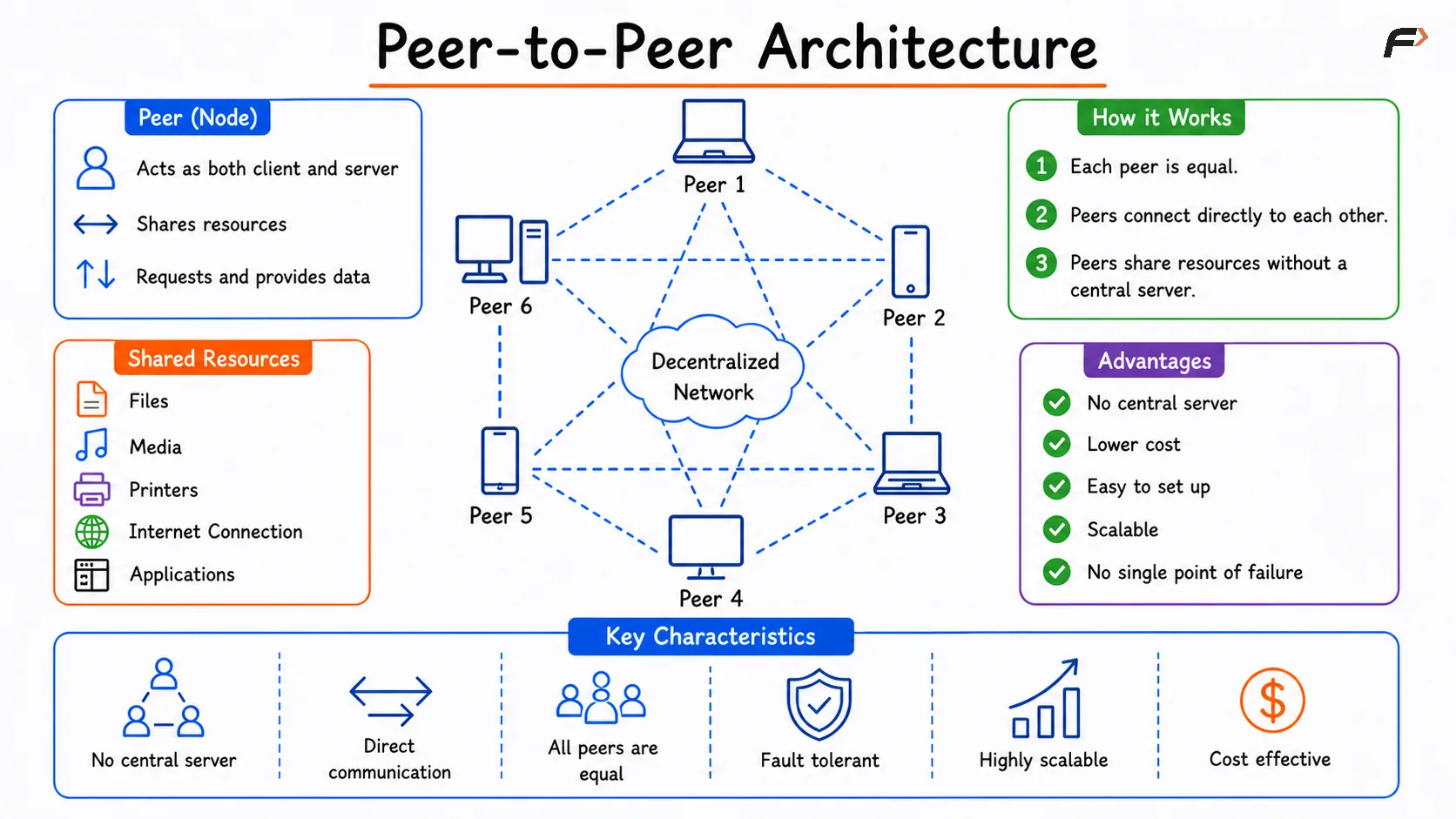
Multiple peer devices communicate directly in a decentralized network, where each peer can both share and access resources without relying on a central server.
Core Principles
In a P2P network, every peer can act as both a client and a server, allowing systems to request resources while also contributing resources to others. Communication occurs directly between peers without relying on a central authority to manage every interaction. Responsibilities such as data storage, bandwidth usage, and processing are distributed across multiple participants, reducing dependence on any single system.
Peer-to-peer architecture is widely used in file-sharing networks such as BitTorrent, where users simultaneously download and upload files. It is also used in real-time communication technologies like WebRTC, which enables direct media exchange in applications such as Google Meet. Another prominent example is blockchain networks, where nodes collaborate to validate, store, and distribute data across the network.
Why This Architecture Exists
Better Scalability: As additional peers join the network, more resources become available, helping the system handle increased demand.
Reduced Central Dependency: The network does not rely on a single central server, reducing the impact of individual failures.
Efficient Resource Utilization: Each peer contributes resources such as bandwidth, storage, and processing power.
Fault Tolerance: Data and services can remain accessible even when some peers become unavailable.
Limitations of P2P Architecture
Despite its advantages, peer-to-peer architecture introduces several challenges. Designing and managing distributed systems can be significantly more complex than managing centralized architectures. Maintaining security and establishing trust between peers is often more difficult because there is no central authority controlling interactions.
Data consistency can also become challenging when information is distributed across many nodes, and overall performance may vary depending on the availability and reliability of participating peers.
Summary
Aspect | Client-Server Architecture | P2P Architecture |
|---|---|---|
Basic Idea | One system provides services while others consume them. | All systems can both request and provide services. |
Control | Centralized control in one or few systems. | Decentralized control across multiple systems. |
Responsibility | Clearly separated between requester and provider. | Shared among all participating systems. |
Data & Logic | Stored and managed centrally. | Distributed across multiple nodes. |
Scalability | Limited unless additional infrastructure is added. | Highly scalable as more nodes join the system. |
Fault Tolerance | Low if no redundancy; central system failure impacts entire system. | High due to multiple nodes providing redundancy. |
Performance | Can become a bottleneck under heavy load. | Load is distributed, reducing bottlenecks. |
Security | Easier to enforce due to centralized control. | Harder to enforce due to decentralized nature. |
Complexity | Simpler to design and manage. | More complex to design, manage, and debug. |
Examples | Web applications, APIs, client-server systems. | Peer-to-peer systems, WebRTC, blockchain networks. |
Be the first to add a comment.