Introduction
CIDR, or Classless Inter-Domain Routing, is the modern way of representing and allocating IPv4 networks. Instead of forcing addresses into fixed classes like Class A, Class B, or Class C, CIDR allows networks to be assigned using flexible prefix lengths based on actual need.
This change was a major improvement in IPv4 networking. It solved two important problems at the same time: wasteful address allocation and oversized routing tables. That is why CIDR is not just a notation like /24 or /26, but a full addressing and routing approach.
Why CIDR Was Needed
Before CIDR, IPv4 followed the classful model. In that model, organizations were assigned large fixed blocks even if they needed only a fraction of the addresses inside them.
That caused a serious problem. Many organizations needed more than a Class C network but far less than a Class B network. Since there was no flexible middle option, a much larger block was often assigned than required.
This created several issues:
Address wastage: Large parts of allocated IPv4 space remained unused.
Poor flexibility: Network allocation did not match real requirements.
Faster IPv4 exhaustion: Limited public address space was consumed inefficiently.
Larger routing tables: More individual route entries had to be maintained.
CIDR was introduced to remove these limitations.
Classless Addressing
What CIDR Means
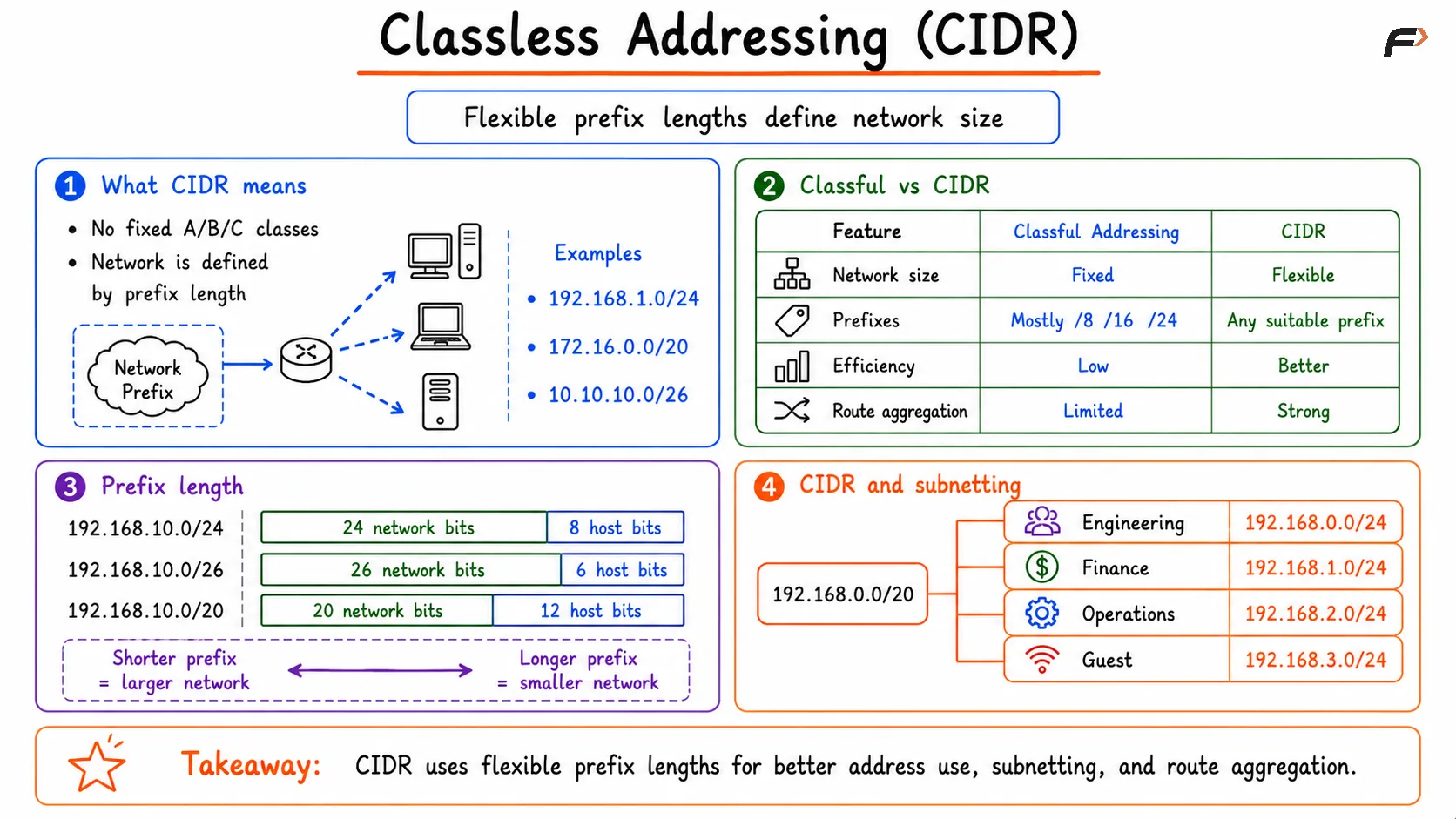
CIDR stands for Classless Inter-Domain Routing. The word classless means that address allocation is no longer tied to fixed address classes. Instead, a network is defined by its prefix length.
That prefix tells how many bits belong to the network portion and how many remain available for hosts.
Examples of CIDR notation include:
192.168.1.0/24172.16.0.0/2010.10.10.0/26
In each case, the number after the slash tells how many leading bits form the network prefix.
How CIDR Differs from Classful Addressing
The biggest difference between classful addressing and CIDR is flexibility.
Feature | Classful Addressing | CIDR |
|---|---|---|
Network sizes | Fixed | Flexible |
Prefix lengths | Mostly /8, /16, /24 | Any suitable prefix length |
Address allocation | Based on class boundaries | Based on actual requirement |
Address efficiency | Low | Much better |
Routing support | Limited aggregation | Strong route aggregation |
With CIDR, address space can be assigned much more precisely. A network no longer has to fit awkwardly into a Class A, B, or C block.
CIDR Notation and Prefix Length
CIDR notation uses the format: IP address/prefix length
The prefix length tells how many bits belong to the network part.
For example:
192.168.10.0/24means 24 network bits and 8 host bits192.168.10.0/26means 26 network bits and 6 host bits192.168.0.0/20means 20 network bits and 12 host bits
Shorter prefixes create larger networks, while longer prefixes create smaller networks.
This gives administrators and providers the freedom to match address allocation more closely with actual usage.
CIDR and Subnetting
CIDR works naturally with subnetting because both rely on flexible prefix lengths. Once a block is assigned, it can be divided further into smaller logical subnets as needed.
For example, an allocated block such as 192.168.0.0/20 can be subdivided internally into smaller networks for:
Engineering
Finance
Operations
Guest network
Server segments
This makes CIDR useful not only for address assignment from providers, but also for practical internal network design.
Supernetting and Route Aggregation
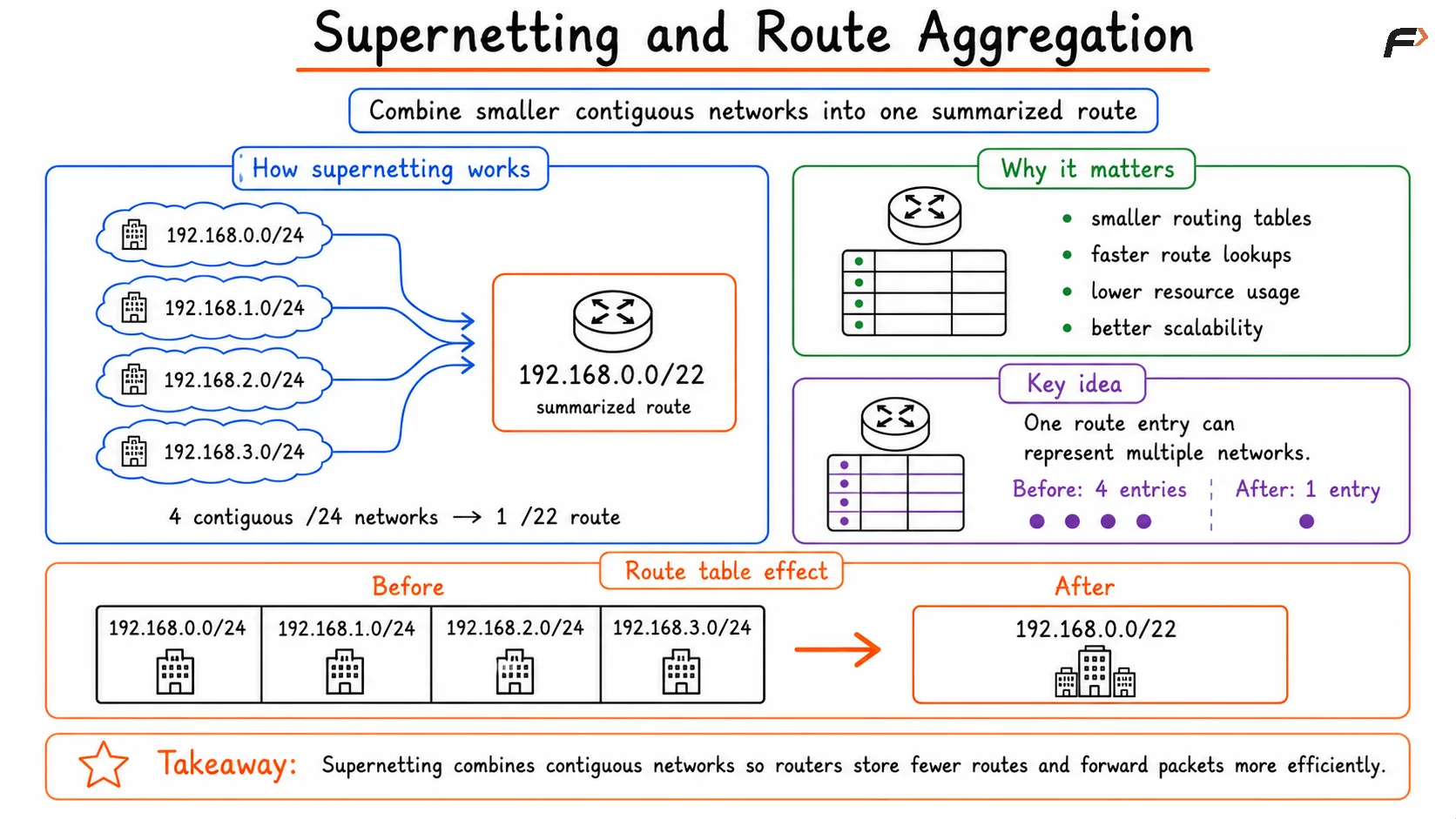
CIDR also supports the opposite of subnetting, which is often called supernetting. Instead of breaking one large network into smaller ones, supernetting combines multiple smaller contiguous networks into one summarized route.
This is extremely useful in routing.
For example, these four networks:
192.168.0.0/24192.168.1.0/24192.168.2.0/24192.168.3.0/24
can be summarized as:
192.168.0.0/22
That means one route entry can represent four different networks. This is one of the most important benefits of CIDR.
Supernetting and Route Aggregation
Why Route Aggregation Matters
Routers rely on routing tables to decide where packets should go next. Every route stored in a routing table consumes memory and processing effort.
If routers had to maintain separate entries for every small network, routing tables would become much larger and less efficient. CIDR helps reduce that problem by allowing many networks to be represented using a smaller number of summarized routes.
This leads to:
Smaller routing tables: Fewer entries need to be stored.
Faster route lookups: Packet forwarding becomes more efficient.
Lower resource usage: Less memory and processing overhead.
Better internet scalability: Routing remains manageable at large scale.
This is one of the main reasons CIDR was so important for internet growth.
Why CIDR Replaced Classful Addressing
CIDR replaced classful addressing because it solved the two biggest weaknesses of the older system:
Inefficient address allocation
Poor routing scalability
Instead of wasting large chunks of IPv4 space, CIDR allowed address allocation to be based on real need. Instead of forcing routers to hold too many separate routes, it allowed route summarization through common prefixes.
That combination made CIDR a practical and necessary upgrade for the modern internet.
Summary
CIDR, or Classless Inter-Domain Routing, is the modern IPv4 addressing system that removes fixed class boundaries and replaces them with flexible prefix lengths. It allows more efficient address allocation, better subnet design, and much stronger routing scalability than the older classful model.
CIDR is important because it supports both precise network allocation and route aggregation. That means fewer wasted addresses, smaller routing tables, and a more scalable internet. In practical networking, CIDR is the standard approach used for IPv4 network design, subnetting, supernetting, and efficient routing.
Be the first to add a comment.