Introduction
Classful addressing is the older method of interpreting IPv4 addresses. Before modern CIDR-based networking became standard, an IPv4 address was not treated as just a 32-bit number with any flexible prefix length. Instead, the address automatically belonged to a predefined class, and that class decided how the network and host portions were split.
This approach made IPv4 addressing easy to understand in the early days of the internet, but it also wasted a large amount of address space. That is why classful addressing is now mostly a historical concept, while CIDR and classless addressing are used in modern networks.
What Classful Addressing Means
In classful addressing, IPv4 addresses were divided into fixed categories called classes. Each class came with its own default subnet mask, fixed network size, and fixed host size.
That means the address itself told the network how to interpret it. By looking at the first bits, or more commonly the first octet, a system could identify the class and immediately know how many bits belonged to the network and how many belonged to the host.
The class determined:
Network bits: How much of the address identified the network
Host bits: How much of the address identified the host
Default mask: The standard subnet mask for that class
Approximate network size: How many addresses were available in that class
IPv4 Classes in Classful Addressing
Classful IPv4 addressing used five classes.
Class | Leading Bits | First Octet Range | Default Mask | Main Purpose |
|---|---|---|---|---|
A | 0 | 1-126 | /8 | Very large networks |
B | 10 | 128-191 | /16 | Medium-sized networks |
C | 110 | 192-223 | /24 | Smaller networks |
D | 1110 | 224-239 | No normal host split | Multicast |
E | 1111 | 240-255 | Reserved | Experimental or reserved use |
Classes A, B, and C were used for normal host addressing. Classes D and E were not used for standard host assignment.
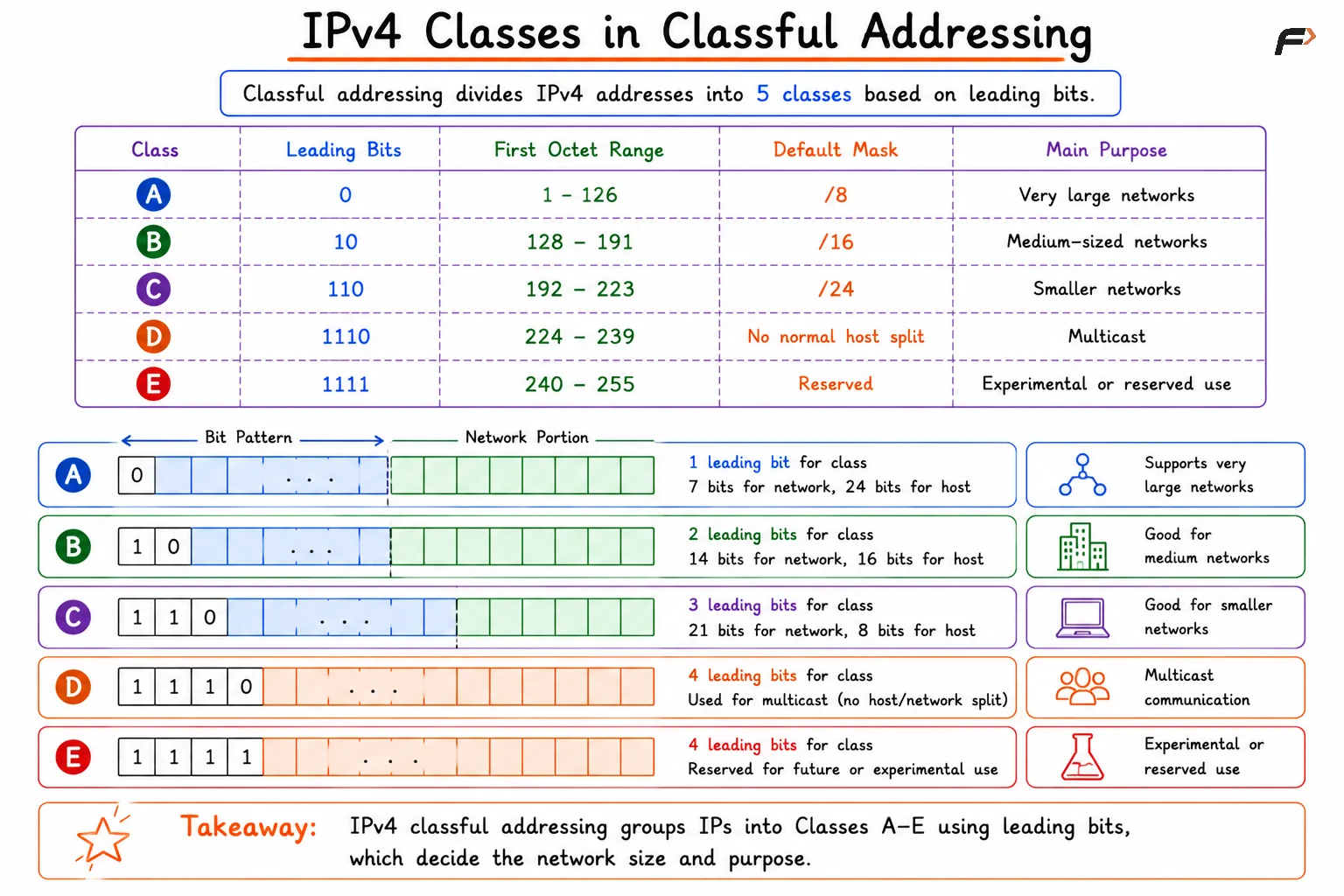
Classful Addressing
Class A, B, and C
The main practical classes in classful addressing were A, B, and C. Each one was designed for a different network size.
A Class A address provided a huge host space, a Class B address provided a medium host space, and a Class C address provided a much smaller host space.
Examples:
Class A example:
10.20.30.40Class B example:
172.20.10.5Class C example:
192.168.1.10
Class D and Class E
Class D and Class E served different purposes from ordinary host addressing.
Class D: Used for multicast communication
Class E: Reserved for experimental or research purposes
Class D addresses fall in the range 224.0.0.0 to 239.255.255.255. These were not assigned to regular end hosts in the same way as Class A, B, or C. They were used when one sender needed to deliver data to a multicast group.
Class E addresses fall in the range 240.0.0.0 to 255.255.255.255. Historically, these were reserved and not used for ordinary public host allocation.
Special Ranges in Classful IPv4
A few ranges had special meanings and were not treated as normal assignable host addresses.
0.x.x.x: Historically associated with special meanings such as "this network"
127.x.x.x: Reserved for loopback
The best-known loopback address is 127.0.0.1. Traffic sent to this address never leaves the machine. It is returned directly to the local networking stack, which is why it is commonly called localhost.
Why Classful Addressing Was Useful
Classful addressing worked well in the early internet because it was simple. A network administrator or router could inspect the address, determine the class, and immediately know the default network-host split.
This simplicity helped with:
Easy interpretation: The address structure was obvious from the class
Simple routing assumptions: Devices could infer the default mask
Straightforward allocation: Organizations could be given Class A, B, or C networks depending on expected size
At a time when the internet was much smaller, that simplicity was a major advantage.
Why Classful Addressing Became a Problem
The weakness of classful addressing was that real organizations rarely matched the fixed class sizes properly. Many needed more than a Class C network but far less than a full Class B network.
For example, an organization needing about 500 addresses had a problem:
Class C: Too small, because it provided only 256 total addresses
Class B: Too large, because it provided 65,536 total addresses
This mismatch caused major waste. Large blocks were assigned even when only a small portion was actually needed.
The results were:
Address wastage: Huge portions of allocated space stayed unused
Poor flexibility: Prefix lengths were fixed instead of being based on actual need
Faster IPv4 exhaustion: Public address space was consumed inefficiently
Summary
Classful addressing is the older IPv4 addressing model in which addresses were divided into fixed classes such as A, B, C, D, and E. Each class had a predefined network-host split, first-octet range, and default subnet mask, which made address interpretation simple in early networking.
Its main problem was inefficiency. Organizations often received networks that were much larger or smaller than they actually needed, which wasted IPv4 address space. That is why classful addressing was eventually replaced by CIDR and classless addressing, which allow flexible prefix lengths and much better address utilization.
Be the first to add a comment.