Introduction
Circuit switching is one of the fundamental switching techniques used in communication networks. Its basic idea is simple: before any real data starts moving, the network first creates a dedicated path between the sender and the receiver.
Once that path is established, communication continues through the same route for the entire session. This makes circuit switching very different from packet-switched communication, where data can be divided and forwarded more dynamically.
What Is Circuit Switching?
Circuit switching is a communication method in which the network establishes a complete end-to-end path before data transfer begins. The required resources along that path are reserved for the full duration of the communication.
So the communication usually follows three broad stages:
Connection setup: The network creates the path
Data transfer: Data moves through the reserved path
Connection release: Resources are freed after communication ends
Because the route is already prepared, data can flow continuously once the session begins.
Why Circuit Switching Was Used
Circuit switching was especially useful for traditional voice communication. A voice call needs a communication channel that remains available throughout the conversation.
Voice traffic works best when it gets:
Continuous transmission: Communication should not stop and restart repeatedly
Predictable bandwidth: The channel capacity should remain available
Stable delay: Delay should not keep changing too much
Minimal interruption: The path should remain consistent during the call
That is why the traditional telephone network is the most common example of circuit switching.
Phases of Circuit Switching
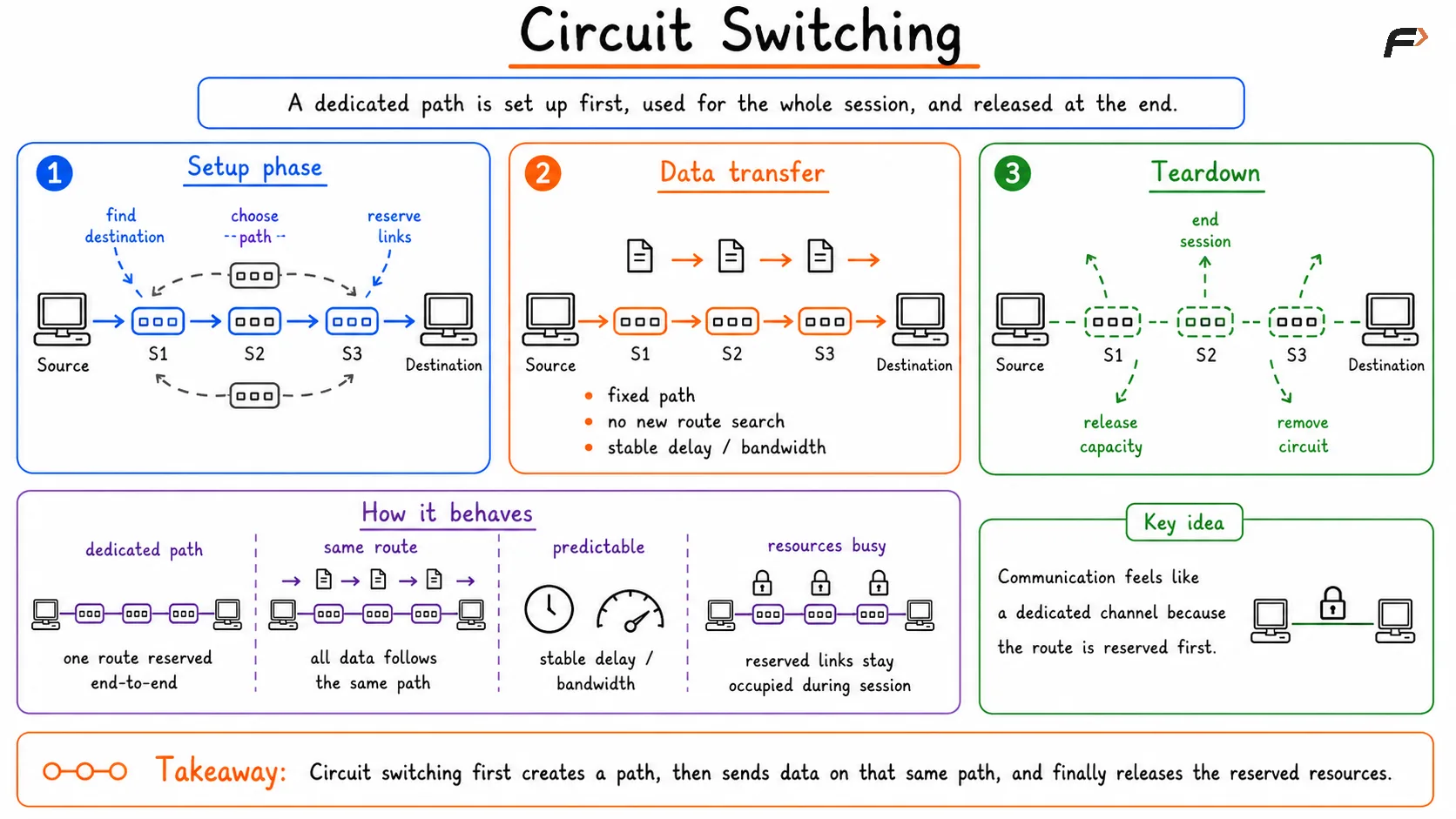
Circuit Switching
Connection Setup
In the first phase, the sender asks the network to establish communication with the receiver.
The network then:
Finds the destination
Searches for an available path
Reserves the necessary resources along that path
Only after this setup is complete can the sender start transmitting.
Data Transfer
Once the circuit has been established, the data transfer phase begins. During this stage, all communication follows the same reserved route.
Important points in this phase are:
Fixed path: Data follows the same route throughout the session
Continuous communication: No repeated route search is needed
Predictable behavior: Delay and bandwidth remain more stable
This makes the communication feel more like a dedicated channel.
Connection Teardown
When communication ends, the connection must be released so that the reserved resources can be used by other users.
During teardown:
The circuit is terminated
Reserved capacity is released
The dedicated path is removed
This final step is important because the network cannot keep those resources blocked forever.
What Gets Reserved?
A dedicated path does not always mean a separate physical wire is given to the communication. In many systems, it means the network reserves part of its available capacity.
Examples of reserved resources may include:
Bandwidth
Time slots
Frequency ranges
Switching entries
Logical channel capacity
The important idea is that something is set aside for that communication before data starts moving.
Advantages of Circuit Switching
Circuit switching became important because it offers several useful properties for continuous communication.
Guaranteed path: The communication route is fixed during the session
Stable bandwidth: Reserved capacity remains available
Predictable delay: Delay variation is usually lower
Good for real-time communication: Especially voice and traditional call systems
These features make circuit switching suitable where smooth, uninterrupted communication matters more than maximum efficiency.
Limitations of Circuit Switching
Even though circuit switching provides stable communication, it also has important drawbacks.
Resource wastage: Reserved resources remain blocked even during silence or idle periods
Setup delay: Communication cannot start instantly because the path must be created first
Call blocking: If resources are not available, the communication may not start at all
Poor fit for bursty traffic: Applications like web browsing do not send data continuously
Single path dependency: If the reserved path fails, the session breaks
This is why circuit switching is not ideal for modern internet traffic, where communication is often irregular and bursty.
Circuit Switching vs Modern Network Traffic
Modern internet communication is usually not continuous like a phone call. A user may load a webpage, pause, click again, wait, and then request something else. This kind of traffic is bursty, not constant.
In that situation, reserving a full path all the time becomes inefficient. Resources stay occupied even when no useful data is being sent. That is one of the major reasons packet switching became far more suitable for modern computer networks.
Summary
Circuit switching is a switching technique in which a dedicated communication path is established before data transfer begins. It works in three main phases: connection setup, data transfer, and connection teardown. During the session, the same path remains reserved, which provides stable bandwidth and more predictable delay.
This makes circuit switching useful for continuous real-time communication such as traditional voice calls. However, it also wastes resources during idle periods and performs poorly for bursty traffic, which is why modern internet networks rely much more on packet switching.
Be the first to add a comment.