Introduction
Cryptography uses a few basic terms again and again. Before going deeper into encryption systems, secure protocols, or network security, these terms should feel clear.
The main idea is simple: readable data is protected using an algorithm and a key, so unauthorized users cannot understand it even if they capture it during transmission.
Plaintext and Ciphertext
Plaintext is the original readable data before encryption is applied. It can be a password, message, email, banking detail, document, API token, or any other information that humans or applications can understand directly.
Ciphertext is the encrypted form of that data. Once plaintext is converted into ciphertext, it should look unreadable to anyone who does not have the correct key.
Term | Meaning | Example |
|---|---|---|
Plaintext | Original readable data |
|
Ciphertext | Encrypted unreadable data | Scrambled output after encryption |
If plaintext is exposed, the information can be read directly. If ciphertext is exposed, the attacker still needs the correct key to recover the original data.
Key and Cipher
A key is a secret value used during encryption and decryption. The same plaintext encrypted with different keys should produce different ciphertext, which is why key secrecy is extremely important.
A cipher is the algorithm or method used to perform encryption and decryption. It defines the actual steps used to transform plaintext into ciphertext and later recover the plaintext.
Key: Secret input used by the cryptographic algorithm.
Cipher: Algorithm that performs encryption and decryption.
AES: A widely used symmetric encryption algorithm.
RSA: A public-key cryptography algorithm.
SHA: A family of secure hash algorithms used for hashing, not encryption.
Modern cryptography usually does not depend on hiding the algorithm. Strong algorithms are often public. Security depends mainly on protecting the key.
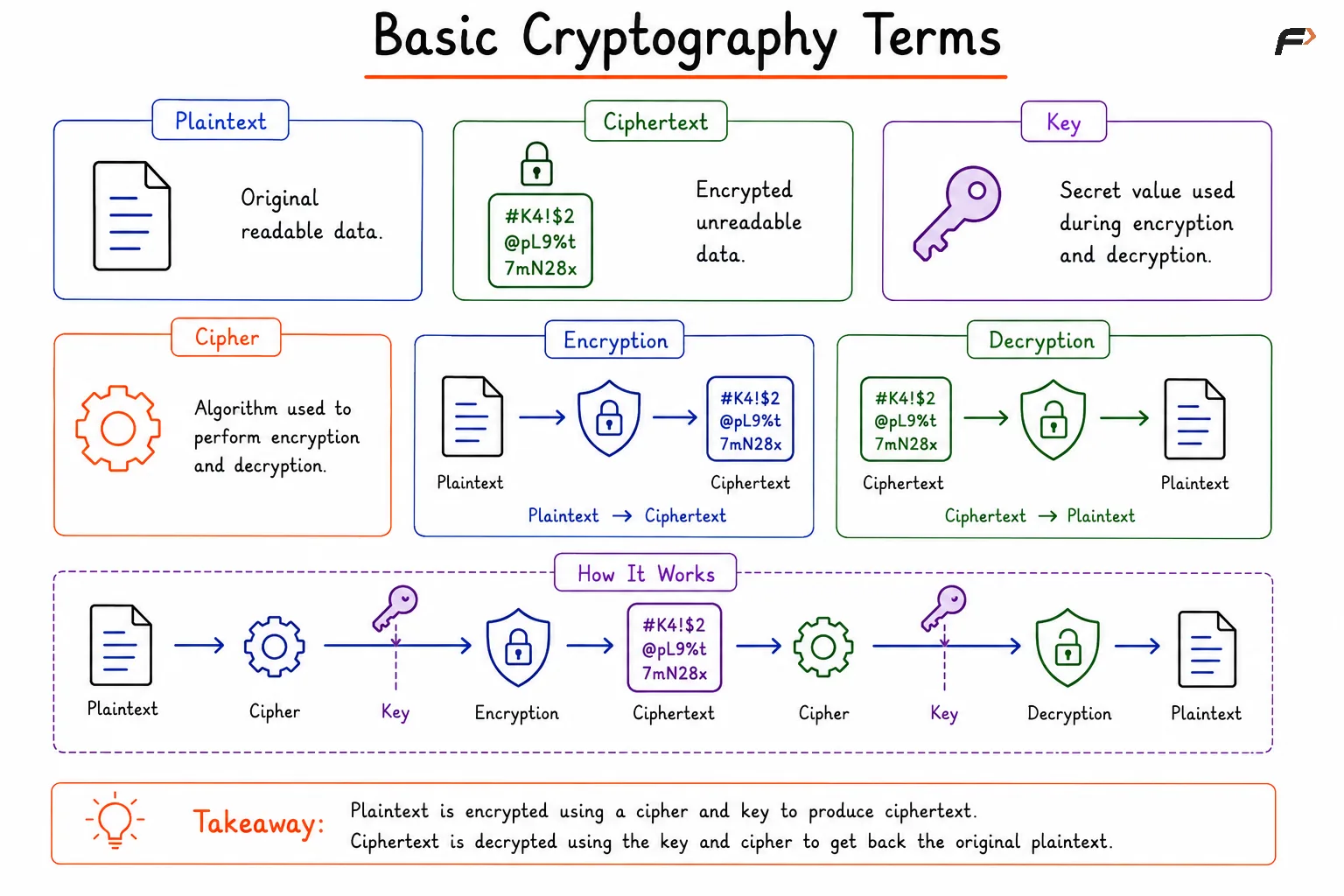
Basic Cryptography Terms
Encryption and Decryption
Encryption is the process of converting plaintext into ciphertext using a cipher and a key. Its purpose is to protect sensitive data from unauthorized reading.
Decryption is the reverse process. It converts ciphertext back into plaintext using the appropriate key, so the receiver can read the original information.
For example, when a browser communicates with a secure website using HTTPS, cryptography helps protect the data so that passwords, cookies, tokens, and messages are not visible in plain form while traveling across the network.
Algorithm vs Key
The algorithm and the key are different. The algorithm is the method, while the key is the secret value used by that method.
Aspect | Algorithm | Key |
|---|---|---|
Meaning | The procedure used for encryption or decryption | Secret value used by the algorithm |
Visibility | Often publicly known | Must be protected |
Example | AES, RSA | Secret encryption key or private key |
Security Role | Defines how transformation happens | Controls who can recover the data |
A useful principle is: algorithms may be public, but keys must remain secret. If the key is leaked, encrypted data may become readable even if the algorithm itself is strong.
Symmetric and Asymmetric Keys
Cryptographic systems may use keys in two main ways: symmetric cryptography and asymmetric cryptography.
Type | Key Usage | Simple Meaning |
|---|---|---|
Symmetric cryptography | Same key is used for encryption and decryption | One shared secret key |
Asymmetric cryptography | Public key and private key are used as a pair | One key can be public, one must stay private |
Symmetric encryption is commonly used for fast bulk data encryption. Asymmetric cryptography is useful for public-key encryption, digital signatures, certificates, and secure key exchange.
Summary
Basic cryptography terms help explain how secure communication works. Plaintext is readable data, ciphertext is encrypted unreadable data, a key is the secret value, and a cipher is the algorithm used to transform data.
Encryption converts plaintext into ciphertext, while decryption converts ciphertext back into plaintext. Modern cryptographic systems may use public algorithms such as AES, RSA, and SHA, but the key principle remains the same: security depends on protecting the key, not hiding the algorithm.
Be the first to add a comment.