Introduction
Zero Trust Architecture, or ZTA, is a modern cybersecurity model built around one simple idea: never trust, always verify. It does not automatically trust a user, device, application, or request just because it comes from inside the organization’s network.
In older security models, the internal network was often treated as trusted and the outside internet was treated as untrusted. Zero Trust changes this thinking. It assumes that every access request must be checked properly, no matter where it comes from.
Why Zero Trust Is Needed
Modern networks are no longer limited to one office or one data center. Users work remotely, applications run in the cloud, companies use SaaS platforms, and employees connect from different devices and locations.
This makes the old perimeter-based model weaker because the “inside” and “outside” boundary is no longer clear. If attackers steal credentials or compromise a laptop, they may enter the internal network and move toward sensitive systems.
Zero Trust reduces this risk by checking access continuously and limiting what each user or device can do.
Remote work: Employees may access internal tools from home, hotels, or public networks.
Cloud applications: Important workloads may run outside the company’s physical network.
BYOD and mobile devices: Personal or unmanaged devices may try to access business resources.
Stolen credentials: A correct password does not always mean the request is safe.
Lateral movement: Attackers should not get broad access after compromising one account or device.
Core Principles of Zero Trust
Zero Trust is not a single tool. It is a security approach built using identity systems, access policies, monitoring, segmentation, authentication, and enforcement points.
The main principles are:
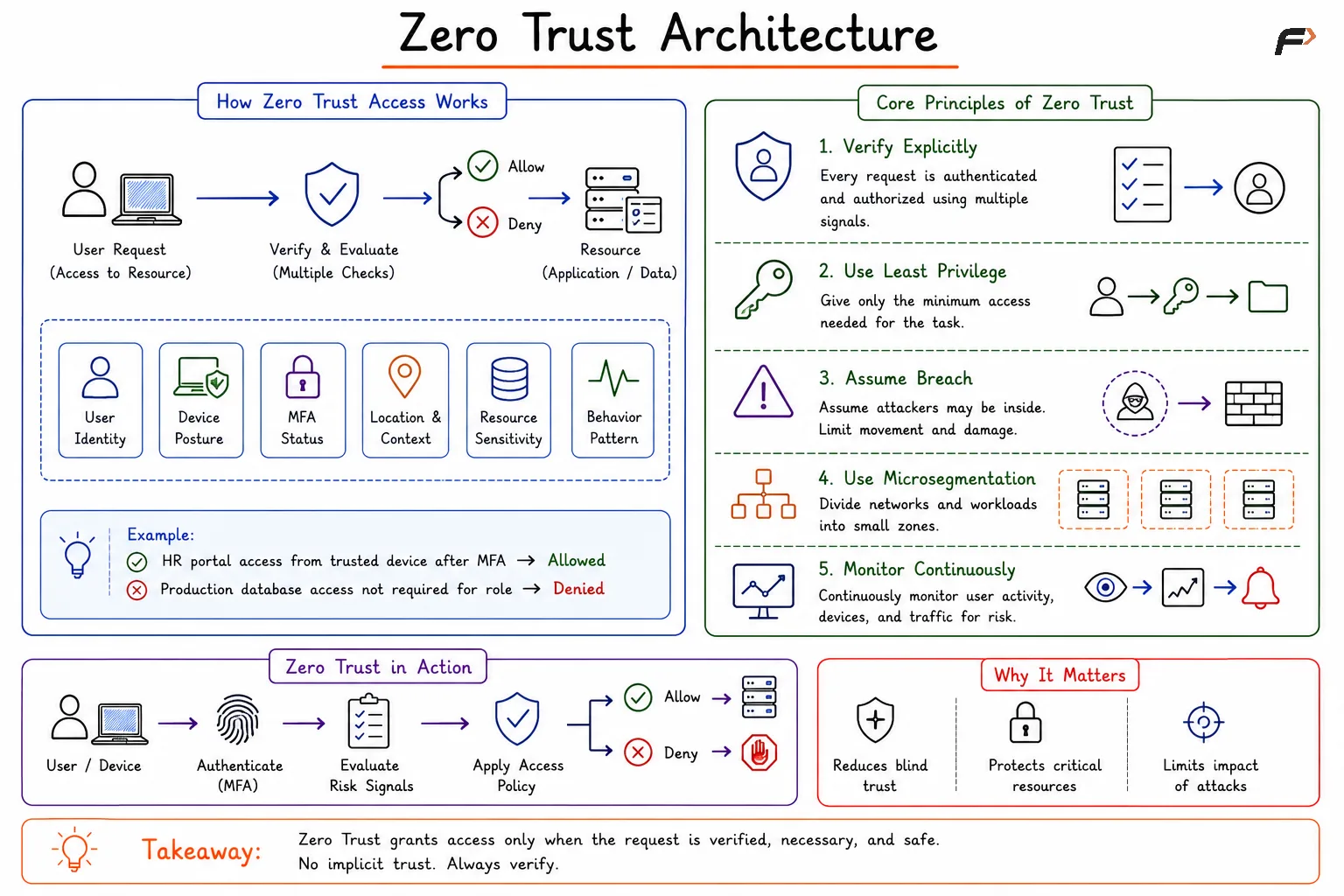
Verify explicitly: Every access request is authenticated and authorized using signals such as user identity, device health, location, MFA status, and behavior.
Use least privilege access: Users, devices, and applications receive only the minimum access required for their task.
Assume breach: Security design assumes that attackers may already be inside, so systems must limit movement and damage.
Use microsegmentation: Networks and workloads are divided into smaller zones so one compromised area does not expose everything.
Monitor continuously: User activity, device posture, login behavior, and network traffic are constantly checked for risk.
These principles work together to reduce blind trust. Access is granted only when the request looks valid, necessary, and safe enough.
Zero Trust Architecture
How Zero Trust Access Works
In a Zero Trust model, access is usually granted based on multiple checks instead of only username and password.
A typical access decision may consider:
User identity: Who is requesting access?
Device posture: Is the device managed, updated, and secure?
MFA status: Has multi-factor authentication been completed?
Location and context: Is the request coming from an expected place or unusual region?
Resource sensitivity: Is the user trying to access a normal dashboard or a critical database?
Behavior pattern: Does the activity match normal usage or look suspicious?
For example, an employee may be allowed to access an HR portal from a trusted device after MFA. The same employee may still be denied access to a production database if that access is not required for their role.
Zero Trust and Least Privilege
Least privilege is one of the most important parts of Zero Trust. It means access should be limited to exactly what is needed, not more.
This reduces the impact of stolen credentials or compromised accounts. If an attacker gets access to a low-privilege account, they should not automatically reach databases, admin panels, source code, or financial systems.
Examples of least privilege access:
Developer access: A developer may access development systems but not production secrets.
HR access: An HR employee may access employee records but not cloud infrastructure.
Contractor access: A contractor may access only project-specific tools for a limited time.
Service access: One microservice should call only the APIs it actually needs.
Zero Trust prefers narrow, controlled access over broad network-level access.
Benefits and Limitations
Zero Trust improves security by reducing unnecessary trust and limiting the damage caused by compromised accounts or devices. It is especially useful for cloud environments, remote work, SaaS applications, internal APIs, and hybrid networks.
Benefits include:
Better access control: Users get access only to what they need.
Reduced attack surface: Internal resources are not broadly exposed.
Lower lateral movement risk: Attackers cannot easily move across systems.
Stronger identity security: MFA, device checks, and context improve decisions.
Better monitoring: Continuous validation helps detect suspicious behavior.
Zero Trust also has limitations. It requires careful planning, strong identity management, accurate policies, monitoring tools, and regular tuning. Poorly designed policies can interrupt legitimate work, so Zero Trust should be implemented gradually and thoughtfully.
Summary
Zero Trust Architecture is a cybersecurity model based on never trust, always verify. It removes the assumption that internal users, devices, or networks are automatically safe.
ZTA uses explicit verification, least privilege access, assume breach thinking, microsegmentation, and continuous monitoring to protect users, applications, cloud workloads, APIs, and sensitive data. It does not replace every security tool, but it changes how trust is granted: access is earned per request, not assumed from network location.
Be the first to add a comment.