Introduction
Network Access Control, commonly called NAC, is a security framework that decides who and what is allowed onto a network. Instead of letting every laptop, phone, printer, or guest device connect freely, NAC checks whether the user is authorized, whether the device is trusted, and whether it meets the required security standards.
In modern enterprise networks, that control is essential. A network may have employee laptops, personal phones, guest devices, unmanaged systems, and IoT endpoints trying to connect at the same time. NAC helps reduce risk by making access conditional rather than automatic.
Why NAC Is Important
A network is only as secure as the devices and users allowed to enter it. If an untrusted or non-compliant system gets access, it can become a path for malware, unauthorized access, or policy violations.
NAC helps solve that problem by enforcing checks before or after a device joins the network. Its main goals are:
Access control: Allows only authorized users and trusted devices.
Security posture validation: Checks antivirus status, OS updates, patch levels, and compliance state.
Policy enforcement: Applies different access rules based on role, device type, and risk level.
Threat reduction: Limits exposure from compromised, unknown, or non-compliant endpoints.
How NAC Works
NAC usually works as a decision process that checks identity first, then checks device health, and finally decides how much access should be granted.
If the device fails the required checks, it may be moved to a restricted area of the network instead of being allowed full access.
In practice, NAC often includes these stages:
Authentication: Confirms the identity of the user or device through credentials, certificates, or multi-factor authentication.
Posture assessment: Checks whether the endpoint meets security requirements such as antivirus, patches, and OS health.
Policy decision: Matches the result against security rules.
Enforcement: Grants full access, limited access, or blocks the connection.
Quarantine or remediation: Places risky devices in a restricted network so they can be updated or fixed.
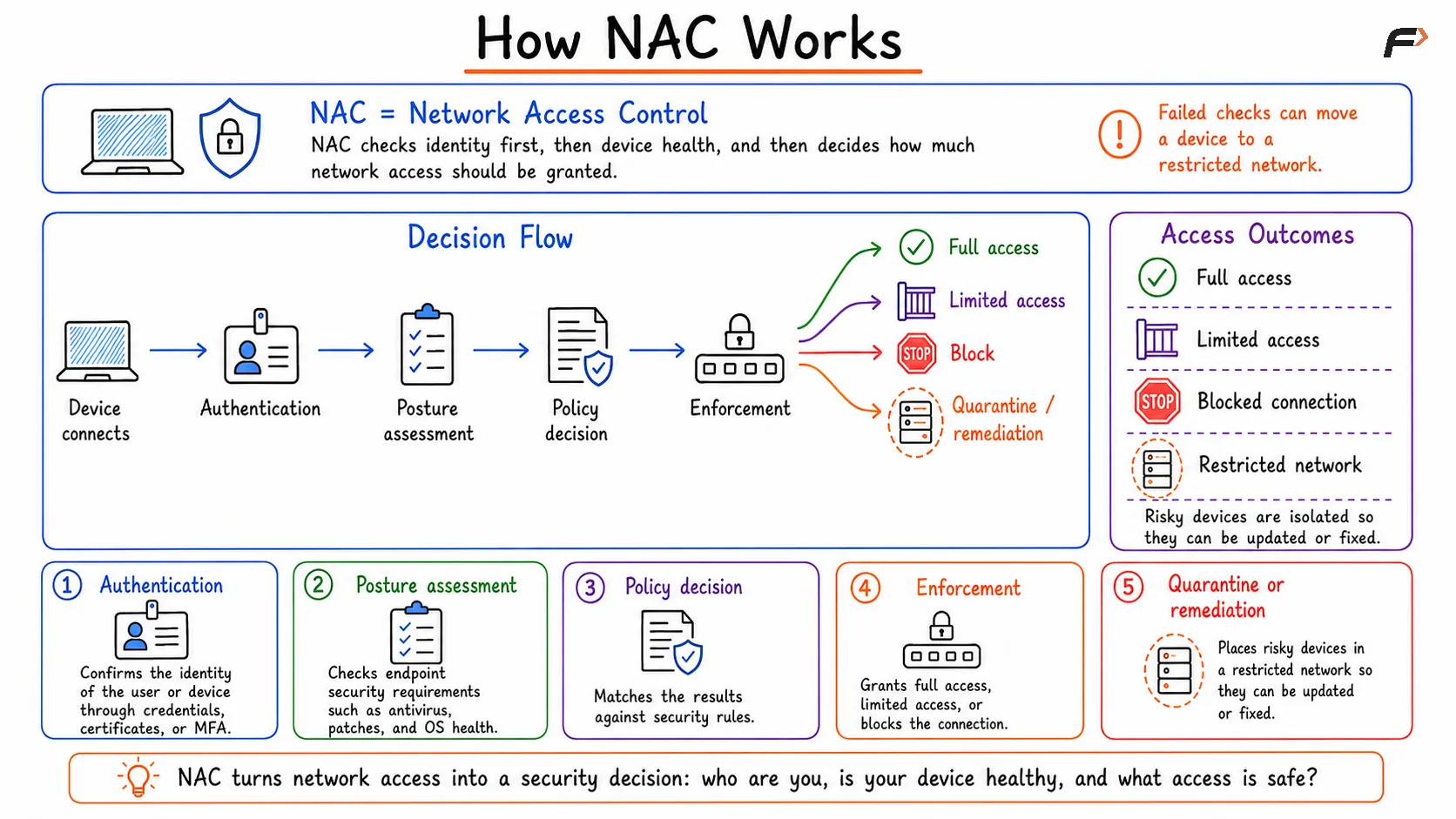
Network Access Control (NAC) workflow showing device authentication, security posture assessment, policy evaluation, and enforcement, resulting in full access, limited access, blocked connection, or quarantine based on security compliance.
Pre-Admission vs Post-Admission NAC
NAC is often discussed in two forms: pre-admission NAC and post-admission NAC. Both are important, but they operate at different stages of network access.
Aspect | Pre-Admission NAC | Post-Admission NAC |
|---|---|---|
When it acts | Before the device is allowed onto the network | After the device has already joined |
Main purpose | Prevent non-compliant devices from entering | Monitor and react if a device later becomes risky |
Typical checks | Identity, OS status, patch level, antivirus, device compliance | Ongoing posture monitoring, suspicious behavior, policy drift |
Result | Full access, limited access, or denial before entry | Access can be reduced, restricted, or removed after entry |
Best use | First-line admission control | Continuous security enforcement |
Pre-admission NAC is useful for stopping risky systems before they gain access. Post-admission NAC is useful because a device can become non-compliant later, even if it was safe at the moment it connected.
Key Components of NAC
A NAC system usually depends on several parts working together. Each part handles a different step in the access decision.
Authentication server: Verifies user or device identity, often with systems such as RADIUS or directory services.
Policy server: Stores the rules that define who gets which level of access.
Enforcement points: Network devices such as switches, routers, firewalls, or wireless controllers that apply the decision.
Endpoint checks: Security validation processes that inspect device health and compliance.
Quarantine or remediation network: A restricted segment where non-compliant systems can fix issues before getting full access.
In many enterprise environments, NAC is closely associated with 802.1X, RADIUS, role-based access, and network segmentation.
What NAC Can Check
NAC does not look only at a username and password. It can also evaluate the condition of the endpoint itself before trusting it.
Some common NAC checks include:
User authentication: Confirms that the connecting user is valid.
Device identity: Verifies whether the endpoint is known, managed, or approved.
Operating system status: Checks version, updates, and security posture.
Antivirus or endpoint protection: Confirms that required protection tools are installed and active.
Patch compliance: Ensures important updates have been applied.
Security policy alignment: Confirms the device matches organizational access rules.
These checks help NAC move beyond simple login control and into broader endpoint security.
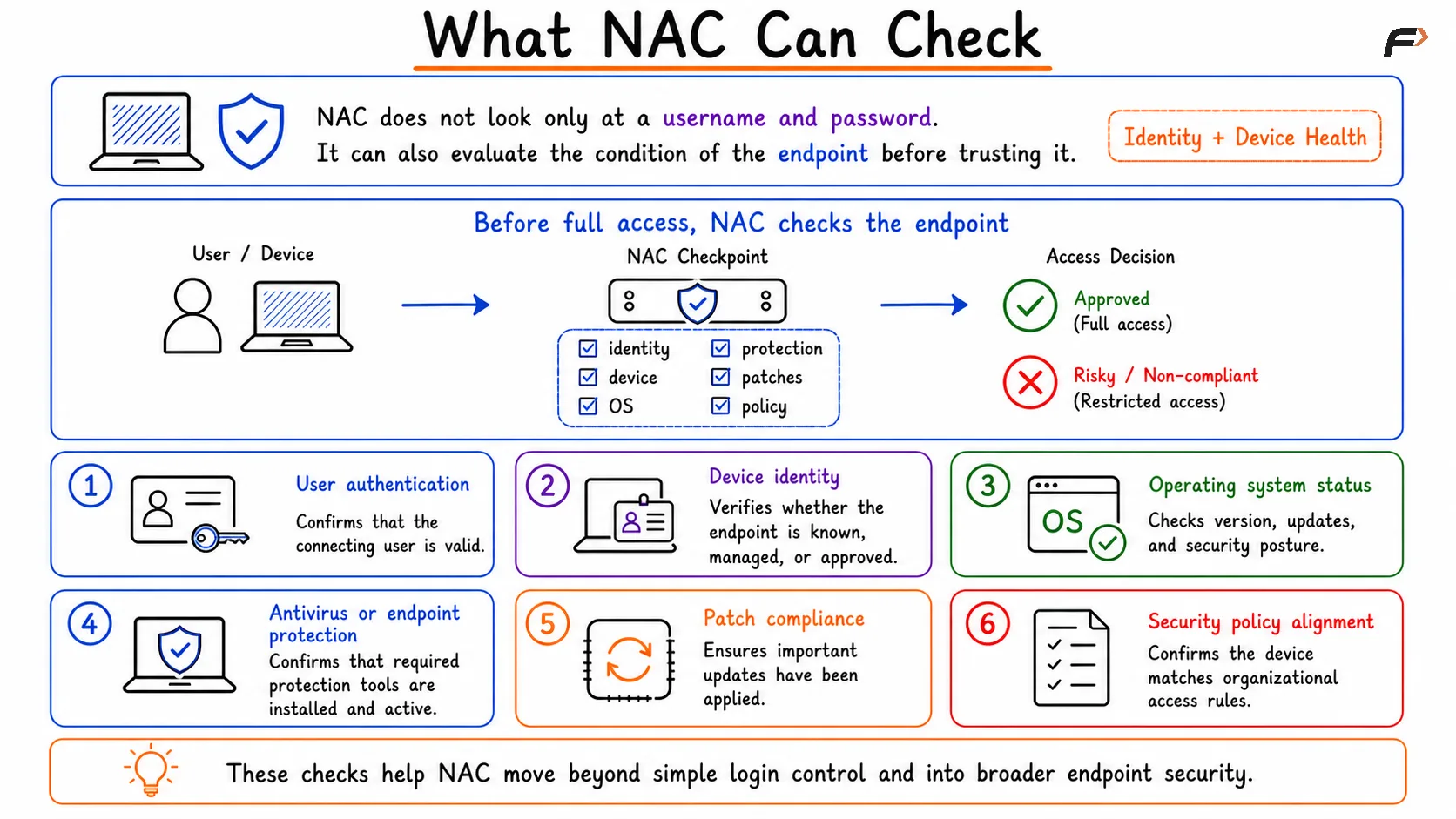
Diagram showing the security checks performed by Network Access Control (NAC), including user authentication, device identity, operating system status, endpoint protection, patch compliance, and security policy validation before granting full or restricted network access.
Advantages of NAC
NAC is valuable because it improves both security and control at the network edge. Instead of trusting every connecting device equally, it makes access conditional and policy-driven.
Some important advantages are:
Stronger network security: Prevents unauthorized or insecure devices from joining freely.
Better visibility: Helps identify who is connecting and with what type of device.
Granular access control: Different users and endpoints can receive different access levels.
Improved compliance: Supports security policies and regulatory requirements.
Reduced risk exposure: Limits the impact of infected, outdated, or unmanaged systems.
Challenges of NAC
NAC is powerful, but it is not always simple to deploy. It introduces security value at the cost of additional planning, integration, and operational effort.
Some common challenges are:
Complex setup: Policies, authentication systems, and enforcement devices must be configured carefully.
Operational overhead: Device checks, updates, and policy tuning require ongoing maintenance.
Connection delays: Authentication and posture validation can add extra time before full access is granted.
Policy design difficulty: Access rules must balance security with usability.
Continuous monitoring needs: Post-admission control is useful only when it is actively maintained.
For that reason, NAC works best when it is treated as a long-term security control rather than a one-time configuration task.
Summary
Network Access Control is a security framework that regulates network access by checking identity, authentication, device compliance, and endpoint security posture before or after a device connects. It acts as a gatekeeper for enterprise networks and helps control which users and devices receive full access, limited access, quarantine, or denial.
NAC is important because modern networks include managed systems, personal devices, guests, and potentially risky endpoints on the same infrastructure. By using policy enforcement, posture assessment, authentication services, and enforcement points such as switches or wireless controllers, NAC strengthens network security and reduces the chance that an untrusted device becomes a path into the network.
Be the first to add a comment.