Introduction
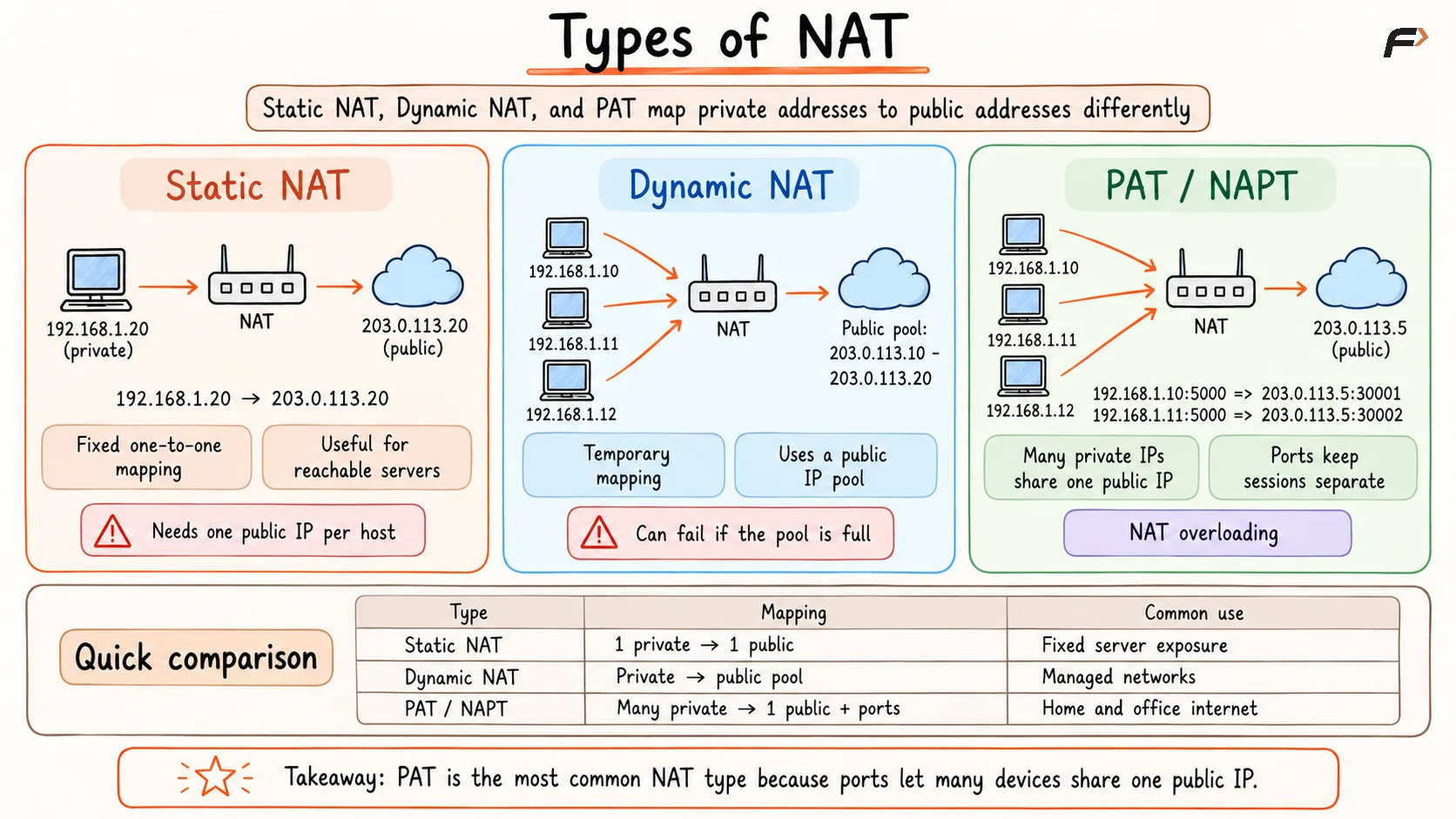
NAT can be implemented in different ways depending on how private addresses are mapped to public addresses. Some NAT setups use fixed one-to-one mappings, some use a pool of public addresses, and some allow many private devices to share one public IP address by also translating port numbers.
The three main types are static NAT, dynamic NAT, and PAT.
Main Types of NAT
NAT is commonly discussed in terms of static NAT, dynamic NAT, and PAT.
Type | Meaning | Common Use |
|---|---|---|
Static NAT | One private IP is permanently mapped to one public IP | Fixed server exposure, one-to-one mapping |
Dynamic NAT | Private IPs are mapped to a pool of public IPs as needed | Larger managed networks with a public address pool |
PAT / NAPT | Many private IPs share one public IP by also translating port numbers | Home routers, office internet access |
Static NAT
Static NAT creates a fixed mapping between one private IP address and one public IP address.
For example:
192.168.1.20 -> 203.0.113.20
Whenever traffic from 192.168.1.20 leaves the network, it is translated to 203.0.113.20. Similarly, traffic arriving for 203.0.113.20 can be mapped back to 192.168.1.20, depending on the rule and firewall policy.
Static NAT is useful when a device needs a consistent public mapping. It is commonly used for servers or services that must be reachable using a predictable public address.
The limitation is that static NAT does not conserve public IP addresses very well. Each private host needs its own public IP mapping.
Dynamic NAT
Dynamic NAT maps private IP addresses to a pool of public IP addresses. The mapping is created when a device needs access and may be released when the session ends.
For example, a company may have this public pool:
203.0.113.10 - 203.0.113.20
Internal devices can temporarily use addresses from this pool when they access outside networks.
Dynamic NAT is more flexible than static NAT because mappings do not have to be permanently assigned to specific internal hosts. However, it still needs enough public addresses in the pool. If all public addresses are already in use, a new internal device may not get a translation.
PAT
PAT stands for Port Address Translation and is also often called NAPT, or Network Address and Port Translation. This is the most common form of NAT in everyday networks.
With PAT, the router may translate traffic like this:
192.168.1.10:5000=>203.0.113.5:30001192.168.1.11:5000=>203.0.113.5:30002
Even though both hosts use the same public IP, the port mappings keep the sessions separate.
Types of NAT
Be the first to add a comment.