What Is the TLS Handshake?
The TLS handshake is the initial setup process that happens before encrypted application data is exchanged. During this phase, the client and server agree on how they will communicate securely.
A simple TLS handshake flow looks like:
The client sends a ClientHello message.
The server responds with a ServerHello message.
The client verifies the server's digital certificate.
The client and server perform the key exchange.
Session keys are generated.
Encrypted data transfer begins.
The exact handshake differs between TLS versions, but the goal remains the same: authenticate the server, agree on cryptographic settings, and create secure session keys.
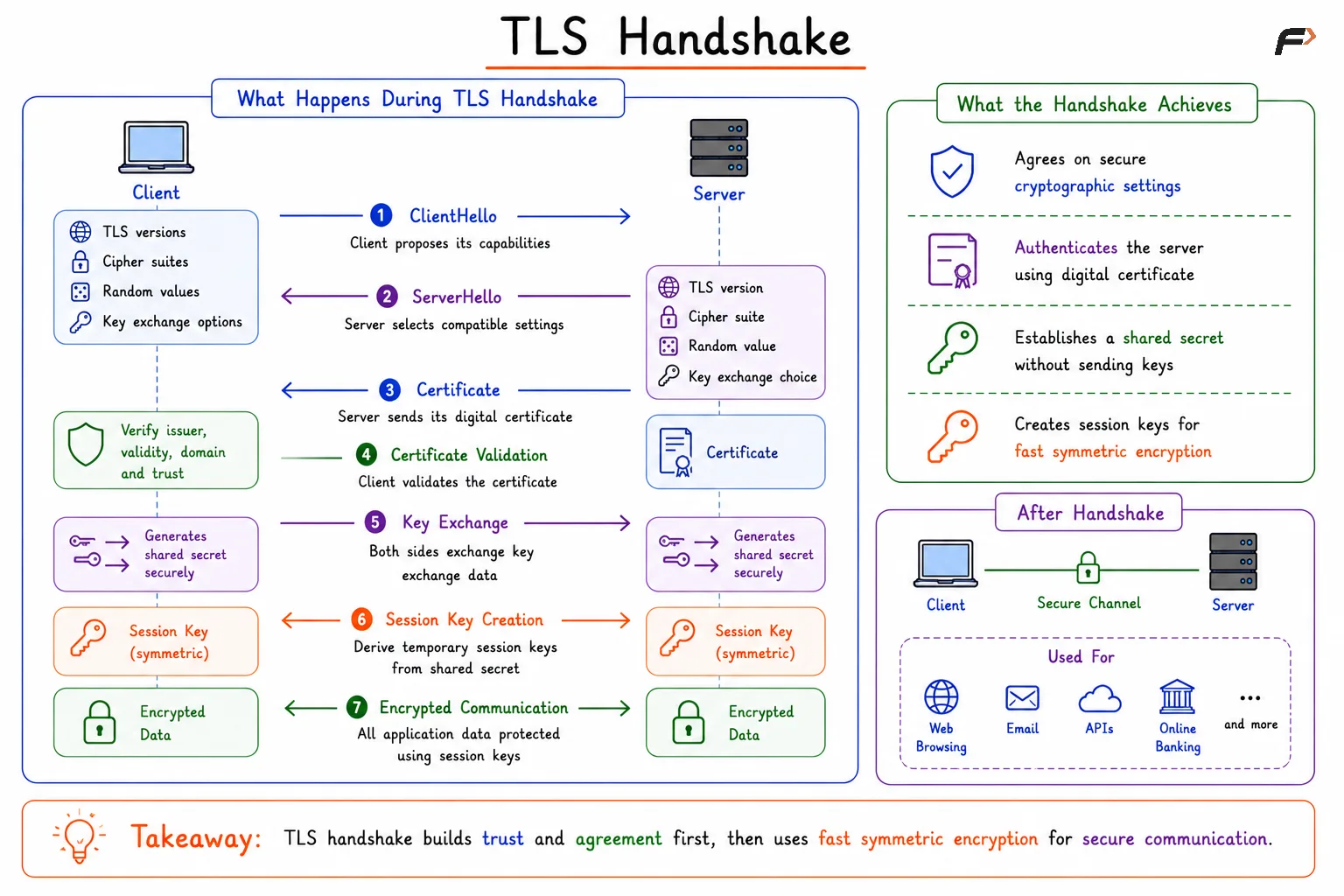
What Happens During TLS Handshake
During the handshake, the client and server exchange information required to build a secure connection. This includes supported TLS versions, cipher suites, certificate information, and key exchange data.
TLS Handshake
The main steps are:
ClientHello: The client sends supported TLS versions, cipher suites, random values, and key exchange options.
ServerHello: The server selects compatible cryptographic settings.
Certificate sharing: The server sends its digital certificate so the client can verify identity.
Certificate validation: The client checks whether the certificate is trusted, valid, and issued for the correct domain.
Key exchange: Both sides establish shared secret material without directly sending the final session key.
Session key creation: Temporary keys are derived and used for fast symmetric encryption.
Encrypted communication: Application data is protected using the negotiated keys.
After the handshake is complete, TLS uses symmetric encryption for actual data transfer because it is fast and efficient.
Certificates and Server Authentication
TLS uses digital certificates to prove server identity. A certificate connects a domain name with a public key and is issued by a trusted Certificate Authority.
When a browser connects to a website, it checks whether:
The certificate matches the domain: The certificate should belong to the website being visited.
The certificate is not expired: The validity period must still be active.
The certificate chain is trusted: The certificate should link back to a trusted root Certificate Authority.
The certificate signature is valid: The certificate should not be forged or modified.
This prevents attackers from easily pretending to be trusted websites during secure communication.
What Is Forward Secrecy?
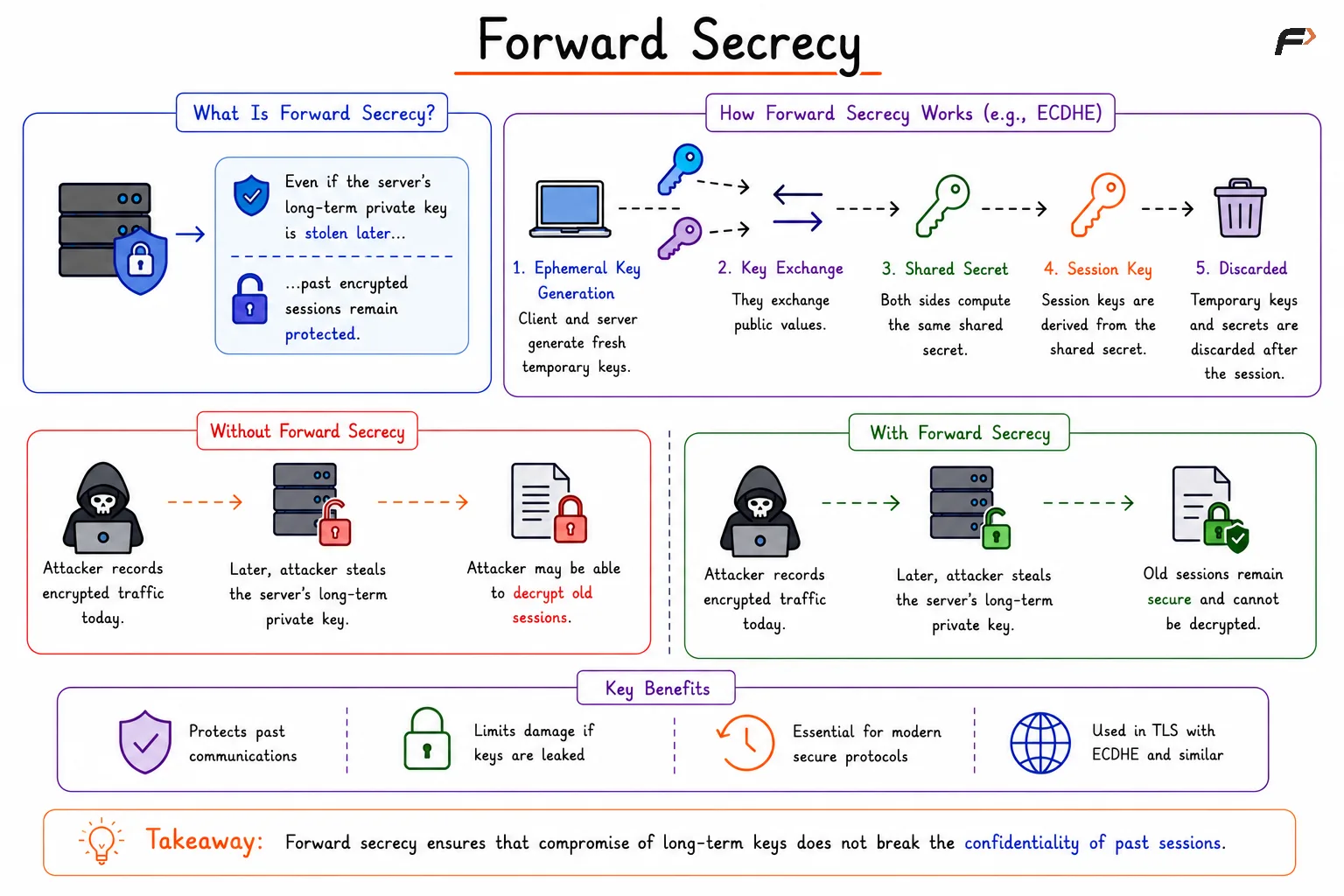
Forward secrecy means that even if a server’s long-term private key is compromised later, past encrypted sessions should still remain protected.
This is usually achieved using ephemeral key exchange methods such as ECDHE, where fresh temporary key material is created for each session. These temporary secrets are used to derive session keys and are later discarded.
Without forward secrecy, an attacker who records encrypted traffic today and later steals the server’s private key may be able to decrypt old communication in some older designs. With forward secrecy, old session keys are not recoverable from the long-term private key alone.
Forward Secrecy
Why TLS Uses Hybrid Encryption
TLS uses a hybrid cryptographic approach. It does not rely only on asymmetric encryption or only on symmetric encryption.
Phase | Cryptography Used | Purpose |
|---|---|---|
Handshake | Asymmetric cryptography and key exchange | Authentication and secure key establishment |
Data transfer | Symmetric encryption | Fast encryption of actual application data |
This design gives TLS both security and performance. Asymmetric cryptography helps start the connection securely, while symmetric encryption protects the actual data efficiently.
Mutual TLS (mTLS)
In normal TLS, the client verifies the server using the server’s digital certificate. This is what happens when a browser checks that it is really communicating with the correct HTTPS website.
Mutual TLS, or mTLS, goes one step further. In mTLS, both sides prove their identity using certificates. The client verifies the server certificate, and the server also verifies the client certificate before allowing communication.
TLS: Server proves its identity to the client.
mTLS: Server and client both prove their identities to each other.
Common use: Internal APIs, microservices, service-to-service communication, banking systems, and zero trust environments.
Main benefit: Only trusted clients with valid certificates can connect, even before application-level login or tokens are checked.
Summary
TLS is the modern security protocol used to protect communication in HTTPS and many other internet systems. SSL is the older predecessor and is no longer considered suitable for modern secure communication.
The TLS handshake verifies server identity, negotiates cryptographic settings, performs key exchange, and creates session keys. Forward secrecy improves protection by ensuring that past sessions remain safe even if long-term private keys are compromised later. Together, TLS, certificates, session keys, and forward secrecy form the foundation of secure web communication.
Be the first to add a comment.