Introduction
Rate limiting is used to control how many requests or actions are allowed within a specific time period. It protects a system from being overwhelmed when one user, bot, script, or application sends too many requests too quickly.
A backend server has limited CPU, memory, database capacity, and network bandwidth. If one client consumes too much of that capacity, other users may experience higher latency, failed requests, or downtime. Rate limiting prevents this by placing a clear limit on request frequency.
What Is Rate Limiting?
Rate limiting is a mechanism that restricts the number of requests allowed from a particular source during a given time window.
For example: 100 requests per user per minute
If the user stays within the limit, requests are processed normally. If the user crosses the limit, extra requests are rejected or temporarily blocked.
Rate limits can be applied based on different identifiers:
User: Limits requests from a logged-in account.
IP address: Limits requests coming from the same IP.
API key: Limits usage for a specific application or customer.
Endpoint: Applies stricter limits to sensitive APIs like login or OTP verification.
Region or device: Used in some systems when traffic needs finer control.
The exact rule depends on the application, traffic pattern, and security requirement.
Why Rate Limiting Is Needed
Consider a backend server serving thousands of users. Under normal traffic, the system works smoothly. Now suppose one user starts sending 50,000 requests per minute.
Without rate limiting, the backend may try to process all of them. This can consume server resources, overload the database, increase latency for other users, and possibly bring the service down.
Rate limiting helps avoid these problems:
Prevents backend abuse: One user cannot consume the entire server capacity.
Protects APIs: Expensive endpoints can be protected from excessive calls.
Reduces server overload: Traffic is kept within manageable limits.
Controls bot traffic: Automated scripts cannot freely flood the system.
Limits brute-force attempts: Login and OTP endpoints become harder to attack.
Handles accidental spikes: Misconfigured clients cannot repeatedly hit the backend without restriction.
Rate limiting is not only a security feature. It is also a reliability and fairness mechanism.
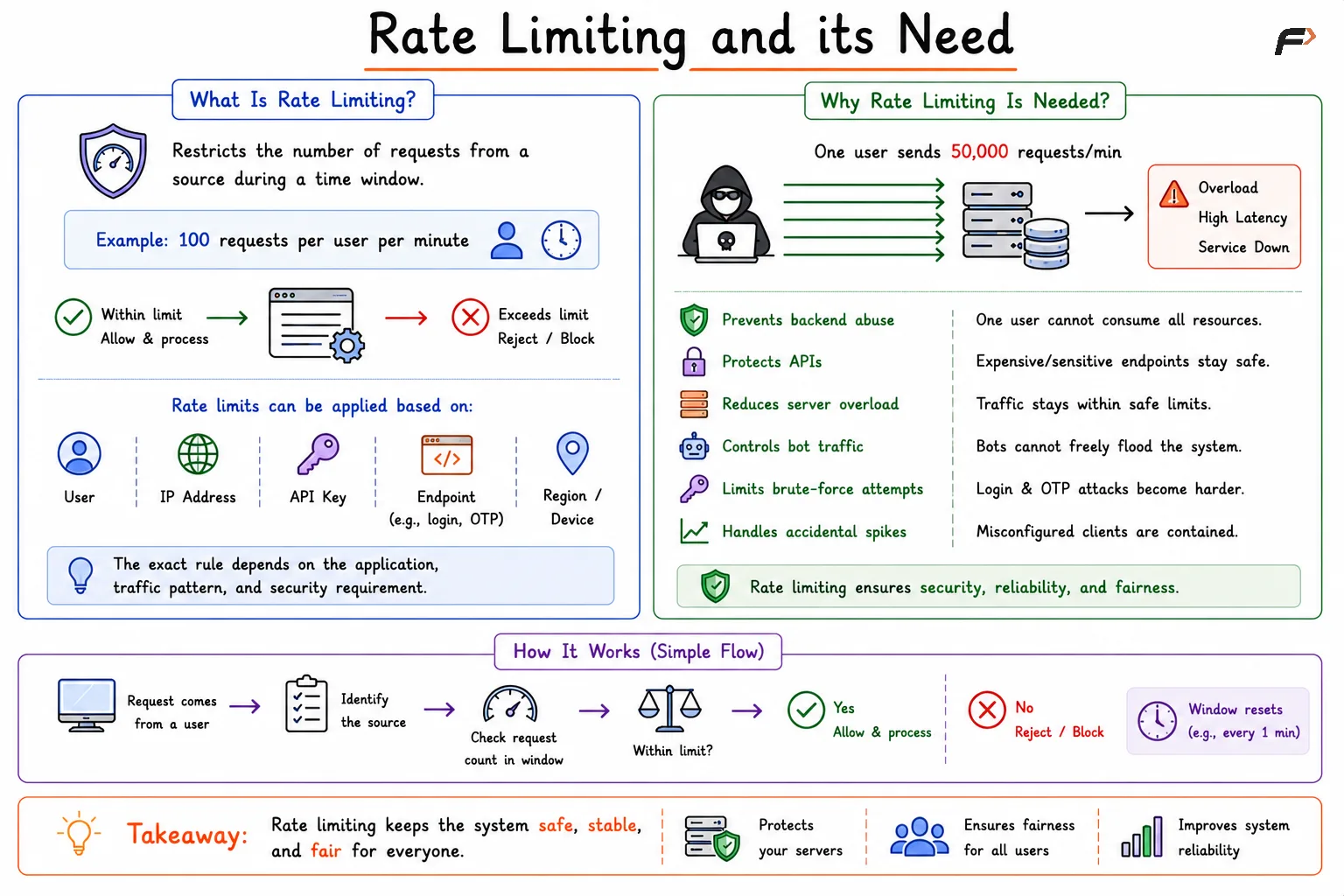
Rate Limiting and its Need
How a Rate Limiter Works
A rate limiter usually sits before the backend service or inside the backend itself. Whenever a request arrives, the rate limiter checks whether the sender is still within the allowed limit.
A simple flow looks like this:
Request arrives => Rate limiter checks limit => Request is allowed or rejected
If the request is allowed, it is forwarded to the backend server. The backend then processes it, talks to the database if needed, and returns a response.
If the request exceeds the configured limit, it is not forwarded to the backend. Instead, the system usually returns: HTTP 429 Too Many Requests
This status code tells the client that it is sending requests too frequently. Some systems may also include retry information so the client knows when to try again.
Rate Limiting and Brute-Force Protection
Rate limiting is very useful for login pages, password reset flows, and OTP verification APIs.
Suppose an OTP has four digits. The possible combinations range from 0000 to 9999, which gives 10,000 possible values. Without limits, an attacker could keep trying combinations until the correct OTP is found.
A safer rule may look like this: 5 OTP attempts per user per minute
Now the attacker cannot test all combinations quickly. The rate limit slows down repeated attempts and reduces the chance of brute-force success.
Sensitive APIs usually need stricter rate limits than normal browsing or read-only APIs.
Where Rate Limiting Is Implemented
Rate limiting can be implemented at different places in a system. The best location depends on how early the system wants to block excessive traffic.
Location | How It Helps |
|---|---|
Backend server | Application checks limits before processing requests |
API gateway | Requests are limited before reaching internal services |
Load balancer | Excessive traffic can be controlled before backend selection |
Reverse proxy | Common place to enforce web and API limits |
CDN or edge layer | Blocks abusive traffic before it reaches the origin server |
Implementing rate limiting closer to the edge can reduce backend load earlier. Implementing it inside the application gives more business-level control, such as limits based on user plan, account type, or endpoint sensitivity.
Common Rate Limiting Strategies
Different algorithms can be used to enforce rate limits. A free-level understanding only needs the main idea behind each one.
Strategy | Main Idea |
|---|---|
Fixed window | Counts requests in fixed time blocks, such as per minute |
Sliding window | Tracks requests over a moving time range for smoother control |
Token bucket | Allows requests when tokens are available and supports controlled bursts |
Leaky bucket | Smooths request handling at a steady rate |
For example, token bucket is commonly used when a system wants to allow short bursts but still enforce an average request rate over time.
Summary
Rate limiting restricts how many requests or actions are allowed within a specific time period. It protects APIs, backend servers, login pages, and databases from abuse, overload, bot traffic, brute-force attempts, and accidental spikes.
A rate limiter checks incoming requests against rules based on users, IP addresses, API keys, endpoints, or other identifiers. Requests within the limit are processed normally, while excessive requests are commonly rejected with HTTP 429 Too Many Requests. It keeps systems fair, stable, and safer under heavy or abusive traffic.
Be the first to add a comment.